Introduction
Regenerative medicine is one of the most exciting frontiers in biomedical research. The goal is to develop methods for repairing, replacing, or regenerating damaged tissues and organs. Among the many tools available to researchers in this field, peptides have emerged as particularly promising research subjects.
Peptides offer several advantages for regenerative medicine research. They are small enough to be synthesized easily. They can be designed to target specific cellular receptors. They often have well-understood mechanisms of action. And they can be modified to optimize their stability and activity.
This guide provides an overview of how peptides are being used in regenerative medicine research. We cover the most commonly studied peptides, their proposed mechanisms, and what the published research shows. All information is for laboratory research purposes only.
Why Peptides for Regenerative Medicine
Traditional approaches to tissue repair often focus on small molecules or large proteins. Small molecules can be difficult to target specifically. Large proteins are expensive to produce and often degrade quickly. Peptides sit in an ideal middle ground.
Peptides are large enough to have specific biological activities. They can be designed to mimic the active regions of larger proteins. They are much cheaper to synthesize than full-length proteins. They are less likely to cause immune reactions than larger biologics. And they can be modified chemically to improve their stability and half-life.
These advantages have made peptides attractive research tools for scientists studying tissue repair, wound healing, and cellular regeneration. Hundreds of published studies have investigated peptide-based approaches in various research models.
BPC-157: Tissue Protection and Healing Research
BPC-157 is one of the most extensively studied peptides in regenerative medicine research. It is a synthetic pentadecapeptide derived from a gastric peptide found in human stomach acid.
In research models, BPC-157 has shown a remarkable ability to protect tissues from damage and accelerate healing. The peptide appears to work through multiple mechanisms. It promotes angiogenesis, the formation of new blood vessels. It modulates inflammatory responses. It protects cell membranes from oxidative damage. And it may influence growth factor expression.
Gastrointestinal research has been a primary focus. BPC-157 has been studied in models of inflammatory bowel disease, gastric ulcers, and intestinal damage. Published research has documented accelerated healing of various types of gastrointestinal injuries in animal models.
Tendon and ligament research is another major area. Multiple studies have investigated BPC-157 in models of tendon repair. The peptide has been shown to accelerate healing of surgically repaired tendons and to improve the mechanical properties of healed tissue.
Soft tissue research has also been extensive. BPC-157 has been studied in models of muscle injury, skin wounds, and even bone healing. The consistent finding across these studies is accelerated and improved tissue repair.
For laboratory research, BPC-157 is typically used at concentrations ranging from 10 picomolar to 10 micromolar in cell culture and at doses of 1 to 10 micrograms per kilogram in animal studies.
TB-500: Cell Migration and Tissue Repair Research
TB-500 is a synthetic peptide fragment of Thymosin Beta-4, a naturally occurring protein involved in actin regulation and cell migration. The TB-500 fragment contains the active region responsible for many of Thymosin Beta-4’s biological effects.
The primary mechanism of TB-500 involves actin, a protein that forms the cytoskeleton of cells. By binding to actin, TB-500 promotes cell migration. This is essential for bringing repair cells to damaged areas. The peptide also promotes angiogenesis and modulates inflammation.
Wound healing research is the most common application for TB-500. Studies in animal models have documented accelerated closure of skin wounds, reduced scar formation, and improved healing quality. Some research has focused specifically on difficult-to-heal wounds such as diabetic ulcers.
Cardiovascular research is another significant area. TB-500 has been studied in models of heart attack and heart failure. Research suggests the peptide may help protect heart tissue from ischemic damage and promote recovery of function after injury.
Corneal research has also shown promise. TB-500 has been studied in models of corneal injury and dry eye disease. The peptide appears to promote healing of the corneal surface and reduce inflammation.
In laboratory research, TB-500 is typically studied at concentrations of 100 nanograms to 10 micrograms per milliliter in cell culture and at doses of 1 to 100 micrograms per animal in research models.
GHK-Cu: Skin Repair and Anti-Aging Research
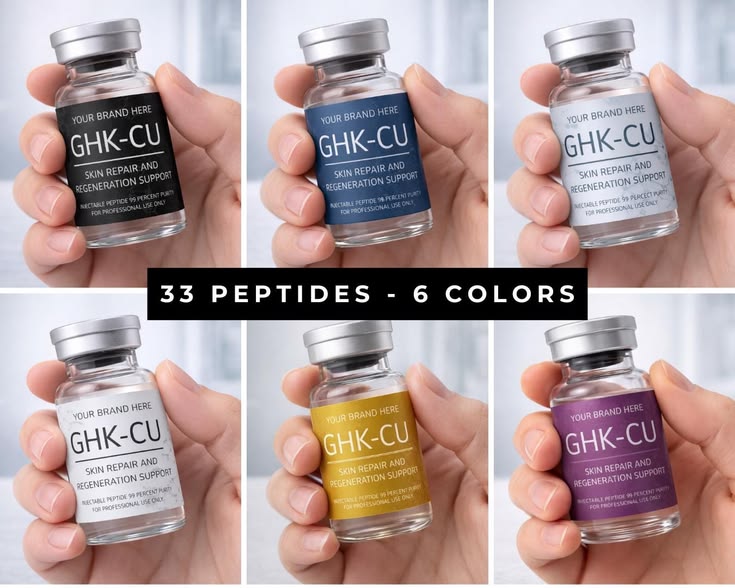
GHK-Cu is a naturally occurring copper-binding tripeptide. It was first isolated from human plasma and has since been studied extensively for its effects on skin and connective tissue.
GHK-Cu works through multiple mechanisms. It stimulates collagen synthesis, which is essential for skin strength and elasticity. It promotes the production of other extracellular matrix components. It modulates the activity of metalloproteinases, enzymes that break down damaged tissue. And it has antioxidant properties that protect cells from damage.
Skin research is the primary application for GHK-Cu. Studies have documented increased collagen production, improved skin elasticity, and accelerated wound healing in various research models. The peptide has been studied for its potential to reverse age-related changes in skin.
Wound healing research is another major area. GHK-Cu has been shown to accelerate healing of full-thickness wounds and to improve the quality of healed tissue. Some research has focused on chronic wounds that fail to heal normally.
Hair research has also been conducted. Some studies suggest GHK-Cu may influence hair follicle biology and promote hair growth in certain research models.
In laboratory research, GHK-Cu is typically used at concentrations of 0.1 to 10 micromolar in cell culture. It is highly stable and readily soluble in water.
Other Peptides in Regenerative Medicine Research
Beyond BPC-157, TB-500, and GHK-Cu, several other peptides have attracted research interest in regenerative medicine.
AOD9604 is a fragment of human growth hormone that has been studied for its effects on fat metabolism and cartilage repair. Unlike full-length growth hormone, AOD9604 does not appear to affect blood sugar or cause tissue overgrowth in research models.
KPV is a tripeptide fragment of alpha-melanocyte stimulating hormone. It has been studied for its anti-inflammatory properties and its potential to treat inflammatory bowel disease in research models.
LL-37 is a human antimicrobial peptide that also has wound healing properties. Research has focused on its ability to promote angiogenesis and re-epithelialization in wound healing models.
Thymulin is a peptide involved in immune function. Research has explored its potential to promote wound healing and reduce inflammation.
Research Models Used in Peptide Regenerative Medicine Studies
Peptide research in regenerative medicine uses a variety of research models depending on the specific question being asked.
Cell culture models are the most common starting point. Researchers use fibroblasts, keratinocytes, endothelial cells, and other cell types to study peptide effects on cell proliferation, migration, and gene expression.
Ex-vivo models use tissues removed from animals and maintained in culture. These models allow study of tissue-level responses while controlling many variables.
Animal models are used for more advanced studies. Common models include mouse and rat wound healing models, tendon injury models, and models of inflammatory bowel disease. These models allow researchers to study peptide effects in living systems with intact immune and circulatory systems.
Each model has advantages and limitations. Cell culture models are fast and inexpensive but lack tissue complexity. Animal models are more physiologically relevant but more expensive and time-consuming.
Challenges in Peptide Regenerative Medicine Research
Despite promising results, several challenges remain in peptide regenerative medicine research.
Stability is a major concern. Peptides can be degraded by enzymes in the body or in cell culture media. Researchers often use chemical modifications or delivery systems to protect peptides from degradation.
Delivery is another challenge. Getting peptides to the right location at the right concentration is not always straightforward. Some research uses local injection directly into the site of injury. Others use systemic administration.
Dose optimization is also important. Too little peptide produces no effect. Too much peptide may cause toxicity or paradoxical effects. Finding the optimal dose for each research model requires careful experimentation.
Reproducibility has been a concern in some areas of peptide research. Variations in peptide purity, handling, and storage can lead to different results across laboratories. This is why high-purity peptides with published Certificates of Analysis are essential.
How Lavish Peptides Supports Regenerative Medicine Research
At Lavish Peptides, we provide high-purity research peptides for regenerative medicine studies. Our BPC-157, TB-500, GHK-Cu, and other products are synthesized to 99 percent or higher purity with batch-specific Certificates of Analysis.
We offer low endotoxin options for cell culture research. Our California-based team is available to answer technical questions and help you select the right products for your research.
Frequently Asked Questions About Peptides in Regenerative Medicine
Are these peptides approved for human use?
No. These peptides are for laboratory research only. They are not approved for human consumption or clinical use.
What purity should I use for cell culture studies?
For cell culture studies, look for 99 percent or higher purity with endotoxin levels below 1.0 EU per milligram. For sensitive cell types, below 0.1 EU per milligram is recommended.
How do I choose between BPC-157 and TB-500 for my research?
BPC-157 is often studied for gastrointestinal and soft tissue healing. TB-500 is often studied for wound healing and cell migration. Some researchers use both in combination. Review the published literature in your specific area.
Where can I find published research on these peptides?
PubMed and Google Scholar contain thousands of published studies. Search by peptide name and your research area of interest.
Do Lavish Peptides products include Certificates of Analysis?
Yes. Every product page includes a link to the batch-specific Certificate of Analysis showing HPLC chromatograms, mass spec data, purity percentage, and endotoxin levels where tested.
Final Thoughts
Peptide research in regenerative medicine continues to advance rapidly. BPC-157, TB-500, GHK-Cu, and other peptides have shown promising results in numerous published studies. As research models improve and our understanding of peptide mechanisms deepens, these tools will become even more valuable for scientists studying tissue repair and regeneration.
Whether you are just beginning your research or are an experienced investigator, high-quality peptides with transparent quality control are essential for reproducible results.
About the Author
This guide was written by the research team at Lavish Peptides, a California-based supplier of 99 percent or higher pure research peptides for regenerative medicine and other applications.
Related Resources
Understanding Peptide Purity: Why 99 Percent or Higher Matters
The Complete Guide to Peptide Reconstitution
How to Read a Peptide Certificate of Analysis
Peptide Storage Best Practices
Call to Action
Need high-purity peptides for your regenerative medicine research? Browse our collection of BPC-157, TB-500, GHK-Cu, and more with published Certificates of Analysis.
Shop Research Peptides Now
Questions about which peptide is right for your research? Contact our California support team for technical guidance.
