
HPLC vs Mass Spectrometry for Peptides: Key Differences
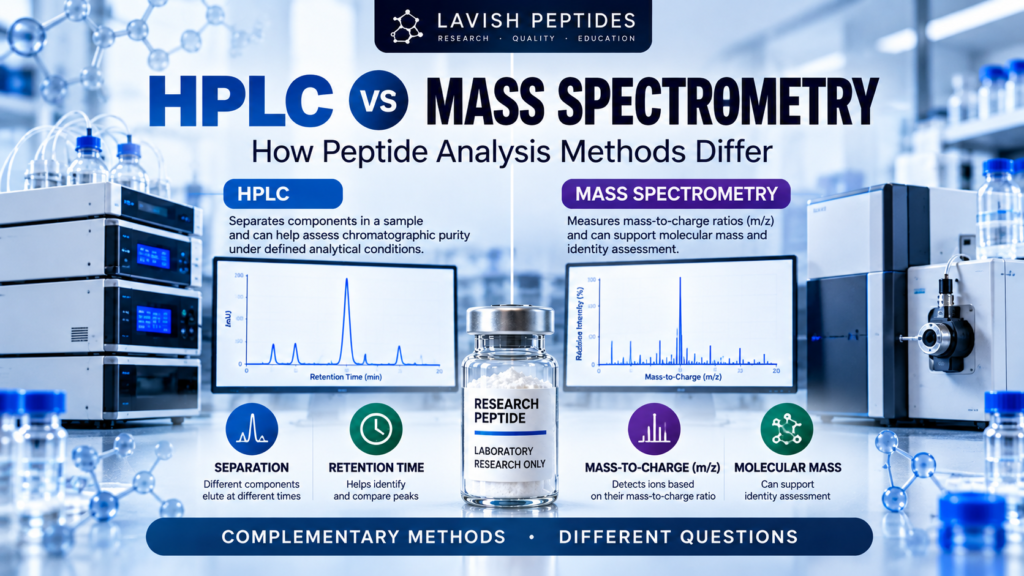
HPLC vs mass spectrometry peptides is an important comparison for researchers who need to understand how synthetic peptides are analysed. Although both techniques can contribute to peptide characterisation, they answer different analytical questions. High-performance liquid chromatography (HPLC) separates components in a sample, while mass spectrometry (MS) measures ions according to their mass-to-charge ratio.
The distinction matters when reviewing laboratory reports, certificates of analysis (COAs) and analytical data. A chromatogram may provide evidence about separation and chromatographic purity, while a mass spectrum may support molecular-mass assessment and, with suitable methods, peptide identity or sequence analysis. Neither technique automatically proves every aspect of sample quality.
This guide explains HPLC vs mass spectrometry for peptides, compares their strengths and limitations, and shows why laboratories may use both techniques when evaluating synthetic peptide materials.
What Is HPLC in Peptide Analysis?
High-performance liquid chromatography is a separation technique. A liquid sample passes through a column under controlled conditions, and the different components interact with the stationary phase and mobile phase in different ways. These differences can cause components to leave the column at different times.
A detector records signals as components elute, producing a chromatogram with peaks plotted against retention time.
What Can HPLC Tell You?
Depending on the method and detector, HPLC can help researchers:
- Separate the target peptide from detectable related components.
- Assess chromatographic purity using a defined calculation.
- Compare retention times with suitable reference data.
- Monitor changes in a sample over time when the method is suitable for stability assessment.
- Investigate whether components are adequately resolved.
Reversed-phase HPLC is commonly used in peptide analysis, but the exact method depends on the peptide and the analytical objective. Column chemistry, mobile-phase composition, gradient, flow rate, detector settings and integration rules can all influence the result.
What Does an HPLC Peak Mean?
Each peak represents a detector signal recorded as material passes through the system. The main peak may be assigned to the target peptide, while secondary peaks may represent other detected components. However, a peak’s position or appearance does not independently establish its chemical identity.
A large main peak can support a high area percentage under the method used, but it does not prove that the sample contains no undetected impurities or that the peptide has the correct molecular structure.
For more detail, read our related guide on what HPLC purity means. Confirm the link matches the published URL on your website before publishing.
What Is Mass Spectrometry in Peptide Analysis?
Mass spectrometry measures ions according to their mass-to-charge ratio, commonly written as m/z. The instrument generates or receives ions, separates them according to their m/z values, and records a mass spectrum.
Peptides can produce ions with different charge states, so interpreting a peptide mass spectrum may require more than reading one peak. The observed signals are evaluated against the expected molecular characteristics and the capabilities of the analytical method.
What Can Mass Spectrometry Tell You?
Depending on the instrument and method, mass spectrometry can help researchers:
- Measure the mass-to-charge ratios of detected ions.
- Support assessment of a peptide’s molecular mass.
- Investigate whether observed mass data agree with an expected structure.
- Identify certain modifications or related species when the method can distinguish them.
- Support sequence analysis using tandem mass spectrometry (MS/MS).
In MS/MS, selected ions are fragmented and the resulting fragment ions are analysed. Interpreting the fragmentation pattern can provide information about a peptide’s sequence, but the strength of that conclusion depends on data quality, method design and the interpretation performed.
What Does a Mass Spectrum Mean?
A mass spectrum typically plots signal intensity against m/z. It is different from an HPLC chromatogram, which generally plots detector response against retention time.
A mass spectrum can support an identity assessment, but a matching molecular mass alone may not distinguish every possible structural alternative. Isomers or other compounds with the same or similar mass may require additional analytical evidence.
The European Medicines Agency’s guideline on the development and manufacture of synthetic peptides discusses the use of suitable analytical data for peptide characterisation, including mass spectrometry and complementary techniques.
HPLC vs Mass Spectrometry Peptides: Main Differences
The central difference in HPLC vs mass spectrometry peptides is the type of information each technique provides.
| Feature | HPLC | Mass spectrometry |
|---|---|---|
| Primary function | Separates components | Measures ions by mass-to-charge ratio |
| Typical output | Chromatogram | Mass spectrum |
| Main horizontal axis | Retention time | Mass-to-charge ratio (m/z) |
| Common contribution | Separation and chromatographic purity assessment | Molecular-mass assessment and identity-related evidence |
| Can identify a peptide alone? | Retention time alone is usually insufficient | Mass alone may be insufficient for unambiguous identity |
| Can assess impurities? | Can separate and detect components within method limits | Can provide mass-related information about detected ions; response and ionisation affect detection |
| Common limitation | Co-elution or weak detector response can conceal components | Ionisation bias, overlapping signals and structural ambiguity may complicate interpretation |
These are general distinctions. Actual performance depends on the specific instrument, sample and analytical procedure.
HPLC vs Mass Spectrometry: Which Is Better for Peptides?
Neither method is universally better. The appropriate technique depends on the question the laboratory needs to answer.
When HPLC Is Useful
HPLC is useful when the objective is to separate a mixture and assess the target component relative to other detectable signals. It is often relevant to chromatographic purity testing and monitoring changes in a sample.
However, the reported purity depends on the method, detector response, peak integration and the signals included in the calculation. An HPLC area percentage is not automatically the same as percentage by mass or total peptide content.
When Mass Spectrometry Is Useful
Mass spectrometry is useful when researchers need mass-related information or stronger evidence about molecular identity. Depending on the approach, MS or MS/MS can help assess expected mass, investigate modifications or provide sequence-related evidence.
Yet mass spectrometry has limitations too. Not every compound ionises equally, and signal intensity does not automatically correspond to concentration. A matching mass also may not resolve all structural alternatives.
When Both Methods Are Useful
Using complementary methods can provide a more informative assessment than relying on either one alone. For example, HPLC may separate components and reveal a chromatographic impurity profile, while mass spectrometry can provide mass-related evidence about the main component or selected secondary signals.
When HPLC is coupled directly to mass spectrometry, the combined method is often called LC-MS. The chromatographic stage separates components before they enter the mass spectrometer, allowing retention-time information and mass-related data to be considered together.
The methods are complementary, not interchangeable. The decision to use one or both should be based on the analytical objective and the evidence needed.
Understanding LC-MS: Combining Separation and Mass Analysis
Liquid chromatography–mass spectrometry (LC-MS) combines liquid chromatographic separation with mass spectrometric detection. The chromatographic stage helps separate components, while the mass spectrometer records the m/z values of ions produced from the eluting material.
This combination can help link a chromatographic signal to mass-related information. It can also help investigate components that may otherwise be difficult to assign using retention time alone.
However, LC-MS is not a guarantee that every component will be detected or identified. Co-elution, ion suppression, weak ionisation, instrument settings and data interpretation can still affect the outcome.
The suitability of LC-MS depends on the question being asked. A method designed to confirm the expected mass may not be sufficient for comprehensive impurity profiling, and a method designed for impurity detection may not establish every aspect of molecular structure.
Understanding HPLC vs Mass Spectrometry Peptides in Laboratory Testing
When comparing HPLC vs mass spectrometry peptides, the first step is to identify the analytical question. HPLC helps separate components in a sample and assess chromatographic purity, whereas mass spectrometry provides information about the mass-to-charge ratios of detected ions. Understanding HPLC vs mass spectrometry peptides helps researchers interpret these different results without confusing purity measurements with molecular identity.
Choosing Between HPLC vs Mass Spectrometry Peptides
The choice between HPLC vs mass spectrometry peptides depends on the purpose of the analysis, the sample and the evidence required. For chromatographic purity assessment, HPLC may be appropriate when the method can separate the relevant components. For molecular-mass assessment, mass spectrometry can provide complementary evidence. In some workflows, combining HPLC vs mass spectrometry peptides provides a more informative analytical picture than relying on one technique alone.
Why HPLC vs Mass Spectrometry Peptides Results Can Differ
Results from HPLC vs mass spectrometry peptides are not directly interchangeable because the techniques measure different properties. HPLC detector responses depend on the analytical conditions and the components detected, while mass spectrometry signals depend on ionisation, charge state and instrument settings. When interpreting HPLC vs mass spectrometry peptides reports, researchers should consider these limitations before drawing conclusions about sample composition or identity.
Reviewing HPLC vs Mass Spectrometry Peptides in a COA
When reviewing a certificate of analysis, compare the reported HPLC vs mass spectrometry peptides methods with the stated results, batch details and acceptance criteria. Confirm what each test was designed to demonstrate and whether supporting evidence is provided. A high chromatographic purity percentage does not independently establish molecular identity, and a matching mass does not necessarily prove the complete peptide structure.
How to Interpret HPLC and Mass Spectrometry Results Together
When reviewing peptide analytical documentation, consider the two types of data separately before drawing a combined conclusion.
1. Confirm the sample reference. Check that the chromatogram, mass spectrum and COA refer to the same sample or batch. A report for a different batch cannot automatically support conclusions about the material in hand.
2. Review the HPLC method. Look at the chromatogram, retention time, peak separation, integration and reported purity calculation. Identify any limitations stated in the report.
3. Review the mass data. Compare the observed mass-related results with the expected value, taking account of ion charge states, adducts and the method used. Do not assume that every spectrum will display a single peak corresponding directly to the neutral peptide mass.
4. Check what the identity test establishes. Determine whether the method supports expected molecular mass, sequence information or another specific characteristic. These are related but different conclusions.
5. Consider unresolved questions. If the HPLC trace contains unexplained peaks or the mass data are inconclusive, additional testing or a more suitable method may be necessary.
6. Read the report as a whole. A single percentage or mass value should not replace review of the method, acceptance criteria and other relevant quality data.
For additional guidance, see our article on peptide purity versus peptide content. It explains why a chromatographic purity percentage should not automatically be interpreted as the total amount of peptide in a sample. Verify that the internal link matches the live page before publishing.
Common Misunderstandings About HPLC and Mass Spectrometry
“A High HPLC Purity Percentage Proves the Peptide Is Correct”
Not necessarily. HPLC can provide evidence about chromatographic separation and purity under the method used. A high area percentage does not independently establish molecular identity, total content or the absence of co-eluting and undetected components.
“A Matching Mass Proves the Complete Structure”
A mass result can support an identity assessment, but some different structures may share the same or similar molecular mass. Additional evidence, such as suitable MS/MS data or another orthogonal method, may be needed to establish identity more confidently.
“The Strongest Mass Spectrum Signal Means the Most Abundant Component”
Not automatically. Signal intensity can be affected by ionisation efficiency, charge state, matrix effects and instrument conditions. Mass-spectrometric intensity should not be treated as a direct measure of relative amount unless the method supports that interpretation.
“HPLC and Mass Spectrometry Measure the Same Thing”
They do not. HPLC separates components; mass spectrometry measures ions by their mass-to-charge ratios. Some systems combine both, but the analytical information and limitations remain distinct.
Frequently Asked Questions
Is HPLC or mass spectrometry better for peptide purity?
HPLC is commonly used for chromatographic purity assessment because it separates components and records detector signals. Mass spectrometry can provide complementary information, but neither technique should be assumed to measure every impurity or quality attribute without considering the method.
Can mass spectrometry confirm peptide identity?
Mass spectrometry can provide strong identity-related evidence, especially when suitable methods such as tandem MS provide sequence information. Whether the evidence is sufficient depends on the peptide, the method and the possibility of alternative structures.
Can HPLC identify a peptide?
HPLC retention time can support identification when compared with suitable reference information under comparable conditions. Retention time alone is generally not sufficient to establish unambiguous molecular identity.
What is the difference between HPLC and LC-MS?
HPLC is the separation technique. LC-MS combines liquid chromatography with mass spectrometry, so components are separated before their ions are analysed by mass-to-charge ratio.
Does a peptide COA need both HPLC and mass spectrometry results?
The required tests depend on the material, the intended purpose, the applicable specification and the laboratory’s quality requirements. A COA should clearly identify the tests performed and their results; the presence of one method should not be assumed to answer every analytical question.
Conclusion: HPLC vs Mass Spectrometry Peptides
Understanding HPLC vs mass spectrometry peptides helps researchers choose the right analytical method for the question they need to answer. HPLC separates sample components and can support chromatographic purity assessment, while mass spectrometry measures ions by their mass-to-charge ratio and can provide evidence about molecular mass and peptide identity. When comparing HPLC vs mass spectrometry peptides, it is important to understand that neither method independently proves every aspect of sample quality.
The main advantage of HPLC vs mass spectrometry peptides is that these methods can provide complementary information. HPLC can reveal separated peaks and help assess chromatographic purity under defined conditions, while mass spectrometry can help evaluate whether detected ions are consistent with the expected molecular mass. In suitable analytical workflows, combining HPLC vs mass spectrometry peptides can provide a more informative assessment than relying on one result alone.
When reviewing a peptide certificate of analysis, researchers should compare the reported methods, results, sample identifiers and relevant acceptance criteria. A high HPLC purity percentage does not automatically prove molecular identity, and a matching mass does not necessarily establish the complete structure. A careful comparison of HPLC vs mass spectrometry peptides therefore requires attention to the method, its limitations and the specific claim each result supports.
For further laboratory education, visit the Lavish Peptides blog and explore our guides on HPLC purity and peptide purity versus peptide content.
This article is for laboratory education only. It is not medical advice and does not establish that any product is authorised or suitable for human use.
Understanding the differences between HPLC and mass spectrometry helps researchers interpret peptide analytical results more accurately. In the comparison of HPLC vs mass spectrometry peptides, HPLC is primarily used to separate sample components and assess chromatographic purity, while mass spectrometry provides information about molecular mass and can support peptide identity testing. Each technique has different strengths, limitations and applications.
For a more complete analytical assessment, these methods can be used together when appropriate. HPLC can reveal the separation profile of a sample, while mass spectrometry can provide additional evidence about the molecular characteristics of detected components. However, neither technique alone guarantees that every aspect of peptide quality has been established.
When reviewing a certificate of analysis, always consider the test methods, sample and batch identifiers, reported results and applicable acceptance criteria. Understanding what each result demonstrates—and what it cannot prove—is essential for making informed laboratory assessments.
Explore the Lavish Peptides blog for more educational articles on peptide analysis, purity testing and laboratory documentation.
This article is for laboratory education only. It is not medical advice and does not establish that any product is authorised or suitable for human use.
