
Research Peptides UK Labelling: A Complete Guide
Research peptides UK labelling is an important consideration for laboratories, research suppliers and organisations handling synthetic peptide materials. Clear labels help identify a material, connect it to the correct batch documentation and communicate relevant handling or hazard information. However, labelling is only one part of a broader quality and safety system.
Understanding research peptides UK labelling means distinguishing general research identification practices from legal requirements that apply to specific products. Chemical hazard labelling, medicinal-product regulation and laboratory traceability are related but separate subjects. A statement such as “for research use only” does not, by itself, determine which laws apply to a product.
This guide explains the information researchers should check on peptide labels, how labels connect with certificates of analysis (COAs), and where to find authoritative UK guidance. It also outlines common documentation problems and practical steps for reviewing product information.
What Is Research Peptide Labelling?
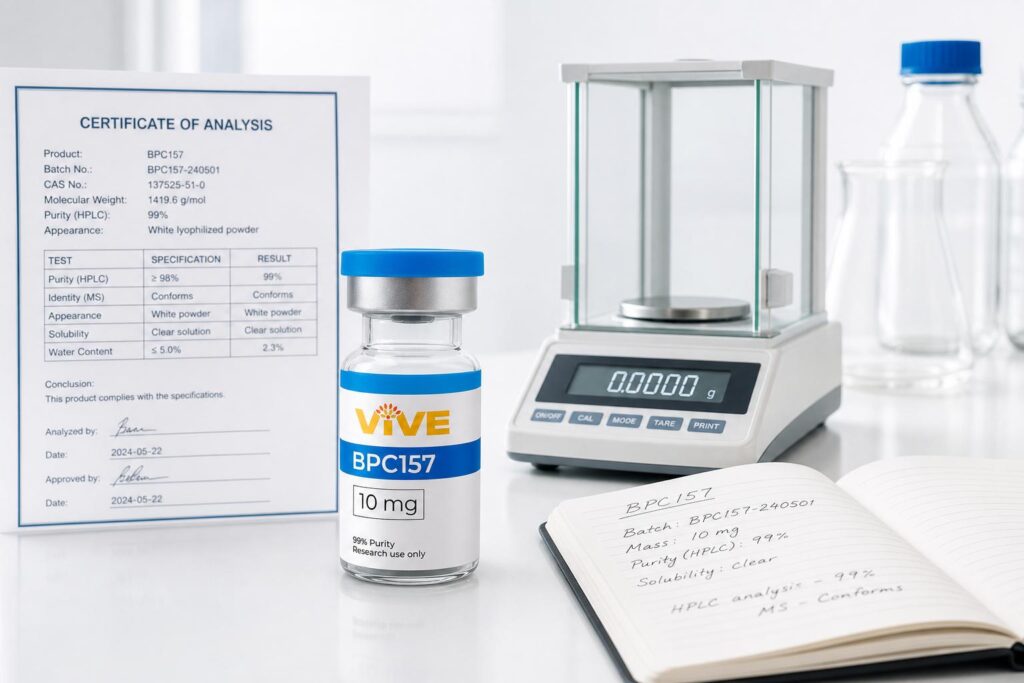
Research peptide labelling is the practice of identifying a peptide material and providing relevant information about its contents, batch and handling. Depending on the product and applicable requirements, this information may include the peptide name, product identifier, batch or lot number, quantity, storage information and references to supporting documentation.
The purpose of research peptides UK labelling is not simply to make packaging look professional. The information should help a qualified user distinguish one material from another and trace a sample back to the relevant records.
For example, two containers may display similar peptide names but relate to different batches, formulations or analytical reports. Without a clear identifier, it can be difficult to determine which certificate of analysis belongs to which sample.
A reliable labelling process therefore connects the container, product specification, batch records and quality documentation. Information displayed on the label should be accurate, legible and consistent with the supporting records.
Best Practices for Research Peptides UK Labelling
Effective research peptides UK labelling starts with accurate product identification, consistent batch records and clear supporting documentation. Suppliers should review their labels regularly to ensure that the information remains consistent with the relevant product specification and applicable requirements.
Research Peptides UK Labelling and Batch Traceability
A reliable research peptides UK labelling process makes it easier to connect a container with its certificate of analysis, batch number and analytical results. This connection helps laboratories investigate discrepancies and maintain organised research records.
Reviewing Research Peptides UK Labelling Before Publication
Before using research peptides UK labelling information in product descriptions or documentation, check that every statement is accurate and supported by the available evidence. Avoid unsupported purity claims, unclear quantities and wording that could misrepresent a product’s regulatory status.
Which UK Rules Apply to Research Peptide Labels?
There is no single universal label template that automatically covers every research peptide. Applicable requirements depend on factors such as the product’s legal classification, its hazards, its intended supply and whether it is supplied in Great Britain or Northern Ireland.
Chemical classification and hazard labelling
In Great Britain, the Health and Safety Executive (HSE) oversees the GB Classification, Labelling and Packaging (CLP) framework for substances and mixtures. Where the relevant requirements apply, suppliers must classify and label products according to their hazards. Required elements may include hazard pictograms, signal words, hazard statements and precautionary statements.
Consult the HSE’s official guidance on chemical classification, labelling and packaging and labelling and packaging.
These resources explain the relevant framework and help suppliers identify the requirements they need to assess. Not every item of information on a research container is necessarily a statutory CLP element, and the exact obligations depend on the substance or mixture and the circumstances of supply.
Northern Ireland has a different regulatory arrangement for CLP. Businesses supplying products across the UK should confirm which framework applies to their particular activities rather than assume the same requirements apply everywhere.
Medicinal-product considerations
A label stating “for research use only” does not, by itself, settle a product’s legal status. Classification depends on the substance, its presentation, intended purpose and applicable law. Medicinal products are subject to separate regulatory controls.
The UK government’s guidance on the supply of unlicensed medicinal products explains the framework for certain unlicensed medicines. It should not be interpreted as blanket permission to supply any peptide under a research label.
For research peptides UK labelling, the practical lesson is to assess the product and supply circumstances rather than assume a disclaimer alone establishes compliance. Where the classification or intended supply is uncertain, obtain advice from an appropriately qualified regulatory professional.
What Information Should a Research Peptide Label Include?
The appropriate label depends on the product and applicable requirements. As a quality-control starting point, laboratories and suppliers can review whether the following information is appropriate, accurate and consistent with the relevant records.
1. Clear material identification
The label should identify the material clearly enough to distinguish it from other products. Depending on the material, this may involve a specified peptide name, recognised identifier or internal product code.
Avoid vague descriptions that could cause a sample to be confused with another peptide, formulation or material. The name on the label should correspond with the product specification and the associated documentation.
2. Batch or lot number
A batch or lot number connects the container with the records for that particular batch. It should match the identifier used in the applicable certificate of analysis and other quality documents.
Batch traceability becomes particularly important when analytical results, specifications or supplier records need to be reviewed later. A missing or inconsistent batch identifier can make it difficult to establish whether a report relates to the material in the container.
3. Quantity and unit information
Where quantity information is appropriate, the value and unit should be clear and consistent with the product documentation. Do not confuse the stated mass of a material with a purity percentage or an analytical estimate of peptide content.
These measurements describe different properties. A purity result alone does not necessarily establish how much target peptide is present in the entire sample.
4. Storage and handling information
Storage instructions should be supported by relevant product-specific information. Do not assume every peptide has identical storage requirements or that a generic storage statement proves stability under all conditions.
Where hazards have been identified, handling information should be consistent with the applicable hazard communication requirements and supporting safety documentation.
5. Supplier and document references
Supplier details, product codes and document references can support traceability. The exact information required depends on the applicable legal framework and supply circumstances; this checklist is not a universal statement of mandatory label elements.
A good research peptides UK labelling process ensures that the information displayed on the container agrees with the controlled records rather than relying on manually copied descriptions.
How Should Labels Match a Certificate of Analysis?
A certificate of analysis records analytical results for a specified material or batch. Depending on the product and testing programme, it may include identification tests, purity results, analytical methods, test dates and other information relevant to the stated specification.
The label and COA should be reviewed together. A useful starting point is to confirm that the batch or lot number on the container matches the batch identified in the report.
Researchers should also review the material name, document date, methods described and meaning of the reported results. A high HPLC purity percentage, for example, does not automatically establish total peptide content or prove every aspect of molecular identity.
For further information, read our guides to how to check a peptide certificate of analysis and what HPLC purity means.
In practice, research peptides UK labelling should make it easier to identify the correct supporting report and investigate discrepancies. If a batch number is missing, inconsistent or unreadable, the discrepancy should be resolved through the supplier’s documented quality process before the report is relied upon.
Common Labelling Problems to Watch For
A label can appear complete while still creating uncertainty. During a documentation review, look for the following issues.
- Missing batch identification: The sample cannot be reliably connected to a specific batch report.
- Inconsistent naming: The label and certificate of analysis appear to describe different materials.
- Unclear units: The quantity or measurement is not expressed clearly.
- Unsupported purity claims: The label states a result that cannot be linked to appropriate analytical evidence.
- Unsubstantiated storage claims: Instructions are presented without relevant supporting information.
- Missing or inconsistent hazard information: The label may not reflect the applicable classification and hazard communication requirements.
- Overreliance on disclaimers: “Research use only” is treated as a substitute for assessing the product’s legal status and applicable obligations.
These problems do not all have the same legal significance. Their relevance depends on the product and context, but each can undermine traceability or create uncertainty about how a material should be identified and handled.
What Does “For Research Use Only” Mean?
The phrase “for laboratory research use only” communicates a stated purpose, but it does not independently establish a product’s quality, safety or regulatory status.
A disclaimer does not replace appropriate classification, required hazard information, reliable batch records or applicable legal authorisations. Nor does it prove that a material is suitable for a particular experiment.
When reviewing research peptides UK labelling, suppliers should ensure that the wording is accurate and consistent with the actual product and its supply circumstances. Laboratories should assess materials according to their own procedures and the evidence available.
If a product’s classification or intended supply is uncertain, seek advice from a qualified regulatory professional rather than relying solely on label wording.
A Practical Label and Documentation Checklist
Use this checklist when reviewing a research peptide container and its associated records.
- Identify the material: Confirm that the name or product identifier is clear.
- Match the batch: Compare the container’s batch or lot number with the certificate of analysis.
- Review quantity information: Confirm that units and stated amounts are clear and consistent.
- Check the analytical report: Understand what the reported tests establish and what they do not establish.
- Review handling information: Confirm that instructions are appropriate to the documented material.
- Assess applicable hazard requirements: Verify the relevant classification and labelling framework.
- Check document consistency: Resolve differences between the label, COA and other supplied records.
- Keep traceable records: Retain the relevant documentation in accordance with the laboratory’s quality procedures.
This approach makes research peptides UK labelling part of a repeatable documentation process instead of treating it as a standalone packaging task.
Frequently Asked Questions
Is there one standard UK label for all research peptides?
No universal template automatically covers every product. The appropriate information and legal requirements depend on the substance, its hazards, the supply circumstances and the applicable regulatory framework.
Does “research use only” guarantee legal compliance?
No. The phrase alone does not determine a product’s legal status or remove other applicable obligations. The product and its intended supply must be assessed in context.
Should the batch number match the certificate of analysis?
Yes. As a sound traceability practice, the container identifier should match the batch covered by the relevant report. Any discrepancy should be investigated before the documentation is relied upon.
Does a purity percentage prove peptide identity?
No. Purity and identity are different analytical questions. Suitable complementary methods may be needed to establish the properties of a material.
Where can UK suppliers find official labelling guidance?
The HSE provides official information about chemical classification, hazard labelling and packaging. Suppliers should also assess other relevant legal requirements for the particular product and supply circumstances.
Conclusion
Research peptides UK labelling supports clear identification, traceability and communication of relevant information. A reliable process connects the container to the correct batch records, certificate of analysis and appropriate handling documentation.
The key is to avoid treating any single label statement as proof of quality or legal compliance. Product-specific assessment, accurate documentation and applicable regulatory guidance are essential. For UK suppliers and laboratories, the HSE’s chemical classification resources are a useful starting point, while questions involving medicinal-product status may require separate regulatory advice.
Educational information only. This article is not legal advice or a product-specific compliance assessment. Research materials should be handled by appropriately qualified personnel and should not be assumed to be authorised or suitable for human use.
