
What Does Peptide Purity Percentage Mean? A Complete Guide
What does peptide purity percentage mean when you are reviewing a laboratory report or certificate of analysis? It describes the proportion attributed to the target peptide according to a specified analytical method and calculation. In many peptide quality reports, the percentage is derived from chromatographic data, such as the relative peak areas recorded during high-performance liquid chromatography (HPLC).
However, a purity percentage does not automatically tell you how much peptide is present in the entire sample, whether the molecule’s identity has been conclusively confirmed, or whether every possible impurity has been detected. Those are separate analytical questions that may require additional methods.
Understanding what does peptide purity percentage mean is important for interpreting laboratory data accurately. A reported result is most useful when you know which method was used, what the calculation represents and what the test cannot establish.
This guide explains peptide purity percentages, how laboratories calculate them, how to interpret common results and why purity, identity and content should not be treated as interchangeable measurements.
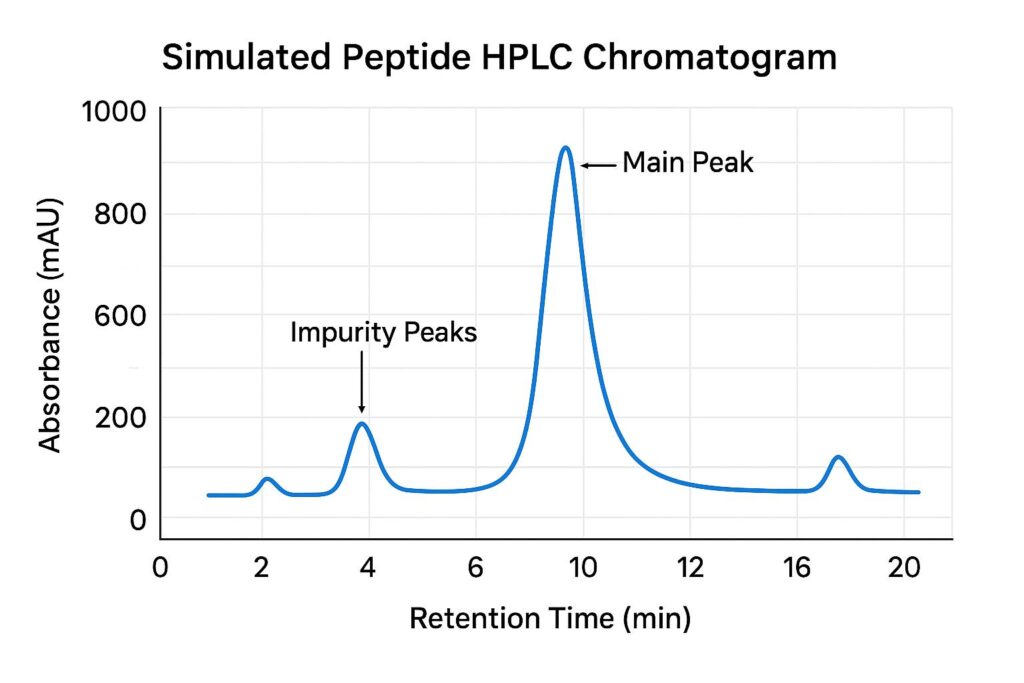
What Is Peptide Purity Percentage?
Peptide purity percentage is a numerical expression of purity determined according to a defined analytical approach. In many routine peptide reports, the result is based on the relative areas of peaks detected in a chromatogram.
During HPLC analysis, a sample passes through a chromatographic column. Different components may separate because they interact differently with the column and mobile phase. A detector records the response as each component elutes, producing a chromatogram containing peaks.
When a suitable calculation is used, the area attributed to the target peak is compared with the total area of the included peaks. The resulting percentage describes the target’s relative contribution to the measured chromatographic response under those conditions.
This is why what does peptide purity percentage mean cannot be answered by looking at the number alone. The analytical method, detector response, integration settings and calculation rules all influence how the result should be interpreted.
1. Add after “What Is Peptide Purity Percentage?”
Understanding What Peptide Purity Percentage Means in Practice
Understanding what does peptide purity percentage mean starts with recognising that the result depends on the analytical method used. A percentage calculated from HPLC peak areas describes the relative detector response under specified conditions, rather than automatically representing the target peptide’s share of the sample by mass. Reviewing the method alongside the reported result provides a more accurate basis for interpreting laboratory data.
2. Add after “How Is Peptide Purity Percentage Calculated?”
What Does Peptide Purity Percentage Mean When Comparing Results?
When comparing laboratory reports, what does peptide purity percentage mean depends on whether the results were obtained using comparable methods and calculation rules. Differences in chromatographic conditions, detector response and peak integration can affect the reported values. A numerical comparison is most meaningful when these analytical factors have been considered.
3. Add after “What Factors Can Affect a Purity Result?”
Why Peptide Purity Percentages Need Context
The question what does peptide purity percentage mean also involves understanding the limits of the test. A high reported percentage does not independently confirm molecular identity, establish total peptide content or demonstrate stability. These characteristics require appropriate supporting evidence and, where necessary, additional analytical methods.
4. Add immediately before the conclusion
Making Sense of a Peptide Purity Percentage
For researchers reviewing analytical documentation, what does peptide purity percentage mean is best answered by examining the reported value, analytical method, calculation and supporting test results together. This approach helps distinguish a chromatographic purity result from other measurements and avoids drawing conclusions that the available data cannot support.
How Is Peptide Purity Percentage Calculated?
A common approach is to calculate the target peak area as a proportion of the total integrated area of the relevant peaks.
The simplified formula is:
For example, suppose the target peak accounts for 98 units of integrated area and all included peaks account for 100 units. The calculated area percentage would be 98%.
This is a simplified illustration, not a universal analytical procedure. Actual calculations depend on the method, which peaks are included and whether any response-factor corrections or other adjustments are required.
The calculation also assumes that the detector responses are appropriate for the intended comparison. Different compounds may respond differently, and some components may be poorly detected or not detected by the chosen method.
Consequently, a chromatographic area percentage should not automatically be interpreted as a direct measurement of the target peptide’s percentage by mass.
What Do Different Peptide Purity Percentages Mean?
Purity percentages are often used as a quick way to compare analytical results. However, the significance of a reported value depends on the test method and the specification against which the result is evaluated.
The following examples illustrate how chromatographic area percentages might be described. They are not universal quality grades or acceptance criteria.
| Illustrative result | What it indicates |
|---|---|
| 90% area purity | The target peak accounts for 90% of the included chromatographic area under the stated method. |
| 95% area purity | The target peak accounts for 95% of the included chromatographic area. |
| 98% area purity | The target peak accounts for 98% of the included chromatographic area. |
| 99% area purity | The target peak accounts for 99% of the included chromatographic area. |
A higher result may indicate a larger relative contribution from the target peak in that particular analysis. It does not, by itself, prove that the sample is free of impurities or establish every aspect of its quality.
When evaluating what does peptide purity percentage mean, always check the method and calculation rather than assuming that the same percentage has identical significance across different laboratories or analytical procedures.
Does 99% Peptide Purity Mean the Sample Is 99% Peptide by Weight?
Not necessarily. This is one of the most important distinctions in peptide analysis.
A result of 99% HPLC area purity usually describes the relative detector response assigned to the target peak under the method’s conditions. It does not automatically mean that 99% of the sample’s total mass is the target peptide.
A sample may contain substances that affect its total mass but are not fully represented in the chromatogram. Depending on the material and method, these may include water, counter-ions, residual solvents or other components.
Some impurities may also be difficult to detect using a particular detector or chromatographic method. The result therefore needs to be interpreted according to the test’s scope and limitations.
For this reason, understanding what does peptide purity percentage mean requires distinguishing chromatographic purity from quantitative content or assay measurements.
Peptide Purity vs Peptide Content
Purity and content answer different questions.
Purity concerns the target’s proportion relative to other detected components under the stated analytical method.
Content concerns how much of the target substance is present in a sample. Establishing content may require a suitable quantitative method, calibration and reference materials, depending on the analytical objective.
For example, two samples could produce similar HPLC area-purity percentages while containing different amounts of the target peptide per unit of total sample mass. The chromatographic result alone would not necessarily reveal that difference.
This distinction matters when comparing reports, evaluating specifications or interpreting laboratory measurements. A purity percentage should not be used as a substitute for a content result unless the method and calculation explicitly support that interpretation.
Read our related guide to peptide purity versus peptide content for a more detailed comparison.
Peptide Purity vs Peptide Identity
Identity testing asks whether a sample matches the intended molecule. Purity testing asks how the target compares with other detected components under the chosen method.
A sample may show one dominant chromatographic peak, but that observation does not necessarily prove that the molecule has the correct amino acid sequence. Another compound may have similar chromatographic behaviour, and some structural isomers may be difficult to distinguish using a single technique.
Mass spectrometry can provide evidence about molecular mass and, with appropriate approaches, support structural characterisation. Other complementary techniques may be needed depending on the identity question.
When considering what does peptide purity percentage mean, remember that a purity result is not a complete identity assessment. The report should be reviewed to determine which identity tests were performed and what they establish.
For more information, see our article on peptide identity testing methods.
What Factors Can Affect a Purity Result?
Several analytical factors can influence a reported purity percentage.
Chromatographic separation
If the method does not adequately separate the target peptide from a related component, the components may appear as one peak. This can make it difficult to evaluate them independently.
Detector response
Different substances may produce different detector responses. A peak-area calculation therefore does not necessarily reflect the exact mass proportion of every compound in the sample.
Integration settings
The way the analytical software identifies peak boundaries and integrates areas can influence the reported result. Consistent, appropriate integration procedures are important for meaningful comparisons.
Sample preparation
Dissolution, filtration, sample handling and other preparation steps may affect which components reach the analytical system or how the sample behaves during testing.
Method suitability
A method should be suitable for the peptide and the analytical question. Results obtained using different columns, conditions or detectors may not be directly comparable without appropriate evaluation.
These factors help explain why what does peptide purity percentage mean depends on more than the reported number. Reliable interpretation requires an understanding of how the result was produced.
1. Add after “What Is Peptide Purity Percentage?”
Understanding What Peptide Purity Percentage Means in Practice
Understanding what does peptide purity percentage mean starts with recognising that the result depends on the analytical method used. A percentage calculated from HPLC peak areas describes the relative detector response under specified conditions, rather than automatically representing the target peptide’s share of the sample by mass. Reviewing the method alongside the reported result provides a more accurate basis for interpreting laboratory data.
2. Add after “How Is Peptide Purity Percentage Calculated?”
What Does Peptide Purity Percentage Mean When Comparing Results?
When comparing laboratory reports, what does peptide purity percentage mean depends on whether the results were obtained using comparable methods and calculation rules. Differences in chromatographic conditions, detector response and peak integration can affect the reported values. A numerical comparison is most meaningful when these analytical factors have been considered.
3. Add after “What Factors Can Affect a Purity Result?”
Why Peptide Purity Percentages Need Context
The question what does peptide purity percentage mean also involves understanding the limits of the test. A high reported percentage does not independently confirm molecular identity, establish total peptide content or demonstrate stability. These characteristics require appropriate supporting evidence and, where necessary, additional analytical methods.
4. Add immediately before the conclusion
Making Sense of a Peptide Purity Percentage
For researchers reviewing analytical documentation, what does peptide purity percentage mean is best answered by examining the reported value, analytical method, calculation and supporting test results together. This approach helps distinguish a chromatographic purity result from other measurements and avoids drawing conclusions that the available data cannot support.
How to Read Peptide Purity on a Certificate of Analysis
A certificate of analysis (COA) may report a purity percentage alongside the analytical method, test date, batch information and other findings. The amount of detail varies between reports.
When reviewing a COA, consider the following:
- Identify the method. Check whether the result is based on HPLC, UPLC or another analytical technique.
- Understand the calculation. Determine whether the percentage represents peak-area purity or another defined measurement.
- Review identity evidence. Check whether a separate identity test is reported and which method was used.
- Check the batch number. Confirm that the report relates to the material being evaluated.
- Look for limitations. Determine whether the report explains the test’s scope or any relevant qualifications.
- Avoid unsupported assumptions. Do not interpret a purity percentage as proof of total content, stability or suitability for a particular application.
A COA is most useful when its findings are interpreted according to the actual tests performed. The presence of a purity percentage does not establish that every possible impurity has been assessed.
For further guidance, read how to check a peptide certificate of analysis.
Why Analytical Method Details Matter
A purity percentage is meaningful only in relation to the method used to obtain it. If two laboratories use different chromatographic conditions, detectors or calculation rules, their reported results may not be directly comparable.
A suitable method should be capable of separating and measuring the relevant components for the intended purpose. Depending on the peptide and the quality questions being investigated, laboratories may need complementary testing to examine identity, impurities or content.
The European Medicines Agency’s guideline on the development and manufacture of synthetic peptides provides additional context on peptide characterisation, specifications and analytical control within its regulatory scope.
When assessing what does peptide purity percentage mean, the most reliable approach is to interpret the value alongside the method description, relevant acceptance criteria and supporting analytical evidence.
Common Misconceptions About Peptide Purity
Misconception 1: A 99% purity result means there are no impurities.
The result reflects the specified method and calculation. Components that are not detected or adequately separated may not be represented accurately.
Misconception 2: Purity percentage proves molecular identity.
Purity and identity are separate questions. Suitable identity evidence may require mass spectrometry or other complementary techniques.
Misconception 3: Purity percentage equals peptide content.
Chromatographic area percentage is not automatically equivalent to the target’s percentage by total sample mass.
Misconception 4: Results from different methods can always be compared directly.
Different analytical conditions and calculations can produce different results. Comparability needs to be established rather than assumed.
Misconception 5: A high purity percentage proves stability.
A purity result describes the sample under the conditions and at the time of the test. Stability requires appropriate evidence over time or under defined conditions.
Frequently Asked Questions
What does peptide purity percentage mean in an HPLC report?
It commonly represents the relative area of the target peak compared with the total area of the included peaks under the specified chromatographic method. The exact meaning depends on the calculation and method details.
Is 99% peptide purity always better than 95%?
A higher area-purity result may indicate a larger relative target peak, but results should be compared only when the methods and calculations are appropriate for comparison. The percentage alone does not establish total content or every aspect of quality.
Does peptide purity percentage tell me how much peptide is in a vial?
Not necessarily. A chromatographic purity result does not automatically establish the total mass or content of the target peptide. A suitable quantitative method may be required.
Can HPLC purity confirm peptide identity?
HPLC can support an identity assessment under suitable conditions, but a chromatographic peak or retention time alone may not prove the complete molecular identity. Additional methods may be needed.
Why should I check the analytical method on a COA?
The method explains how the result was obtained and what it can establish. Without that context, a purity percentage can be misunderstood or compared incorrectly with results from other methods.
Conclusion
What does peptide purity percentage mean? It is a method-dependent measurement that commonly describes the relative contribution of the target peptide to the detected chromatographic signal. It is useful for assessing a sample’s analytical profile, but it is not a complete measure of identity, total content or stability.
Researchers should review the method, understand the calculation and examine supporting test results before drawing conclusions. Separating purity, identity and content helps prevent misleading comparisons and makes laboratory documentation more informative.
Educational information only. Research peptides should be evaluated and handled by appropriately qualified laboratory personnel. This article does not establish that any research peptide is authorised or suitable for human use.
