
Difference Between Peptide Purity and Concentration: A Complete Guide
The difference between peptide purity and concentration is fundamental to understanding peptide analysis, laboratory reports and certificates of analysis (COAs). Although these terms are sometimes used interchangeably, they describe different analytical properties. Purity generally concerns the relative contribution of the target peptide compared with other detected components, while concentration describes the amount of a specified substance within a defined volume or quantity of material.
A peptide sample can produce a high HPLC purity result without that result establishing how many milligrams of the target peptide are present. Likewise, a concentration measurement cannot independently prove that the sample contains the correct peptide or that impurities are absent.
Understanding the difference between peptide purity and concentration helps researchers interpret analytical results more accurately, compare laboratory documentation responsibly and recognise when additional testing is needed. This guide explains how both measurements work, what they reveal, where their limitations lie and how to assess them when reviewing peptide quality documentation.
What Is Peptide Purity?
Peptide purity describes the target peptide’s relative contribution to the components detected by a specified analytical method. High-performance liquid chromatography (HPLC) and ultra-performance liquid chromatography (UPLC) are commonly used to separate peptide-related components and assess their chromatographic profiles.
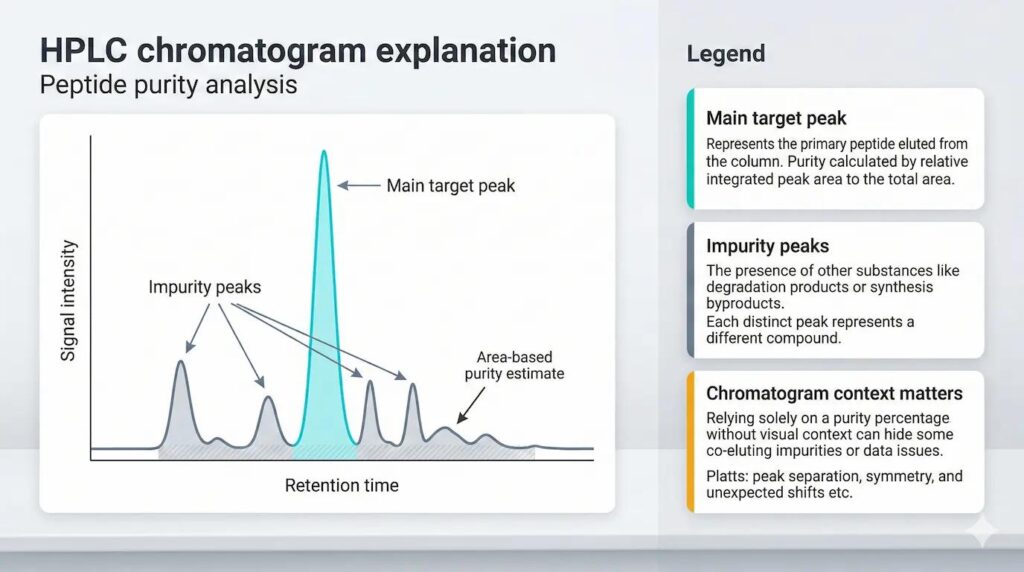
During HPLC analysis, a sample passes through a column under controlled conditions. Components may separate according to differences in their interactions with the stationary phase and mobile phase. A detector records the resulting signals, producing a chromatogram with peaks corresponding to detected components.
In many reports, peptide purity is expressed as a percentage calculated from integrated peak areas. The target peak area is compared with the total area of the peaks included in the calculation.
For example, if the target peak accounts for 98 units of a total 100 units of included chromatographic area, the calculated area percentage is 98%.
However, this is a measure of relative detector response under the specified method. It is not automatically equivalent to the target peptide’s percentage by mass. Components that are poorly detected, unresolved or outside the method’s scope may not be represented adequately.
For a fuller explanation, read our guide to what HPLC purity means.
What Is Peptide Concentration?
Peptide concentration describes how much of a specified substance is present in a defined volume or other stated quantity. For a solution, common units include milligrams per millilitre (mg/mL), micrograms per millilitre (µg/mL) and moles per litre (mol/L).
For example, a laboratory report may state that a solution contains 2 mg/mL of a specified peptide. This means the measured amount corresponds to 2 milligrams per millilitre according to the method and reporting basis used.
A concentration result depends on the analytical procedure, calibration, sample preparation and the definition of what is being quantified. Depending on the material, additional factors such as counter-ions, water or residual solvents may affect the relationship between the mass of the supplied material and the amount of the target peptide.
Concentration is therefore a quantitative measurement, not a purity percentage. To understand the difference between peptide purity and concentration, it is necessary to examine what each result measures and how it was obtained.
Understanding the Difference Between Peptide Purity and Concentration
The difference between peptide purity and concentration becomes clearer when each result is linked to the question it answers. Purity commonly describes the target peptide’s relative contribution to detected chromatographic components, while concentration measures the amount of a specified substance per defined volume or quantity. Both results can be useful, but they should be interpreted independently.
Why the Difference Between Peptide Purity and Concentration Matters in Laboratory Reports
When reviewing a certificate of analysis, the difference between peptide purity and concentration can prevent incorrect conclusions about sample composition. A high HPLC area-purity percentage does not automatically establish the mass of peptide present, while a concentration value does not prove that the sample is free from other components. Always check the analytical method, units and calculation basis before comparing results.
Comparing the Difference Between Peptide Purity and Concentration
The difference between peptide purity and concentration is especially important when comparing two samples or laboratory reports. Similar purity percentages can occur in samples with different measured concentrations, and similar concentration values do not necessarily indicate identical impurity profiles. Reliable comparisons require appropriate analytical methods and supporting data.
Researchers evaluating the difference between peptide purity and concentration should also distinguish both measurements from total peptide content and molecular identity. These are separate analytical questions that may require additional testing.
Ultimately, understanding the difference between peptide purity and concentration means interpreting each result according to its intended purpose rather than treating one number as a complete measure of sample quality.
Difference Between Peptide Purity and Concentration at a Glance
| Feature | Peptide purity | Peptide concentration |
|---|---|---|
| Main question | What proportion of the detected chromatographic signal is attributed to the target? | How much of the specified substance is present per defined volume or quantity? |
| Common reporting format | Percentage, such as HPLC area purity | mg/mL, µg/mL or mol/L |
| Typical analytical approach | HPLC or UPLC with an appropriate calculation | A suitable quantitative method, often using calibration or a reference standard |
| Primary information | Relative chromatographic composition under the stated conditions | Amount of the measured substance on a defined basis |
| What it does not establish by itself | Total content, complete identity or concentration | Purity, complete identity or absence of impurities |
The distinction matters because these values are not interchangeable. A purity percentage cannot normally be converted directly into a concentration, and a concentration result cannot be used alone to calculate chromatographic purity.
Can a Peptide Have High Purity but Low Concentration?
Yes. Purity and concentration can differ independently because they describe separate properties.
Consider two hypothetical solutions containing the same target peptide. Both produce an HPLC area-purity result of 98% using a suitable, comparable method. One solution contains a lower amount of peptide per millilitre than the other.
Their reported purity percentages could be similar even though their concentrations differ. The area-purity calculation describes the relative contribution of the target peak, not the absolute amount present in each millilitre.
The reverse distinction also matters. A solution may contain a measurable or relatively high concentration of a target substance while also containing other detectable components. Concentration alone does not show what proportion of the sample those components represent.
These examples illustrate the difference between peptide purity and concentration: one result concerns relative composition under an analytical method, while the other concerns quantity on a defined basis.
How Is Peptide Purity Measured?
HPLC separates components in a sample and produces a chromatogram. Where the method is suitable, the target peak can be integrated and compared with the total area of the included peaks to calculate an area-purity percentage.
The result depends on several factors:
- Chromatographic separation: Components that co-elute may appear as one peak, making separate evaluation difficult.
- Detector response: Different compounds may produce different signal intensities for the same amount of material.
- Integration settings: The way peak boundaries are identified and areas are calculated can affect the result.
- Method suitability: The method must be appropriate for the peptide and the impurities or related components being investigated.
- Undetected components: Substances that the method does not detect adequately may not be reflected in the reported percentage.
Consequently, an HPLC purity result should be interpreted alongside the method description and any relevant qualifications. It should not be treated as a complete assessment of every characteristic of the sample.
How Is Peptide Concentration Measured?
Concentration requires a quantitative method appropriate for the sample and the intended measurement. Depending on the circumstances, laboratories may use calibrated chromatography, UV-based analysis, amino acid analysis, quantitative nuclear magnetic resonance (qNMR) or another validated approach.
A quantitative method may rely on a calibration curve, a reference standard or a defined measurement model. The laboratory must consider sample preparation, matrix effects, measurement uncertainty and the chemical form of the material.
The reporting basis is equally important. A result expressed in mg/mL describes the measured amount per volume of solution. It is not the same as the total mass in a container, and it does not automatically represent the mass fraction of the peptide in a dry sample.
To interpret a concentration value correctly, check the units, the substance being quantified and the method used to obtain the result.
Peptide Purity, Concentration and Total Content
Purity and concentration are often discussed alongside total peptide content, but all three concepts need to be distinguished.
Purity describes the target’s relative contribution to detected components under a specified method.
Concentration describes the amount of a specified substance per defined volume or other stated basis.
Total content describes the total amount of the target substance in the sample being assessed, commonly expressed as a mass or amount of substance.
For example, a laboratory could report an HPLC area-purity percentage and separately quantify the amount of target peptide in a prepared solution. If the total content in a container is required, that amount must be established using suitable quantitative information and the relevant sample details.
These values cannot reliably be derived from one another using an area-purity percentage alone. A suitable analytical procedure must support the particular quantity being reported.
For a related explanation, see our article on peptide purity versus peptide content.
How to Interpret Purity and Concentration on a Certificate of Analysis
A certificate of analysis may list purity, identity, content, concentration or other test results. The scope and level of detail vary between laboratories and products, so the headings and methods should be read carefully.
When reviewing a COA, consider these checks:
- Confirm the batch details. Check that the report identifies the batch or sample being evaluated.
- Identify the analytical method. Determine which procedure was used for each result.
- Check the units. A percentage, mg/mL value and total mass describe different kinds of measurement.
- Understand the calculation. Establish whether a purity figure is based on chromatographic area or another defined approach.
- Review identity evidence. Determine whether separate testing supports the intended molecular identity.
- Look for qualifications. Consider the method’s limitations and whether the report explains what was measured.
- Avoid unsupported conclusions. Do not infer concentration, total content or complete identity from a purity percentage alone.
The difference between peptide purity and concentration becomes especially important when a COA presents multiple results together. Each value should be interpreted according to its own method, units and intended meaning.
For more guidance, read how to check a peptide certificate of analysis.
Common Mistakes When Comparing Purity and Concentration
Assuming HPLC area purity equals percentage by mass
A chromatographic area percentage is based on detector response and a specified calculation. It does not automatically represent the target peptide’s fraction of the sample’s total mass.
Treating concentration as proof of purity
A concentration result quantifies a specified substance under the stated method. It does not establish the relative abundance of other components.
Assuming a purity result confirms molecular identity
A dominant chromatographic peak is not, by itself, conclusive evidence of the complete molecular structure. Appropriate identity testing may require complementary methods, such as mass spectrometry.
Comparing figures without checking the units
Percentages, mass concentrations and total amounts are different measurements. They should not be compared directly without considering their definitions and reporting basis.
Ignoring method limitations
Different methods can detect, separate or quantify components differently. Results should only be compared directly when the analytical methods and calculations support that comparison.
Why Multiple Analytical Measurements Matter
Peptide characterisation may involve several distinct questions: whether the molecule has the intended identity, how related impurities are assessed, how much target substance is present and how the material behaves under specified conditions.
No single measurement necessarily answers every question. HPLC may provide useful chromatographic information, while mass spectrometry and suitable quantitative methods can contribute different evidence about identity or amount.
The European Medicines Agency’s guideline on the development and manufacture of synthetic peptides provides regulatory context on peptide characterisation, analytical procedures, specifications and impurity control within its scope.
When evaluating laboratory documentation, the strongest interpretation comes from considering each result alongside its method and the specific question it is intended to answer.
Frequently Asked Questions
What is the main difference between peptide purity and concentration?
Purity generally describes the target peptide’s relative contribution to detected components under a specified method. Concentration describes how much of a specified substance is present per defined volume or other stated basis.
Does 99% peptide purity mean 99% concentration?
No. A 99% chromatographic area-purity result does not automatically establish a 99% mass fraction or a particular solution concentration. The analytical method and calculation must be considered.
Can two samples have the same purity but different concentrations?
Yes. Two samples may produce similar area-purity results while containing different amounts of target peptide per millilitre, provided the methods and sample profiles support the comparison.
Which is more important: purity or concentration?
Neither measurement replaces the other. The appropriate measurement depends on the question being investigated. Purity, concentration, total content and identity should be evaluated separately when the relevant quality assessment requires them.
Does peptide concentration confirm molecular identity?
No. Concentration describes quantity under the stated measurement. Separate analytical evidence may be needed to establish whether the material matches the intended peptide.
Can concentration be calculated directly from HPLC purity?
Not from an area-purity percentage alone. Quantitative measurement requires suitable analytical data and a method that supports the calculation, potentially including calibration or a reference standard.
Conclusion
The difference between peptide purity and concentration comes down to two distinct questions: how the target peptide compares with other detected components, and how much of the specified substance is present in a defined volume or sample.
HPLC area purity can provide useful information about a sample’s chromatographic profile. Concentration measurements provide quantitative information on a defined basis. Total content and molecular identity are separate considerations that may require additional analytical evidence.
When interpreting a COA or comparing laboratory results, review the method, units, calculation and supporting information together. This gives a more accurate understanding than relying on a single percentage or numerical result.
Educational information only. Research peptides should be assessed and handled by appropriately qualified laboratory personnel. This article does not establish that any research peptide is authorised or suitable for human use.
