
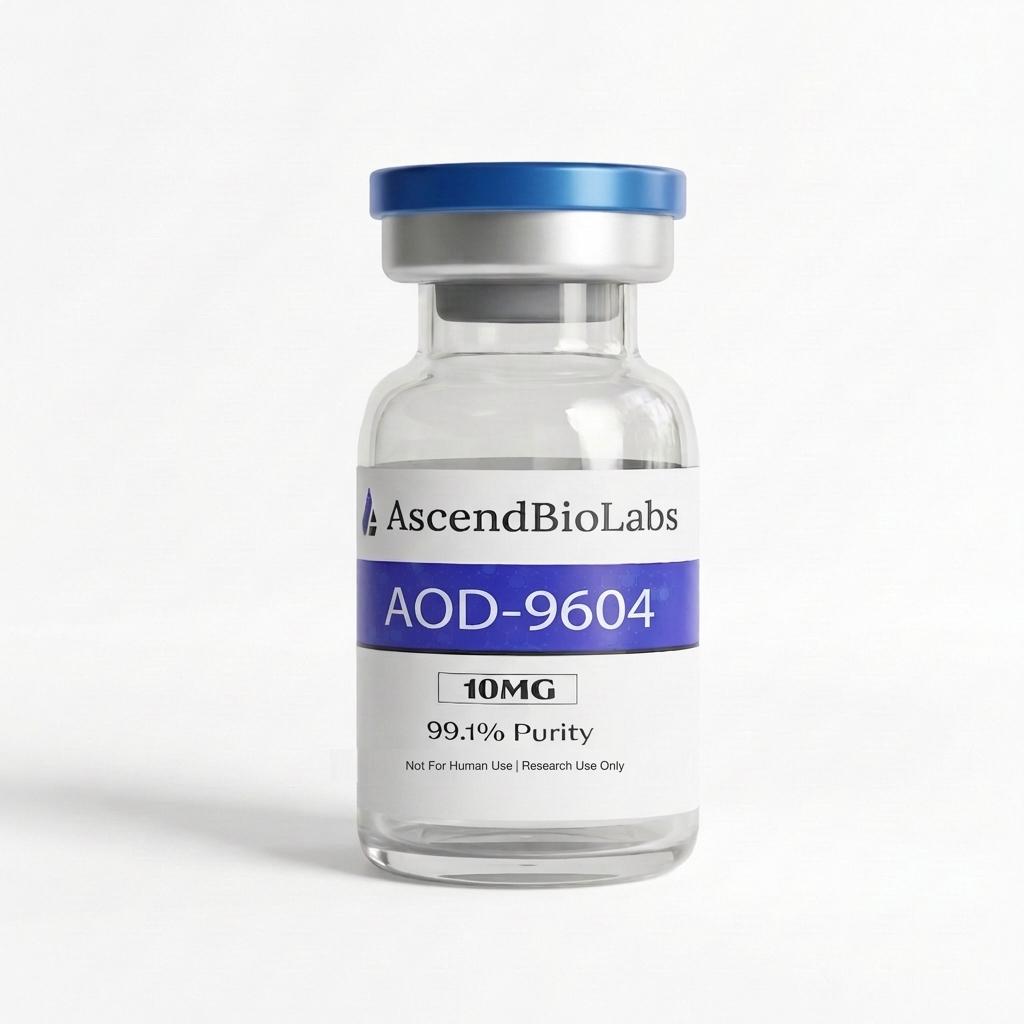
AOD-9604 UK – Human Growth Hormone Fragment Research Profile
AOD-9604 Peptide Profile
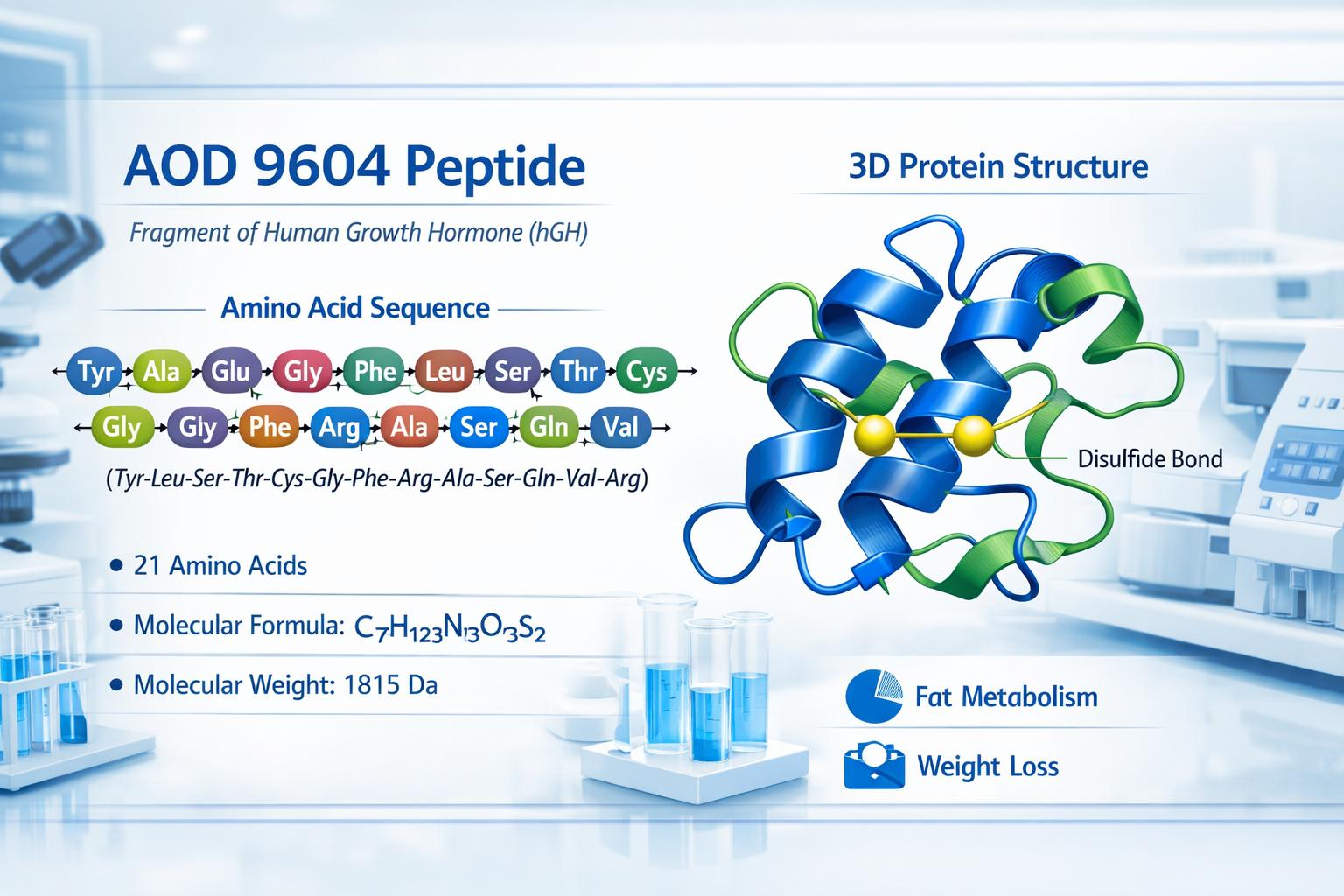
The AOD-9604 UK research profile examines a synthetic peptide analogue derived from the C-terminal region of human growth hormone (hGH). AOD-9604 was investigated as a potential anti-obesity drug candidate, with research exploring lipid metabolism and the biological activity associated with this region of the hormone.
AOD-9604 is commonly discussed alongside human growth hormone fragment terminology, including hGH 177–191. However, AOD-9604 and the unmodified hGH fragment should not automatically be treated as identical materials. The precise molecular identity, specification and analytical evidence must be established for the particular material under investigation.
At Lavish Peptides, scientific information should be interpreted alongside appropriate analytical documentation. This page provides an educational research profile covering peptide identity, the proposed mechanism of action, analytical characterisation and the limitations of published evidence.
Important: AOD-9604 is not an authorised weight-loss medicine in the UK. Published human research did not establish a sufficiently convincing weight-loss benefit to support an approved treatment. This page does not claim that AOD-9604 is effective, safe or suitable for human use.
What Is AOD-9604?
AOD-9604 is a synthetic peptide analogue developed from the C-terminal region of human growth hormone. The original research programme investigated whether aspects of growth hormone’s effects on lipid metabolism could be studied separately from its broader growth-related activity.
The compound attracted attention because researchers were interested in the biological processes associated with fat breakdown and fat storage. This led to laboratory investigations and clinical development as a potential obesity-treatment candidate.
However, a proposed biological mechanism is not the same as demonstrated clinical efficacy. AOD-9604 progressed into human studies, but its development did not establish an approved weight-loss treatment.
When reviewing an AOD-9604 peptide profile, it is therefore important to distinguish the historical scientific rationale from the outcomes of subsequent research.
Human Growth Hormone Fragment and the 177–191 Region
Human growth hormone is a protein containing 191 amino acid residues. Research into its structure and biological activity examined whether different regions of the molecule contributed to distinct effects.
The C-terminal region became a focus of research into lipid metabolism. AOD-9604 is associated with a modified version of this region, commonly described in the literature using hGH fragment 177–191 terminology.
The terminology requires care. AOD-9604 is a modified analogue, whereas an unmodified human growth hormone fragment is a different molecular entity. Differences in amino acid composition or other structural features can affect molecular mass, analytical identification and the interpretation of laboratory results.
For this reason, a supplier description alone is not sufficient to confirm identity. Appropriate analytical evidence should support the name and specification assigned to a particular batch.
AOD-9604 Mechanism of Action: What Has Been Investigated?
The proposed AOD-9604 mechanism of action arose from research into the lipid-metabolism activity associated with the C-terminal region of human growth hormone.
Early laboratory work investigated lipolysis, the process through which stored triglycerides are broken down, as well as related processes involved in lipid storage. Researchers sought to determine whether activity associated with this region could be separated from some of the broader effects of intact growth hormone.
These findings formed part of the scientific rationale for developing AOD-9604. However, proposed mechanisms and findings from laboratory models cannot automatically be translated into meaningful weight loss in people.
The later clinical development programme did not establish AOD-9604 as an effective, authorised obesity treatment. Its mechanism should therefore be described as a subject of research, not as proof that the compound produces a clinically useful fat-loss effect.
Lipolytic Domain 177–191: Understanding the Research Terminology
The phrase “lipolytic domain 177–191” is used in discussions of the C-terminal region of human growth hormone and its proposed relationship to lipid metabolism.
Lipolysis refers to the breakdown of stored fats into smaller components. Lipid metabolism is broader and includes the processes involved in lipid synthesis, storage, transport and utilisation.
Research into peptide fragments can help scientists investigate relationships between molecular structure and biological activity. Nevertheless, describing a region as lipolytic does not mean every compound derived from that region has established clinical benefits.
AOD-9604’s structural relationship to human growth hormone provides scientific context for its research history. It does not establish a recommended application, a clinically effective dose or an approved therapeutic use.
Fat Metabolism Research Peptide: Evidence and Limitations
AOD-9604 is frequently discussed in the context of fat metabolism research because it was developed as a candidate for obesity treatment.
Its history includes preclinical investigations and human clinical studies. The human evidence is particularly important: development did not result in an approved obesity medicine, and the available clinical programme did not establish the intended weight-loss benefit convincingly.
This distinction matters when interpreting online descriptions of metabolic research peptides. Mechanistic explanations, supplier claims and preliminary laboratory findings should not be treated as equivalent to positive clinical evidence.
Researchers reviewing the published literature should consider study design, endpoints, sample size, statistical findings and whether results were reproduced independently. A scientifically responsible AOD-9604 research profile should communicate both the original hypothesis and the limitations of the evidence.
Analytical Characterisation and Documentation
Analytical characterisation helps establish whether a research material matches its stated identity and specification. The appropriate tests depend on the material, the analytical question and the quality requirements applicable to the research.
Relevant documentation may include:
- Molecular identity evidence: Analytical results supporting the identity assigned to the material.
- Chromatographic data: Results from an appropriate separation method, such as HPLC, where applicable.
- Batch traceability: A batch identifier connecting the material with its supporting documentation.
- Test-method details: Information explaining how the reported result was obtained.
- Specification and limitations: Clear information about what the analytical results establish and what they do not establish.
A reported purity percentage should not be confused with molecular identity, total peptide content, sterility or suitability for administration. These are different quality questions that may require different tests.
For additional background, read our guides to what HPLC purity means and how to check a peptide certificate of analysis.
AOD-9604 5mg Lyophilised Powder: Specification Matters
The phrase “AOD-9604 5mg lyophilised powder” describes a proposed product presentation, not proof of a particular batch’s identity, purity or total peptide content.
Lyophilisation is a freeze-drying process used for a range of materials. Whether a particular AOD-9604 product is supplied in lyophilised form, and whether it contains the stated amount, must be confirmed from the actual product specification and appropriate documentation.
Before publishing any product specification, verify the material’s identity, stated quantity, presentation, storage information supplied by the manufacturer and the relevant batch records. Do not infer these details from another supplier’s listing.
Where a specification cannot be independently confirmed, it should not be presented as an established product fact.
Synthetic hGH Fragment UK: Important Distinctions
Searches for synthetic hGH fragments may return information about several related compounds. Similar terminology does not necessarily indicate identical molecular structures or interchangeable analytical specifications.
AOD-9604 should be distinguished from unmodified hGH fragment preparations. Accurate naming helps researchers compare scientific publications and interpret analytical documentation without confusing related substances.
For UK-facing educational content, it is also important to distinguish research information from claims about medical use. A research-use disclaimer does not itself establish that a product can lawfully be supplied or promoted in a particular context.
Before listing AOD-9604 as a commercial product, confirm the applicable regulatory requirements for the intended product, customer category and supply arrangement.
AOD-9604 and Anti-Obesity Research Compounds
AOD-9604 has a historical connection to anti-obesity drug development. That history should be presented accurately rather than used to imply that the compound is a proven weight-management solution.
The distinction between an investigational compound and an authorised medicine is essential. Research into a biological pathway does not establish clinical effectiveness, and an unsuccessful development programme should not be presented as evidence of a successful treatment.
For readers interested in anti-obesity research compounds, the most useful scientific questions concern the quality of the evidence, the methods used to measure outcomes and the reasons a candidate did or did not progress through clinical development.
AOD-9604 is an example of why the original scientific hypothesis must be considered alongside subsequent clinical findings.
Frequently Asked Questions About AOD-9604
What is AOD-9604?
AOD-9604 is a synthetic peptide analogue derived from the C-terminal region of human growth hormone. It was investigated as a candidate for obesity treatment, but it did not become an authorised weight-loss medicine in the UK.
Is AOD-9604 the same as human growth hormone fragment 176–191?
They are related but should not automatically be treated as identical. AOD-9604 is a modified analogue, so molecular identity should be established using appropriate documentation and analytical methods.
AOD-9604 UK research information should be evaluated alongside reliable analytical documentation and published scientific evidence. Learn what HPLC purity means, understand peptide purity versus peptide content, and explore how to check a peptide certificate of analysis. For additional quality-control context, review peptide batch number traceability and HPLC versus mass spectrometry for peptides. For scientific background, consult this published AOD-9604 metabolic research study on PubMed. Interpret all findings according to the study methods, limitations and applicable regulations.
What is the proposed AOD-9604 mechanism of action?
The original research focused on processes associated with lipid metabolism, including lipolysis. The proposed mechanism is a research hypothesis and does not establish clinically effective weight loss.
Is AOD-9604 an approved weight-loss treatment in the UK?
No. AOD-9604 is not an authorised UK weight-loss medicine. Its clinical development did not establish the intended weight-loss benefit required for an approved treatment.
What does an AOD-9604 certificate of analysis show?
Depending on the tests performed, a certificate of analysis may provide information about batch identity, chromatographic results and other specified characteristics. It should be read according to its actual methods and limitations rather than treated as proof of every aspect of quality.
Does a 5mg label prove the peptide content?
No. A stated quantity is a product specification that should be supported by appropriate documentation. A label alone does not independently establish identity, purity or total content.
Conclusion
AOD-9604 is a synthetic analogue of a region of human growth hormone that attracted scientific interest because of its proposed relationship to lipid metabolism. Its research history includes laboratory studies and human clinical development, but it did not become an authorised weight-loss treatment.
A reliable AOD-9604 peptide profile should distinguish molecular identity from related hGH fragments, explain the proposed mechanism without overstating the evidence, and give appropriate attention to analytical documentation and regulatory status.
For laboratory research, accurate identification, traceable documentation and careful interpretation of published evidence are more informative than unsupported therapeutic claims.
Research information only. Not medical advice. AOD-9604 is not an authorised UK weight-loss medicine and this page does not recommend human or veterinary use.
The AOD-9604 UK research profile provides an overview of this synthetic peptide analogue derived from the C-terminal region of human growth hormone. Understanding AOD-9604 UK requires distinguishing its proposed mechanism of action from established clinical evidence. The AOD-9604 UK research background includes investigations into lipid metabolism, while the AOD-9604 UK scientific literature also highlights important limitations in its development as an obesity-treatment candidate.
When reviewing AOD-9604 UK documentation, researchers should examine molecular identity, analytical methods and batch traceability. An AOD-9604 UK peptide profile should not be interpreted as proof of weight-loss effectiveness. The AOD-9604 UK research context also requires distinguishing modified analogues from related human growth hormone fragments.
For accurate AOD-9604 UK information, consult relevant scientific publications and appropriate analytical records. Any AOD-9604 UK product specification must be verified against genuine supplier documentation. Ultimately, AOD-9604 UK should be discussed through accurate scientific information, transparent limitations and applicable regulatory requirements.


Reviews
There are no reviews yet.