
What Does HPLC Purity Mean? A Guide to Peptide Testing
What does HPLC purity mean when you see a percentage such as 95%, 98% or 99% on a peptide analytical report? HPLC purity is a measurement commonly used in analytical chemistry to describe the relative chromatographic signal attributed to a target component under specified testing conditions. It can provide useful information about a sample’s chromatographic profile, but it does not automatically establish the sample’s total peptide content, identity, safety or suitability for a particular application.
Understanding what HPLC purity means is important when interpreting peptide certificates of analysis (COAs), laboratory reports and scientific documentation. The result must be considered alongside the analytical method, sample preparation and limitations of the test.
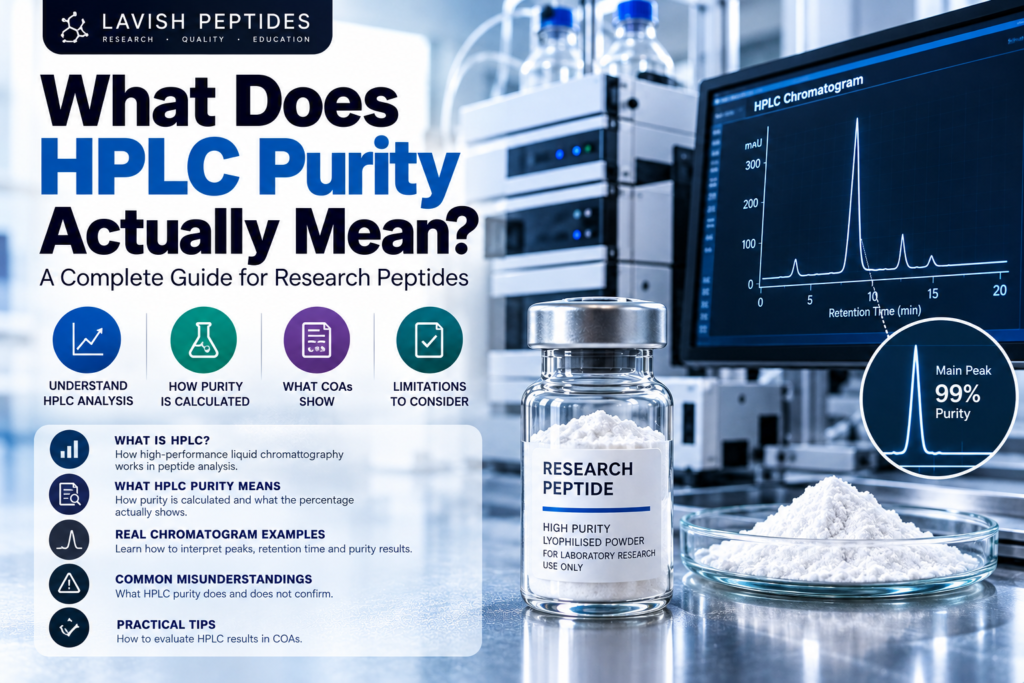
This guide explains how high-performance liquid chromatography works, how chromatographic purity is commonly calculated, what a 99% result can tell you and which questions remain unanswered by a purity percentage alone.
What Is HPLC?
HPLC stands for high-performance liquid chromatography. It is an analytical technique used to separate components within a mixture so they can be detected and evaluated.
In a typical HPLC system, a liquid mobile phase carries a prepared sample through a column containing a stationary phase. Different components interact with the column and mobile phase in different ways, causing them to separate as they travel through the system.
A detector records signals from components as they leave the column. These signals are displayed as a chromatogram, which plots detector response against time.
HPLC is used across pharmaceutical analysis, biochemistry, chemistry and other laboratory disciplines. Depending on the method, it can support the evaluation of target compounds, related impurities and changes in sample composition.
For peptide analysis, the separation method and detector must be appropriate for the material being examined. Not every HPLC method is suitable for every peptide or every analytical question.
What Does HPLC Purity Mean?
When people ask what HPLC purity means, they are usually referring to a percentage calculated from the chromatographic peaks recorded during analysis.
In a common approach known as peak-area normalisation, the integrated area of the main peak is divided by the combined integrated areas of the peaks included in the calculation. The result is then expressed as a percentage.
This is a relative measurement of the detected chromatographic signal under the specified conditions. It is not automatically a measurement of the percentage of the sample’s total weight that consists of the target peptide.
For example, a chromatogram may show one dominant peak and several smaller peaks. If the main peak accounts for 98% of the integrated peak area included in the calculation, the reported result may be 98% chromatographic purity by that method.
The interpretation depends on the method’s ability to separate and detect relevant components, as well as the integration rules and detector response. A percentage should therefore always be read in the context of the report that produced it.
How Is HPLC Purity Calculated?
A common peak-area normalisation calculation is:
HPLC peak-area percentage = (area of the target peak ÷ total area of the included peaks) × 100
This formula describes a common calculation approach, not a universal method for every purity assay.
Consider a hypothetical chromatogram with a target peak area of 980 units and other included peak areas totalling 20 units. The combined area is 1,000 units, so the target peak represents 98% of the included chromatographic area.
This example illustrates the calculation only. It does not represent a tested peptide product or a validated laboratory result.
Several factors affect how the result should be interpreted:
- Peak integration: The way the software identifies and integrates peaks affects the calculated areas.
- Chromatographic separation: Components that are not adequately separated may affect interpretation.
- Detector response: Different substances may produce different detector responses for the same amount of material.
- Detection limits: Components below the method’s detection capability may not appear as measurable peaks.
- Method conditions: The column, mobile phase, detector settings and sample preparation can influence the chromatogram.
For these reasons, a reported percentage is meaningful only when the analytical method and calculation basis are understood.
What Does 99% HPLC Purity Mean?
A report stating 99% HPLC purity generally indicates that the main peak accounts for approximately 99% of the included integrated chromatographic area under the stated method, when peak-area normalisation is used.
It does not automatically mean that 99% of the sample’s total mass is the target peptide.
The sample may contain water, counterions, residual solvents or other components that are not represented proportionally in the chromatographic calculation. The method may also have limitations in detecting certain substances.
A 99% result should therefore not be treated as proof of absolute chemical purity, a specific quantity per container, sterility or suitability for human use.
The correct interpretation is narrower: the reported chromatographic result supports a particular conclusion about the detected profile under the specified analytical conditions.
What Can an HPLC Chromatogram Tell You?
A chromatogram provides a visual record of detector response as separated components pass through the instrument.
The main peak
The main peak is often assigned to the target compound based on the analytical method and supporting evidence. Its area can be used in a chromatographic purity calculation.
However, a large peak does not independently prove the chemical identity of the material. Identity should be supported by appropriate analytical evidence.
Smaller peaks
Smaller peaks may represent related impurities, degradation products, residual components or other detected substances. Their significance depends on their identity, the method and the context of the analysis.
A small peak is not automatically harmless or unimportant, and the absence of a visible peak does not prove that a sample contains no impurities.
Retention time
Retention time describes how long a component takes to reach the detector under specified chromatographic conditions.
It can help compare results with an appropriate reference under comparable conditions, but retention time alone is not definitive proof of molecular identity.
Baseline and peak shape
The baseline and shape of a peak can affect integration and interpretation. Poor separation, overlapping peaks or inconsistent integration can complicate the calculation.
When reviewing a chromatogram, consider the overall quality of the analytical method rather than focusing exclusively on the largest peak.
HPLC Purity vs Peptide Content
HPLC purity and peptide content are related but different measurements.
Chromatographic purity commonly describes the proportion of detected peak area attributed to the target component. Peptide content concerns how much target peptide is present in a defined sample, as established using an appropriate quantitative method.
For example, water and counterions can contribute to total sample mass without contributing proportionally to the target peptide’s chromatographic signal. This is one reason why a high chromatographic purity result does not automatically establish a high mass-based peptide content.
Content may require a suitable quantitative assay, calibration or reference material, depending on the analytical objective.
For a more detailed explanation, read our related guide: Peptide Purity vs Peptide Content: What Is the Difference?.
The distinction matters because each measurement answers a different question. Neither should be used as a substitute for the other.
What Does an HPLC Purity Result Not Prove?
Understanding the limitations of HPLC purity is just as important as understanding the calculation.
A chromatographic purity result alone does not necessarily establish:
- The definitive molecular identity of the target component.
- The total amount of peptide present in a container.
- The absence of all impurities or contaminants.
- Sterility or endotoxin status.
- The suitability of a material for human consumption or administration.
- Regulatory authorisation or compliance with every applicable quality requirement.
Different analytical methods address different questions. Depending on the material and the purpose of the assessment, additional testing may be needed for identity, content, residual solvents, water, counterions or other quality attributes.
A responsible interpretation distinguishes the evidence provided by a particular test from conclusions that require additional evidence.
How to Read HPLC Results on a Certificate of Analysis
A certificate of analysis is most useful when its results can be connected to a clearly identified sample and an understandable analytical procedure.
When reviewing a COA, consider these points:
1. Check the sample or batch identification. Confirm which material the report describes and whether the identifier matches the associated documentation.
2. Identify the analytical method. Look for the named technique and any relevant method details.
3. Check how purity is reported. Determine whether the result is described as peak-area percentage, assay, mass percentage or another measurement.
4. Review the chromatogram where available. Look for the main peak, other detected peaks and information about integration or method conditions.
5. Check the test date and laboratory details. These help establish the context of the report, although they do not by themselves guarantee its authenticity or completeness.
6. Note the limitations. A purity percentage should not be interpreted as evidence for properties that were not tested.
For further scientific context, the European Medicines Agency provides a guideline on the development and manufacture of synthetic peptides, which discusses analytical considerations relevant to peptide characterisation.
Common Misunderstandings About HPLC Purity
A higher percentage always means a better sample
Not necessarily. A higher reported peak-area percentage may be useful evidence, but meaningful comparison depends on appropriate methods, separation, detector response and the purpose of the analysis.
HPLC proves the exact identity of a peptide
HPLC can support analysis, but chromatographic retention and peak area alone may not establish molecular identity. Additional evidence may be needed.
A 99% result means 99% by weight
Not automatically. Peak-area percentage and mass-based content are different measurements.
No additional peaks means there are no impurities
Not necessarily. Some components may be undetected, unresolved or outside the method’s detection capability.
Every HPLC result can be compared directly
Results produced by different methods or under different conditions may not be directly comparable. The method and calculation basis matter.
Frequently Asked Questions
What does HPLC purity mean in a peptide report?
It commonly refers to the relative chromatographic peak area attributed to the target component under the stated method. The precise meaning depends on how the assay and calculation are defined.
Is 99% HPLC purity the same as 99% peptide content?
No. A 99% peak-area result does not automatically establish that 99% of the sample’s total mass is peptide. Content requires an appropriate quantitative measurement when that information is needed.
Can HPLC detect every impurity?
No. Detection depends on the method, detector, separation conditions and characteristics of the components being analysed. Some substances may not be detected or adequately resolved.
Does HPLC confirm peptide identity?
HPLC can provide supporting analytical information, but a chromatographic result alone may not definitively establish identity. Appropriate complementary evidence may be necessary.
Why do HPLC purity results matter?
They provide information about the chromatographic profile of a sample and can help analysts evaluate detected components under defined conditions. Their value depends on sound methodology and correct interpretation.
Where can I learn more about peptide analytical testing?
Explore the Lavish Peptides blog for educational content about peptide science and analytical chemistry, including our article on peptide purity versus peptide content.
Conclusion: Understanding What HPLC Purity Means
Understanding what HPLC purity means helps readers interpret peptide analytical reports without confusing a chromatographic percentage with absolute chemical purity or total peptide content. The reported result describes the detected chromatographic profile under a specified method, and its significance depends on the quality of the separation, detector response, calculation rules and supporting evidence.
For researchers and readers exploring peptide science, the most reliable approach is to examine the analytical method, understand the limits of the reported result and distinguish purity from identity and quantitative content. A percentage is only as meaningful as the measurement behind it.
Lavish Peptides provides educational information about peptide science, laboratory analysis and research-related compounds. Visit the Lavish Peptides blog to explore further scientific topics.
Educational notice: This article is for informational purposes only. It does not constitute medical advice, establish that any product is suitable for human use or verify the quality of a specific product or batch. Analytical results should be interpreted by appropriately qualified personnel in the context of the relevant methods and documentation.
Understanding what HPLC purity means is essential when evaluating peptide analytical reports and certificates of analysis. HPLC purity generally describes the relative proportion of chromatographic peak area attributed to the target compound under specified testing conditions. Knowing what HPLC purity means helps distinguish chromatographic purity from actual peptide content, molecular identity and other quality measurements. A reported 99% HPLC purity result does not automatically mean that 99% of the sample’s total weight is peptide. To understand what HPLC purity means, researchers should review the analytical method, chromatogram, calculation basis and supporting documentation. Proper interpretation of HPLC purity also requires recognising that analytical methods have limitations and may not detect every component. By understanding what HPLC purity means,
Conclusion: What Does HPLC Purity Mean for Peptide Analysis?
Understanding what does HPLC purity mean is essential when evaluating peptide testing reports and certificates of analysis. HPLC purity generally describes the proportion of detected chromatographic peak area attributed to the target compound under specified analytical conditions. Knowing what does HPLC purity mean helps researchers distinguish a relative peak-area percentage from actual peptide content, molecular identity and overall sample quality. For example, a reported 99% HPLC purity result does not automatically establish that 99% of the sample’s total weight is the target peptide. To understand what does HPLC purity mean in a particular report, examine the analytical method, chromatogram, peak integration and calculation basis. These details help explain what the result supports and which conclusions require additional testing. Ultimately, understanding what does HPLC purity mean allows readers to interpret laboratory findings more accurately and avoid confusing chromatographic purity with a complete assessment of peptide composition.
