
Peptide Purity vs Peptide Content: What Is the Difference?
Understanding peptide purity vs peptide content is important when reading analytical reports, certificates of analysis (COAs) and laboratory documentation. Although these terms are sometimes used interchangeably, they describe different measurements. A peptide sample can show a high chromatographic purity result without that result establishing how much of the total sample mass is the target peptide.
For researchers, laboratory professionals and readers exploring peptide science in the UK, understanding this distinction helps prevent misinterpretation of analytical results. It also highlights why the method used, the sample tested and the information reported all matter.
This guide explains peptide purity, peptide content, peptide identity and the differences between these measurements.
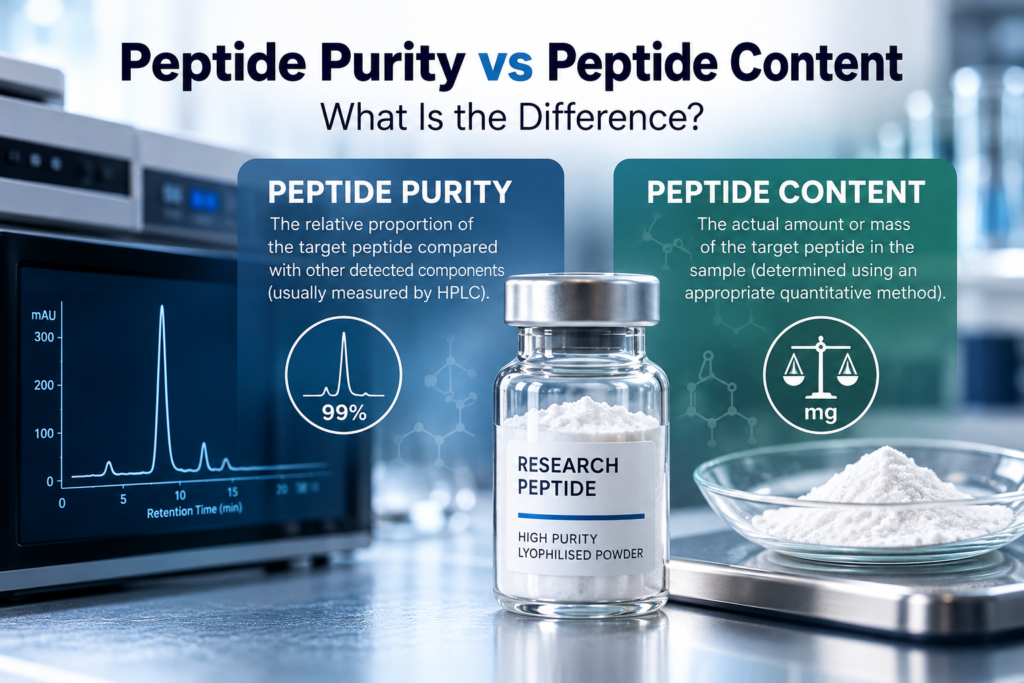
Table of Contents
- What Is Peptide Purity?
- What Is Peptide Content?
- Peptide Purity vs Peptide Content: The Main Differences
- Why Can Purity and Content Produce Different Results?
- What Does 99% Peptide Purity Mean?
- Peptide Identity, Purity and Content Explained
- Which Analytical Methods Are Used?
- How to Read Peptide Analytical Documentation
- Common Misunderstandings About Peptide Purity
- Frequently Asked Questions
- Conclusion
1. What Is Peptide Purity?
Peptide purity describes the relative proportion of a target peptide compared with other detected components under a specified analytical method. One commonly used technique for evaluating peptide-related impurities is high-performance liquid chromatography (HPLC).
In a typical reversed-phase HPLC analysis, a prepared sample passes through a chromatographic column. Components separate according to their interactions with the column and mobile phase. A detector records signals as the separated components pass through the system.
The resulting chromatogram displays peaks that can be evaluated according to the analytical procedure.
When purity is reported using peak-area normalisation, the area attributed to the main peak is expressed as a percentage of the total integrated peak area included in the calculation.
However, this result depends on the method, detector response, sample preparation, integration rules and the components the system can detect. It should therefore be interpreted within the context of the actual analytical report.
A chromatographic purity percentage is useful information, but it does not automatically establish every aspect of a sample’s composition or quality.
2. What Is Peptide Content?
Peptide content addresses a different question: how much of the target peptide is present in the material being measured?
Depending on the analytical procedure, content may be reported as a mass percentage, an amount per sample or a quantity assigned to a particular preparation.
A weighed sample of lyophilised peptide material may contain more than the target peptide itself. Its total mass can also include water, counterions, residual solvents, salts and other material, depending on the preparation and purification process.
These additional components can contribute to the sample’s total mass without contributing proportionally to the target peptide’s chromatographic peak.
For this reason, peptide content cannot automatically be calculated from a chromatographic purity percentage alone.
Quantitative content determination requires an appropriate method for the question being asked. Depending on the material and analytical objective, methods may include amino acid analysis, a validated quantitative chromatographic assay or other suitable quantitative techniques.
The report should identify the method and the basis on which the result was calculated.
3. Peptide Purity vs Peptide Content: The Main Differences
The central difference between peptide purity vs peptide content is that the measurements use different definitions and answer different questions.
| Measurement | What it tells you | Important limitation |
|---|---|---|
| Chromatographic purity | The relative share of detected chromatographic signal assigned to the target peak under the stated method | Does not automatically establish the total mass of peptide in the sample |
| Peptide content | The amount or mass fraction of target peptide determined using an appropriate quantitative method | Depends on the analytical method, reference material and reporting basis |
| Peptide identity | Whether the material is consistent with the expected molecular identity | Identity alone does not establish purity or quantity |
| Labelled amount | The nominal quantity stated for a sample or container | The label alone does not independently verify the actual amount present |
These measurements complement one another, but they are not interchangeable.
For example, a chromatographic purity result cannot independently confirm that a sample contains the exact quantity printed on its label. That question requires appropriate quantitative evidence.
Likewise, a content result does not necessarily establish the identity of the target compound unless the analytical approach also supports that conclusion.
A useful principle in analytical chemistry is to match every reported number to the question the test was designed to answer.
4. Why Can Purity and Content Produce Different Results?
There are several reasons why chromatographic purity and peptide content can differ.
Water and residual moisture
Water contributes to a sample’s total mass. Depending on the preparation and storage conditions, a lyophilised material may retain moisture.
If the analytical purity calculation is based on detected chromatographic peak areas, water may not be represented in that calculation in the same way it contributes to total sample mass.
Counterions and salts
Peptides can exist in salt forms, including acetate or trifluoroacetate forms, depending on the production and purification process.
Counterions contribute to the mass of the material but are not necessarily represented as peptide-related peaks in a conventional UV chromatographic purity calculation.
Residual solvents and other material
Residual solvents, inorganic residues and other process-related material may also contribute to total mass. Whether and how these components are detected depends on the analytical method.
Their presence and amount should not be assumed without appropriate testing.
Differences in analytical methods
Analytical methods are designed for particular purposes. A method intended to separate and compare detected components does not necessarily provide an absolute measurement of the target peptide’s mass.
Quantitative methods may require calibration against a suitable reference material or another validated measurement approach.
These differences explain why two apparently different results are not necessarily contradictory. They may simply describe different properties of the same sample.
5. What Does 99% Peptide Purity Mean?
A report stating 99% peptide purity by HPLC commonly indicates that the principal peak accounts for approximately 99% of the integrated chromatographic peak area included in the calculation, under the stated analytical conditions.
It should not automatically be interpreted as meaning that 99% of the sample’s total weight is the target peptide.
Consider a hypothetical laboratory report:
- Reported chromatographic purity: 99% peak area.
- Independently measured peptide content: not reported.
- Confirmed amount per container: not established by the purity result alone.
In this example, the purity result describes the chromatographic profile, but the available information does not establish the total peptide mass or the actual amount in the container.
The example is illustrative only; it does not represent a tested product or batch.
Before interpreting a numerical result, check the report’s terminology, analytical method and calculation basis. Avoid expanding a narrow analytical finding into a broader claim that the evidence does not support.
6. Peptide Identity, Purity and Content Explained
Peptide identity, purity and content are related concepts, but each addresses a separate analytical question.
Identity: Is it the expected molecule?
Identity testing evaluates whether the material is consistent with the expected chemical structure or molecular characteristics.
Mass spectrometry can provide useful evidence about molecular mass. Depending on the peptide and analytical objective, additional techniques may be needed to establish identity more fully.
A matching molecular mass does not, by itself, establish the sample’s purity or total peptide content.
Purity: What does the analytical profile show?
Purity testing evaluates the relative presence of the target component and detected impurities under the stated method.
HPLC is frequently used for this purpose, but its findings must be interpreted according to the method’s detection capabilities and limitations.
Content: How much target peptide is present?
Content determination aims to quantify the target peptide in the material being measured.
The appropriate method depends on the substance, sample matrix and required level of confidence.
For a broader technical discussion of analytical methods used to characterise synthetic peptides, consult the European Medicines Agency’s guideline on the development and manufacture of synthetic peptides.
The guideline discusses analytical approaches for identity, assay and impurities, illustrating why these are distinct elements of peptide characterisation.
7. Which Analytical Methods Are Used?
No single analytical method answers every question about a peptide sample. The selection depends on what needs to be established.
High-performance liquid chromatography
HPLC separates components in a sample and can be used to evaluate chromatographic purity and peptide-related impurities.
The reported result depends on the selected method, detector, sample preparation and data-processing procedure.
Mass spectrometry
Mass spectrometry measures mass-to-charge ratios and can provide evidence supporting molecular identity. More detailed structural questions may require additional analytical techniques.
A mass result should not automatically be treated as a measurement of the total quantity of peptide in a sample.
Amino acid analysis
Amino acid analysis can contribute to quantitative characterisation of peptide materials. The suitability of the method depends on the analytical objective, sample preparation and calculation approach.
Other quantitative methods
Other suitable techniques may be used when validated for the intended measurement. The analytical report should make clear what was measured and how the reported value was assigned.
For further scientific context, see the peer-reviewed article Reference Standards to Support Quality of Synthetic Peptide Therapeutics, which discusses the use of multiple analytical approaches when characterising peptide reference materials.
8. How to Read Peptide Analytical Documentation
When reviewing peptide analytical documentation, focus on the evidence presented rather than relying on a single headline percentage.
Consider the following questions:
- What exactly was measured? Determine whether the result refers to chromatographic purity, identity, content or another property.
- Which method was used? Look for the analytical technique and any relevant method details.
- What units and calculation basis are stated? A peak-area percentage is not the same as a mass percentage.
- Which sample or batch was tested? Check whether the documentation identifies the material to which the result applies.
- Are the methods and results clearly reported? Look for relevant test dates, laboratory details and explanations of the reported values.
- What does the report not establish? A purity result alone does not establish sterility, endotoxin status, suitability for human use or regulatory authorisation.
Documentation should be evaluated according to its scope and limitations. A result is meaningful only when the underlying measurement and its interpretation are understood.
For additional information about the analytical methods used in peptide research, explore the educational resources on the Lavish Peptides website.
9. Common Misunderstandings About Peptide Purity
Misunderstanding 1: 99% purity means 99% peptide by weight
Not necessarily. A chromatographic peak-area result and a quantitative mass-based content result use different measurement principles.
Misunderstanding 2: High purity confirms the exact amount in a container
A purity percentage alone does not establish the actual quantity of peptide in a container. That requires suitable quantitative evidence.
Misunderstanding 3: One analytical test confirms every quality characteristic
Different tests answer different questions. Identity, purity, content and other quality attributes should not be treated as interchangeable.
Misunderstanding 4: All purity percentages can be compared directly
Comparisons require attention to analytical methods, detector conditions, calculation rules and reporting conventions. Results obtained under different conditions may not be directly comparable.
Misunderstanding 5: A certificate automatically proves every claim about a product
A certificate should be assessed for its scope, authenticity, batch relevance and supporting analytical evidence. Its existence alone does not establish every possible quality or regulatory claim.
10. Frequently Asked Questions
What is the difference between peptide purity and peptide content?
Peptide purity commonly describes the relative chromatographic signal attributed to the target component under a specified method. Peptide content describes the amount or mass fraction of the target peptide determined using an appropriate quantitative method.
Does 99% HPLC purity mean 99% peptide content?
No. A 99% HPLC peak-area result does not automatically mean that 99% of the sample’s total mass is peptide. Content must be established separately when that information is required.
Can a peptide have high purity but lower content?
Yes. A sample can show a high relative chromatographic purity result while containing water, counterions or other material that contributes to its total mass. The actual difference must be established by appropriate testing rather than assumed.
Does mass spectrometry measure peptide purity?
Mass spectrometry can provide evidence supporting molecular identity and can be incorporated into broader analytical workflows. Whether it establishes purity or quantity depends on the specific method and how the measurement is validated.
What should a peptide certificate of analysis include?
The relevant information depends on the material and testing requirements. Useful documentation may identify the sample or batch, analytical methods, test results, units, dates and laboratory. The report should distinguish purity, identity and quantitative content where those measurements are reported.
Why is peptide content important in research?
Quantitative content can be important when a laboratory needs to establish how much target peptide is present in a defined sample. The appropriate measurement and reporting basis depend on the research objective and analytical protocol.
Understanding peptide purity vs peptide content helps readers interpret analytical documentation more accurately. Purity describes a relative analytical result, while content addresses the quantity of target peptide established by a suitable quantitative method.
Neither measurement should be interpreted beyond what the method supports. Identity, purity, content and other quality characteristics are separate questions, and a complete understanding of a sample may require complementary analytical evidence.
Lavish Peptides shares educational information about peptide science, analytical chemistry and laboratory research. Explore our research resources and product catalogue for further information about the website’s research-related offerings.
Research information notice: This article is educational and does not constitute medical advice, establish that a product is suitable for human use, or confirm the quality of any specific product or batch. Analytical results should be interpreted by appropriately qualified personnel using the relevant methods and documentation.
Conclusion: Why Understanding Peptide Purity vs Peptide Content Matters
Understanding peptide purity vs peptide content is an important part of interpreting laboratory reports, certificates of analysis and peptide research documentation. Although these terms are closely related, they describe different analytical measurements and should not be used interchangeably.
Peptide purity generally describes the relative proportion of the target component detected under a specified analytical method, while peptide content refers to the amount of target peptide established through an appropriate quantitative method. Neither measurement alone provides a complete assessment of every characteristic of a sample.
For anyone exploring peptide science in the UK, understanding peptide purity vs peptide content can help support more informed interpretation of analytical results and laboratory documentation. Always consider the testing method, reported units, sample identity and limitations of the available evidence.
Explore the Lavish Peptides blog for more educational information about peptide science, analytical chemistry and laboratory research, or visit our research product catalogue to learn more about our listed research compounds.
Disclaimer: This article is provided for educational and informational purposes only. It does not constitute medical advice or establish that any product is suitable for human use. Product quality and composition should be assessed using appropriate, verifiable analytical evidence.
Understanding peptide purity vs peptide content is essential for accurately interpreting laboratory testing results and certificates of analysis. While peptide purity indicates the relative proportion of the target peptide detected through a specified analytical method, peptide content measures how much of that peptide is present in the sample. These two measurements provide different information, and a high purity percentage does not automatically confirm the total peptide quantity. By understanding peptide purity vs peptide content, researchers can better interpret analytical data, evaluate laboratory documentation and recognise the importance of reliable testing methods. Explore the Lavish Peptides blog for more educational insights into peptide science, analytical chemistry and laboratory research.
