
Table of Contents
- Introduction
- What Is Peptide Reconstitution?
- Why Proper Reconstitution Matters
- Choosing the Right Diluent
- Understanding Reconstitution Ratios
- Using a Peptide Calculator
- Avoiding Common Reconstitution Mistakes
- Reconstitution and Peptide Storage
- Best Practices for Research Laboratories
- Frequently Asked Questions
- Conclusion
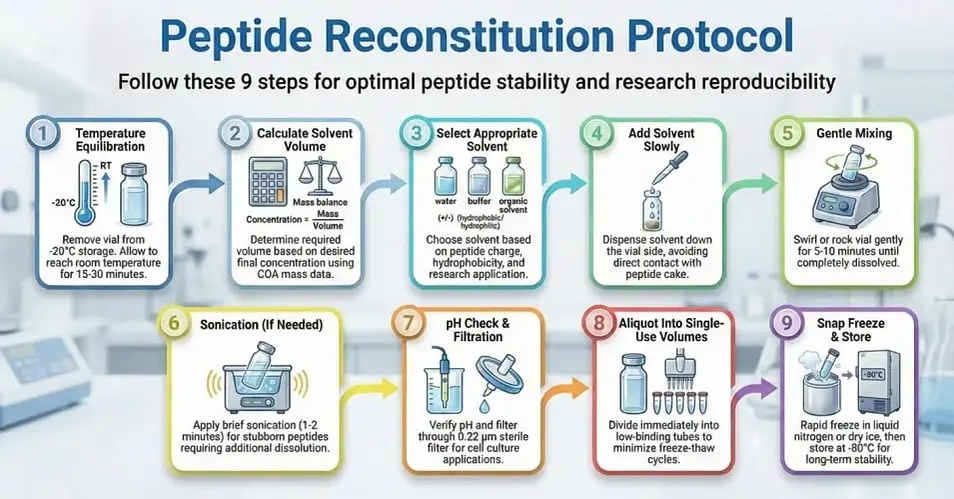
Introduction
A Peptide Reconstitution Guide is an important resource for researchers working with lyophilised peptides in laboratory environments. Before many research peptides can be used for scientific investigations, they must first be reconstituted using an appropriate solvent and handled according to established laboratory procedures.
Researchers throughout the United Kingdom and Europe frequently work with compounds such as Tesamorelin UK and CJC-1295 No DAC & Ipamorelin UK. Understanding proper reconstitution procedures helps support accurate calculations, consistent preparation, and reliable laboratory conditions.
This Peptide Reconstitution Guide explains the fundamentals of peptide preparation, dilution calculations, storage considerations, and best practices for laboratory research.
What Is Peptide Reconstitution?
Peptide reconstitution refers to the process of adding a suitable liquid solvent to a lyophilised peptide powder in order to create a usable solution for laboratory research.
Many research peptides are supplied in freeze-dried form because this helps support stability during storage and transportation.
Once reconstituted, researchers can calculate concentrations, prepare solutions, and document preparation procedures more effectively.
A Peptide Reconstitution Guide helps researchers understand the steps involved while reducing avoidable preparation errors.
Why Proper Reconstitution Matters
Proper preparation is essential for maintaining consistency throughout scientific investigations.
A well-structured Peptide Reconstitution Guide helps researchers:
- Improve preparation accuracy
- Maintain consistent concentrations
- Reduce calculation errors
- Support laboratory documentation
- Standardise handling procedures
Researchers frequently combine reconstitution procedures with resources such as Peptide Calculator UK to calculate concentrations accurately after preparation.
1. Choose the Appropriate Diluent
Selecting a suitable solvent is one of the most important parts of peptide preparation.
Researchers commonly use:
- Bacteriostatic water
- Sterile water
- Laboratory-approved solvents
The choice of diluent often depends on laboratory protocols and research objectives.
Following a Peptide Reconstitution Guide helps ensure that researchers use appropriate preparation methods while maintaining consistency across studies.
2. Understand Reconstitution Ratios
Reconstitution ratios determine the concentration of peptide within a prepared solution.
For example:
- 10 mg peptide
- 2 mL diluent
Produces:
- 5 mg/mL concentration
Understanding these calculations is important because concentration values affect laboratory preparation procedures and documentation.
Researchers often use a Peptide Calculator UK to simplify these calculations and improve accuracy.
3. Add Diluent Slowly
A common recommendation found within any Peptide Reconstitution Guide is to add the solvent slowly.
Researchers often introduce the diluent carefully against the side of the vial rather than directing it aggressively onto the peptide powder.
This approach may help reduce unnecessary agitation during preparation.
Maintaining controlled preparation techniques supports more consistent laboratory procedures.
4. Avoid Excessive Agitation
One of the most common preparation mistakes involves vigorous shaking.
Researchers generally avoid excessive agitation and instead use gentle mixing methods according to laboratory protocols.
A Peptide Reconstitution Guide encourages careful handling throughout the preparation process to support peptide integrity and consistency.
5. Calculate Concentrations Accurately
Concentration calculations remain one of the most important aspects of peptide preparation.
Researchers should record:
- Peptide amount
- Diluent volume
- Final concentration
- Preparation date
Educational resources such as Peptide Calculator UK can help simplify concentration calculations while reducing the likelihood of manual errors.
6. Follow Proper Storage Procedures After Reconstitution
Storage becomes especially important once a peptide has been reconstituted.
Researchers commonly follow established storage procedures to help maintain stability and consistency.
For additional guidance, researchers may review our Peptide Storage UK resource, which explains storage considerations, handling procedures, and common storage mistakes.
Combining a Peptide Reconstitution Guide with appropriate storage practices supports more reliable laboratory preparation procedures.
7. Maintain Accurate Documentation
Documentation is an essential part of laboratory research.
Researchers often record:
- Batch information
- Preparation dates
- Concentration calculations
- Storage conditions
- Laboratory notes
A Peptide Reconstitution Guide helps researchers establish repeatable preparation procedures while supporting consistency across investigations.
Common Peptide Reconstitution Mistakes
Even experienced researchers may occasionally encounter preparation errors.
Common mistakes include:
Incorrect Calculations
Failing to calculate concentrations accurately may affect preparation records and laboratory consistency.
Using Incorrect Volumes
Adding the wrong amount of diluent changes the final concentration.
Poor Documentation
Failure to record preparation details can make future investigations more difficult.
Improper Storage
Researchers should combine preparation procedures with guidance from a Peptide Storage UK resource whenever appropriate.
Avoiding these mistakes helps support more consistent research environments.
Why Researchers Use a Peptide Reconstitution Guide
Interest in peptide research continues growing throughout the United Kingdom and Europe.
As more laboratories work with compounds such as Tesamorelin UK and CJC-1295 No DAC & Ipamorelin UK, educational resources become increasingly important.
A Peptide Reconstitution Guide helps researchers:
- Understand preparation procedures
- Improve concentration calculations
- Support laboratory consistency
- Reduce avoidable errors
- Improve documentation practices
Scientific Research Resources
Researchers seeking additional scientific information regarding peptide preparation, stability, and handling procedures may review published literature through the National Library of Medicine:
https://pubmed.ncbi.nlm.nih.gov
Scientific literature continues providing valuable insights into peptide preparation and laboratory methodologies.
Frequently Asked Questions
What is peptide reconstitution?
Peptide reconstitution is the process of adding a suitable solvent to a lyophilised peptide powder to create a solution for laboratory research.
Why is a Peptide Reconstitution Guide important?
A Peptide Reconstitution Guide helps researchers understand preparation procedures, concentration calculations, and laboratory handling practices.
Why do researchers use a Peptide Calculator UK?
Researchers often use a Peptide Calculator UK to simplify concentration calculations following peptide preparation.
Should reconstituted peptides be stored properly?
Researchers commonly follow storage procedures after preparation and may refer to a Peptide Storage UK resource for additional guidance.
What are the most common reconstitution mistakes?
Incorrect calculations, improper diluent volumes, poor documentation, and inadequate storage practices are among the most common preparation errors.
Conclusion
A reliable Peptide Reconstitution Guide helps researchers improve preparation accuracy, maintain consistent laboratory procedures, and support more reliable scientific investigations. Understanding reconstitution principles, concentration calculations, storage considerations, and documentation practices allows researchers to establish more standardised workflows throughout the preparation process.
Researchers working with compounds such as Tesamorelin UK and CJC-1295 No DAC & Ipamorelin UK often combine proper preparation procedures with resources such as Peptide Calculator UK and Peptide Storage UK to support consistency throughout laboratory research.
By following established preparation practices and maintaining accurate records, researchers can create more reliable environments for peptide-related investigations.
