
Introduction
A Peptide Calculator UK is one of the most useful tools available for researchers working with lyophilised peptides. Accurate calculations help ensure consistency throughout laboratory investigations by simplifying concentration measurements, dilution ratios, and peptide preparation procedures.
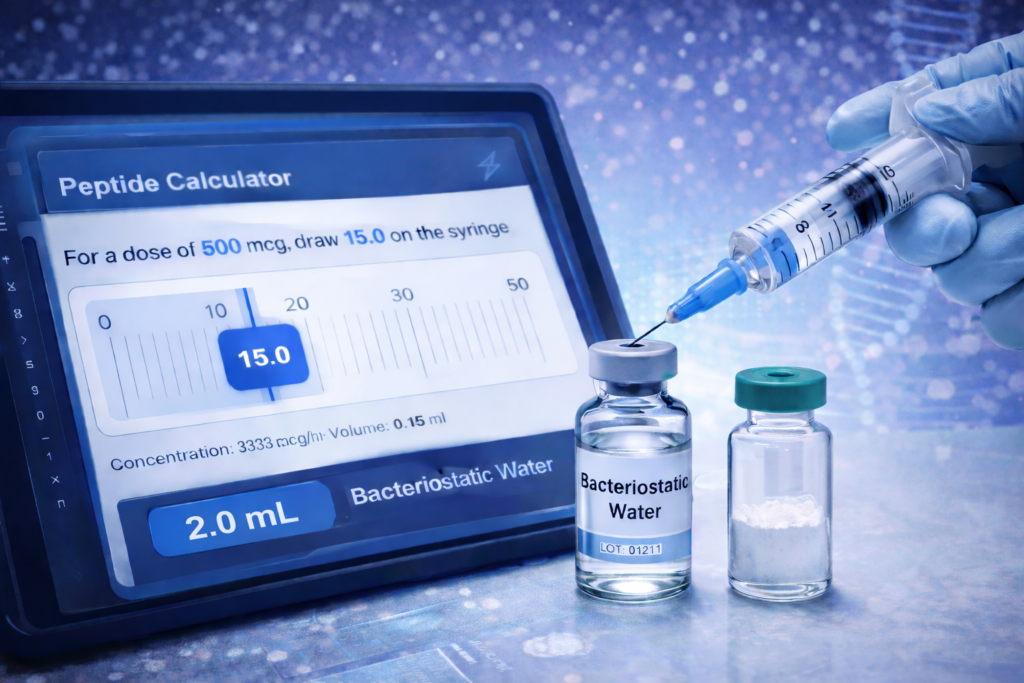
As peptide research continues expanding across the United Kingdom and Europe, researchers are increasingly working with compounds such as Tesamorelin UK, CJC-1295 No DAC & Ipamorelin UK, BPC-157, TB-500, Retatrutide, and Tirzepatide. Understanding peptide calculations remains an important part of maintaining accurate and consistent laboratory practices.
Whether you are new to peptide research or an experienced laboratory professional, a reliable peptide calculator can help simplify complex calculations while reducing the likelihood of manual errors.
What Is a Peptide Calculator?
A peptide calculator is a tool designed to calculate peptide concentrations after reconstitution. Researchers commonly use peptide calculators to determine how much peptide is present within a specific volume of solution.
Most research peptides are supplied as lyophilised powders that require reconstitution before laboratory use. Once a solvent has been added, researchers need a simple method to calculate concentrations accurately.
A peptide calculator helps determine:
- Peptide concentration
- Reconstitution ratios
- Solution strength
- Volume measurements
- Laboratory preparation values
These calculations help researchers standardise procedures and improve consistency throughout scientific investigations.
Researchers may also explore Tesamorelin UK and CJC-1295 No DAC & Ipamorelin UK.
Why Researchers Use a Peptide Calculator UK
A Peptide Calculator UK helps researchers calculate peptide concentrations quickly and accurately. Rather than relying on manual calculations, a peptide calculator reduces errors and improves consistency throughout laboratory investigations.
Researchers working with compounds such as Tesamorelin UK and CJC-1295 No DAC & Ipamorelin UK frequently use a Peptide Calculator UK to simplify concentration calculations and support standardised preparation procedures.
As peptide research continues growing throughout the UK, educational resources such as a Peptide Calculator UK remain valuable tools for both new and experienced researchers.
Why Accurate Peptide Calculations Matter
Accurate calculations are essential within any laboratory environment. Even small mathematical errors may affect concentration values and lead to inconsistencies during research.
Researchers working with compounds such as Tesamorelin UK and CJC-1295 No DAC & Ipamorelin UK often rely on peptide calculators to support accurate preparation procedures.
Benefits of accurate peptide calculations include:
- Improved laboratory consistency
- Better research documentation
- Reduced calculation errors
- Standardised preparation methods
- More reliable concentration measurements
By using a Peptide Calculator UK resource, researchers can save time while maintaining greater accuracy throughout the preparation process.
Understanding Peptide Concentration
Before using a peptide calculator, it is important to understand concentration.
Concentration refers to the amount of peptide dissolved within a specific volume of liquid.
The basic formula is:
Concentration = Total Peptide ÷ Total Liquid Volume
For example:
- 10 mg peptide
- 2 mL bacteriostatic water
Produces:
- 5 mg per mL
This formula forms the foundation of most peptide calculator systems and is commonly used throughout peptide research environments.
Understanding concentration allows researchers to prepare solutions more accurately and maintain consistent research conditions.
How a Peptide Calculator Works
Most peptide calculators require only a few pieces of information.
Peptide Amount
The total quantity of peptide contained within the vial.
Examples include:
- 5 mg
- 10 mg
- 15 mg
- 20 mg
Water Volume
The amount of bacteriostatic water or suitable solvent added during reconstitution.
Examples include:
- 1 mL
- 2 mL
- 3 mL
- 5 mL
Desired Measurement
The concentration or volume the researcher wishes to calculate.
The calculator then determines the final concentration based on the information provided.
This process helps eliminate manual calculations and improves laboratory efficiency.
Common Peptide Calculation Examples
Example One
Peptide Amount:
10 mg
Water Added:
1 mL
Result:
10 mg/mL
Example Two
Peptide Amount:
10 mg
Water Added:
2 mL
Result:
5 mg/mL
Example Three
Peptide Amount:
20 mg
Water Added:
4 mL
Result:
5 mg/mL
These examples demonstrate how increasing the volume of water decreases overall concentration.
Many researchers use peptide calculators because they provide these results instantly without requiring manual calculations.
Benefits of Using a Peptide Calculator UK
Improved Accuracy
One of the biggest advantages of a peptide calculator is accuracy. Automated calculations help reduce mathematical mistakes and improve reliability.
Faster Laboratory Preparation
Researchers can quickly determine concentrations without manually calculating every value.
Better Consistency
Standardised calculations help maintain consistency across multiple laboratory investigations.
Simplified Documentation
Recording concentration values becomes easier when calculations are generated automatically.
Reduced Human Error
Manual calculations may occasionally produce mistakes. Peptide calculators help minimise these risks.
Researchers investigating compounds such as Tesamorelin UK and CJC-1295 No DAC & Ipamorelin UK frequently rely on accurate concentration calculations to support consistent laboratory procedures.
Common Peptide Calculation Mistakes
Although peptide calculations are relatively simple, researchers occasionally encounter common errors.
Incorrect Unit Conversion
Confusing milligrams (mg) and micrograms (mcg) remains one of the most frequent mistakes.
Incorrect Water Volume
Using the wrong amount of solvent will immediately alter the final concentration.
Rounding Errors
Excessive rounding may affect concentration accuracy.
Poor Documentation
Failure to record calculations properly can create inconsistencies later in the research process.
Using a reliable Peptide Calculator UK resource helps minimise these common issues.
Scientific Resources and Research
Peptide calculators are useful tools, but researchers should also consult established scientific literature and laboratory references when conducting peptide investigations.
Published scientific studies involving growth hormone-releasing peptides, endocrine signalling compounds, and metabolic research peptides can be explored through the National Library of Medicine:
https://pubmed.ncbi.nlm.nih.gov
Educational resources help researchers better understand peptide preparation methods, concentration calculations, and laboratory best practices.
Frequently Asked Questions
What is a peptide calculator?
A peptide calculator is a tool used to calculate peptide concentrations, dilution ratios, and preparation values following reconstitution.
Why do researchers use peptide calculators?
Researchers use peptide calculators to improve accuracy, reduce manual calculation errors, and simplify laboratory preparation procedures.
What information is required?
Most calculators require the peptide amount, solvent volume, and desired measurement value.
Can a peptide calculator improve consistency?
Yes. Standardised calculations help researchers maintain more consistent preparation procedures.
Are peptide calculators useful for all peptides?
Peptide calculators can be used with many common research compounds, including growth hormone-related peptides and other laboratory research compounds.
Choosing the Right Peptide Calculator UK Resource
Not all calculation tools provide the same level of accuracy and usability. A reliable Peptide Calculator UK should be easy to use, provide clear concentration calculations, and support common peptide preparation scenarios.
Researchers often combine a Peptide Calculator UK with proper storage procedures, laboratory documentation, and established research protocols to improve consistency throughout scientific investigations.
Using a trusted Peptide Calculator UK can help reduce preparation errors and improve overall laboratory efficiency.
Conclusion
A Peptide Calculator UK remains one of the most valuable resources available for peptide researchers. By simplifying concentration calculations and reducing manual errors, peptide calculators help improve laboratory consistency and support more accurate preparation procedures.
As peptide research continues growing throughout the UK and Europe, researchers increasingly rely on tools that improve efficiency and standardisation. Understanding concentration calculations allows laboratories to maintain greater consistency while supporting reliable research practices.
Researchers exploring growth hormone-related compounds may also wish to review Tesamorelin UK and CJC-1295 No DAC & Ipamorelin UK available through Lavish Peptides.
While a peptide calculator cannot replace proper laboratory procedures, it can significantly simplify the mathematical aspects of peptide preparation and contribute to more consistent scientific investigations.
