
How to Read a Peptide Certificate of Analysis (COA)
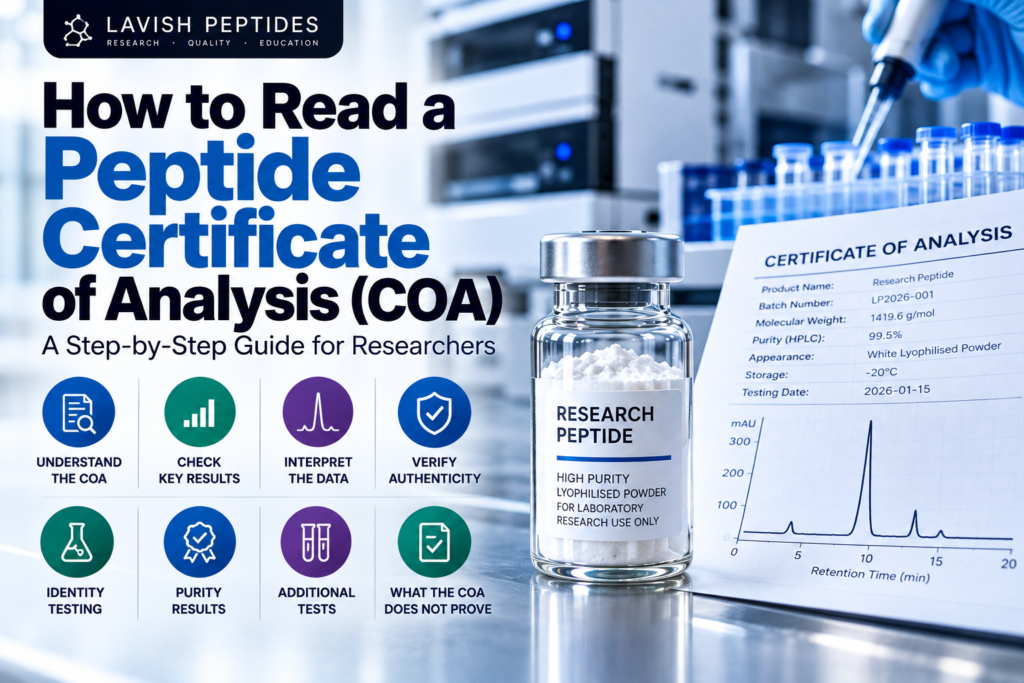
Knowing how to read a peptide certificate of analysis is an important skill when reviewing laboratory documentation and analytical test results. A Certificate of Analysis, commonly called a COA, presents information about a particular sample or batch, including the tests performed, the reported results and, where provided, the methods used to obtain them.
However, a COA is only as informative as its supporting evidence. A high purity percentage does not automatically confirm molecular identity, total peptide content, sterility or suitability for a particular application. Understanding the terminology and limitations of each result is essential.
In this guide, we explain how to read a peptide certificate of analysis, what information to check, how to interpret HPLC purity results and which questions to ask before drawing conclusions from a laboratory report.
What Is a Peptide Certificate of Analysis?
A Certificate of Analysis is a document that reports analytical findings for an identified material, sample or production batch. Depending on the product and testing programme, it may contain information about identity, appearance, purity, assay, impurities and other specified quality characteristics.
In peptide research, a COA can help readers understand which analytical tests were conducted and what those tests reported. It may also identify the laboratory, test date, batch number and relevant analytical methods.
A COA should not be treated as a universal guarantee of quality. It does not necessarily include every test that might be relevant to a material, and its findings do not automatically apply to other batches.
When learning how to read a peptide certificate of analysis, the first step is to establish exactly which material was tested and what the document claims to demonstrate.
1. Check the Product Name and Batch Number
Start by checking the product name, sample identifier and batch or lot number.
These details connect the document to the material it is intended to describe. If a report has no clear sample identification, it can be difficult to establish whether its findings relate to the product or batch under review.
Look for the following information:
- Product or sample name: Does it identify the material being analysed?
- Batch or lot number: Is there a unique identifier for the tested batch?
- Sample identification: Is the sample traceable through the relevant documentation?
- Report reference: Is there a document number or other identifier that can be used when asking the issuing laboratory questions?
A batch number printed on a document is not independent proof of authenticity. It is a starting point for checking traceability.
If the COA cannot be connected reliably to the material being reviewed, its relevance remains uncertain regardless of the reported purity percentage.
2. Identify the Laboratory and Testing Date
The laboratory details help establish where the analysis was performed and when the findings were reported.
Look for the laboratory’s name, contact information, report date and any available accreditation information. If accreditation is claimed, check the accreditation body’s records and whether the relevant testing falls within the laboratory’s accredited scope.
The testing date is also important. A report describes the sample at the time it was tested, under the conditions and methods used. It does not automatically establish the current condition of material that has subsequently been stored, transported or handled.
When learning how to read a peptide certificate of analysis, distinguish between a document’s appearance and independently verifiable evidence. A professional-looking PDF, laboratory logo or digital signature should not be treated as sufficient proof on its own.
Where appropriate, contact the issuing laboratory through independently verified contact details to ask whether the report is genuine and whether the sample reference matches its records.
3. Understand the Analytical Methods
A COA should identify the tests performed or provide enough information to understand how the reported results were obtained.
Different analytical techniques answer different questions. The presence of one test does not mean every aspect of the sample has been assessed.
High-performance liquid chromatography (HPLC)
HPLC separates components in a sample and produces a chromatogram. It is commonly used to examine chromatographic purity and related components under specified analytical conditions.
The interpretation depends on the method, detector, separation quality and calculation rules.
Mass spectrometry (MS)
Mass spectrometry measures mass-to-charge ratios and can provide evidence supporting molecular identity. Depending on the method and sample, additional techniques may be required to establish identity more fully.
A matching molecular mass alone does not establish every aspect of molecular structure, purity or quantity.
Amino acid analysis
Amino acid analysis can support the characterisation or quantitative assessment of certain peptide materials when the method is suitable for the sample and intended measurement.
Other tests
Additional methods may be relevant depending on the material and intended use. Examples include testing for water content, residual solvents, counterions or specific impurities.
A key principle is to match each result to the question the method was designed to answer. A COA containing an HPLC result should not automatically be interpreted as comprehensive evidence of all quality characteristics.
Why Learning How to Read a Peptide Certificate of Analysis Matters
Knowing how to read a peptide certificate of analysis helps you distinguish documented laboratory findings from claims that have not been independently established. A useful COA should identify the material tested, explain the analytical methods used and report the results clearly. When learning how to read a peptide certificate of analysis, avoid relying on a single purity percentage without checking the supporting information. The sample identity, testing date, batch reference and calculation method all help establish what the report actually demonstrates.
How to Read a Peptide Certificate of Analysis: A Practical Example
Imagine a hypothetical COA reporting 98% HPLC peak-area purity alongside a separate molecular-mass result. How to read a peptide certificate of analysis correctly means interpreting each result independently. The chromatographic result describes the detected peak-area distribution under the stated method, while the mass result may support an assessment of molecular identity. Neither result automatically confirms the total amount of peptide in the container, sterility or the absence of every impurity. Those conclusions require appropriate evidence. This example is illustrative and does not represent a tested Lavish Peptides product.
How to Read a Peptide Certificate of Analysis and Identify Missing Information
When considering how to read a peptide certificate of analysis, look for missing details as carefully as the reported results. Is the analytical method named? Is the tested batch identifiable? Are units and specifications provided? Can the issuing laboratory be independently verified? If important information is absent, ask for clarification rather than assuming the material passed every possible quality test. A transparent report makes its scope and limitations understandable.
How to Read a Peptide Certificate of Analysis Before Drawing Conclusions
The most reliable approach to how to read a peptide certificate of analysis is to evaluate the document as a whole. Compare the sample identification, analytical methods, reported values and supporting chromatograms where available. Check whether the results address identity, purity or quantitative content, because these are different measurements. A COA can provide useful analytical evidence, but it cannot establish properties that were not tested. Understanding this distinction helps readers interpret laboratory documentation more accurately.
Conclusion: How to Read a Peptide Certificate of Analysis
Learning how to read a peptide certificate of analysis means looking beyond the headline purity percentage and examining the evidence behind every reported result. Verify the sample and batch information, review the testing methods, understand the units and distinguish molecular identity from chromatographic purity and quantitative content. When learning how to read a peptide certificate of analysis, remember that each test has a defined purpose and limitations. A well-documented report supports informed interpretation, but it does not automatically establish every aspect of sample quality, safety or regulatory status. For further educational information, explore the Lavish Peptides blog and its guides to peptide purity and HPLC analysis.
4. Understand What HPLC Purity Means
One of the most prominent values on peptide analytical documentation is often the HPLC purity percentage.
In a common peak-area normalisation approach, the area of the main chromatographic peak is divided by the total integrated area of the included peaks. The result is expressed as a percentage.
For example, a report might state that the principal peak accounts for 98% of the integrated chromatographic area under the specified method. This describes the relative detector signal included in that calculation.
It does not automatically mean that 98% of the sample’s total mass is the target peptide. Water, counterions and other material may contribute to the total mass without contributing proportionally to the target peak.
The method may also have limitations in detecting or separating particular components.
When reviewing a COA, check whether the percentage is described as chromatographic purity, assay, mass percentage or another measurement. These terms should not be treated as interchangeable.
For a deeper explanation, read our related guide: What Does HPLC Purity Mean?.
5. Distinguish Purity, Identity and Content
Understanding how to read a peptide certificate of analysis requires recognising three different analytical questions.
Identity: Is the material consistent with the expected compound? This requires suitable evidence supporting the molecular identity.
Purity: What does the analytical profile show about the target component relative to detected impurities under the specified method?
Content: How much of the target peptide is present in the material, as established by an appropriate quantitative method?
These measurements provide complementary information, but one does not automatically establish the others.
For example, a high chromatographic purity result does not necessarily confirm the exact amount of peptide in a container. Likewise, a result supporting molecular identity does not by itself establish that the sample has a particular purity.
See our related article, Peptide Purity vs Peptide Content: What Is the Difference?, for a more detailed explanation of these measurements.
6. Read the Results, Units and Acceptance Criteria
A COA may include numerical results, units, specifications and pass-or-fail statements. Read these fields together rather than interpreting an isolated number.
For each result, ask:
- What property was measured?
- Which analytical method was used?
- What units are reported?
- Is the result numerical or qualitative?
- Is a specification or acceptance criterion stated?
- Does the document explain whether the result met that criterion?
A result marked “pass” means only what the stated specification and test support. It should not be interpreted as proof that every possible quality attribute has been assessed.
For example, a sample could meet a specified chromatographic purity criterion while other properties remain untested. Without additional evidence, the COA cannot establish the outcome of those other tests.
Similarly, a numerical result without a clear method, unit or calculation basis may be difficult to interpret.
7. Check Whether the COA Matches the Material
A relevant question is whether the report actually applies to the material being reviewed.
Compare the sample name, batch identifier and available product documentation. If the product is described as belonging to a particular batch, look for evidence connecting the COA to that batch.
Be cautious when a supplier provides a generic document without a clear connection to the material offered. A report for one batch does not automatically establish the characteristics of another batch.
Where a supplier claims independent laboratory testing, ask which laboratory performed the work, which sample was submitted and whether the report can be verified.
These checks are practical steps when learning how to read a peptide certificate of analysis because they focus on traceability rather than relying exclusively on a headline result.
8. Understand What a COA Does Not Prove
A COA can be useful, but it has limitations.
Unless the relevant property was assessed using an appropriate method, a COA does not automatically establish:
- The absence of every impurity or contaminant.
- The total amount of target peptide in a sample.
- Sterility or endotoxin status.
- Stability throughout storage and transport.
- Suitability for human consumption or administration.
- Regulatory authorisation as a medicine.
- The authenticity of the report merely because it contains a laboratory logo.
Different tests address different properties, and some tests may not be included in a particular report.
A responsible review identifies both what the evidence supports and what remains unknown. This is especially important when interpreting research-related materials that may not be authorised for human use.
9. A Practical Checklist for Reviewing a Peptide COA
Use this checklist when assessing a laboratory report:
- Identify the sample. Check the product name, sample reference and batch number.
- Review the issuing laboratory. Confirm its identity and investigate any accreditation claims.
- Check the date. Establish when the material was tested.
- Read the methods. Understand which analytical techniques were used.
- Interpret each result. Distinguish identity, chromatographic purity and quantitative content.
- Check the units and criteria. Read numerical values alongside their definitions and specifications.
- Review traceability. Establish whether the document corresponds to the relevant sample or batch.
- Identify missing evidence. Do not assume that unreported properties have been tested.
- Verify when necessary. Ask the issuing laboratory for clarification through independently confirmed contact details.
This checklist does not certify a material or replace professional analytical assessment. It provides a structured way to review the information available.
Frequently Asked Questions
How do I know whether a peptide COA is genuine?
Check the issuing laboratory’s identity and independently verified contact details. Where possible, ask the laboratory to confirm the report reference and whether the sample or batch information matches its records. A logo or signature alone is not sufficient verification.
What does 99% purity on a peptide COA mean?
If the result is based on HPLC peak-area normalisation, it generally indicates that the principal peak accounts for approximately 99% of the included integrated chromatographic area under that method. It does not automatically establish 99% peptide by total sample mass.
Does every peptide certificate of analysis include mass spectrometry?
No. The tests included depend on the material, analytical programme and requirements. Check the actual report rather than assuming a particular technique was performed.
Can a COA guarantee product safety?
No. A COA reports specified findings and cannot automatically establish every safety characteristic, regulatory status or suitability for human use.
Why is the batch number important?
The batch number helps connect analytical results to a specific material or production batch. Without reliable traceability, it may be difficult to determine whether the report applies to the material under review.
What should I do if a COA is missing important information?
Ask the supplier or issuing laboratory for clarification about the sample identity, methods, results and any unreported properties relevant to your assessment. Do not assume that missing information indicates either a pass or a failure.
Conclusion: How to Read a Peptide Certificate of Analysis Correctly
Knowing how to read a peptide certificate of analysis means looking beyond a headline purity percentage and examining the evidence behind each result. Check the sample and batch identifiers, laboratory details, testing date, analytical methods, units and stated acceptance criteria. Then distinguish chromatographic purity from molecular identity and quantitative peptide content.
A useful COA provides interpretable, traceable information about the tests performed, but it does not automatically establish every aspect of sample quality, safety or regulatory status. Understanding these limitations helps readers assess laboratory documentation more carefully and avoid drawing conclusions that the evidence cannot support.
Explore the Lavish Peptides blog for more educational information about peptide science, analytical chemistry and laboratory testing.
Educational notice: This article is for informational purposes only. It does not constitute medical advice, verify any particular product or batch, or establish suitability for human use. Analytical findings should be interpreted by appropriately qualified personnel in the context of the relevant methods and documentation.
European Medicines Agency (EMA)
Development and manufacture of synthetic peptides — scientific guideline
Place in the section about analytical methods, peptide characterisation or interpreting test results.
Suggested anchor text: EMA guidance on synthetic peptide characterisation
European Medicines Agency — ICH Q14
Analytical procedure development
Place in the section explaining analytical methods and their limitations.
Suggested anchor text: guidance on analytical procedure development
