
Peptide Batch Number Traceability: How to Verify Lab Records
Peptide batch number traceability is an important part of laboratory quality documentation because it helps connect a specific material to its label, manufacturing or preparation records, analytical results and associated certificate of analysis (COA). Without a clear link between these records, it can be difficult to establish whether a test report actually relates to the sample being reviewed.
For researchers working with synthetic peptides, understanding batch identification is just as important as understanding reported purity or analytical testing. A batch number does not prove that a peptide is pure, correctly identified or suitable for a particular experiment. Instead, it provides a reference that helps people locate and compare the records needed to assess the material.
This guide explains what a peptide batch number means, how peptide batch number traceability works, how to compare identifiers across documents, and which warning signs deserve further investigation.
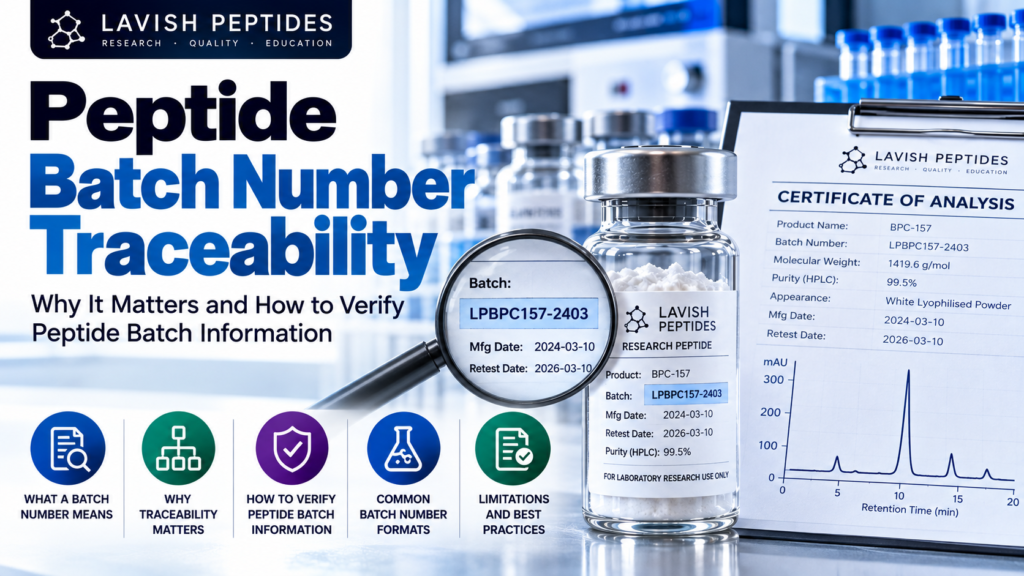
What Is a Peptide Batch Number?
A batch number is an identifier assigned to a defined quantity of material that is treated as a batch under the supplier’s or manufacturer’s documentation system. Depending on the organisation and process, a batch may be associated with a particular manufacturing run, production stage, preparation process or controlled grouping of material.
The format varies between organisations. A batch identifier might contain letters, numbers, a date code or an internal reference. There is no single universal format that every peptide supplier must use.
For example, an illustrative identifier might be LP-PEP-2604-018. The characters could represent an internal product category, a date-related code and a sequence number. However, the meaning of each section depends entirely on the organisation’s documented system.
Do not assume a batch number contains a manufacturing date, purity value or laboratory result unless the supplier explains that format.
A batch number is also different from a product name, catalogue number, order number or individual vial number. These identifiers may be related, but they serve different purposes.
Why Peptide Batch Number Traceability Matters
Peptide batch number traceability creates a documented connection between a material and the records associated with it. That connection can support quality reviews, laboratory recordkeeping, investigations and the identification of affected material if a discrepancy is discovered.
1. Connecting a Sample to Its Analytical Report
A COA may list the product name, batch identifier, analytical method and reported results. Matching the batch number on the document to the label helps establish whether the report is intended to apply to the material under review.
A document containing the correct peptide name but a different batch number should not automatically be treated as evidence for the sample in hand.
2. Supporting Investigations
If a laboratory notices an unexpected analytical result, a clear batch reference can help staff retrieve the relevant documentation. Depending on the recordkeeping system, that may include sample receipt information, testing records, storage information, handling history and supplier correspondence.
Traceability makes an investigation more organised, although it cannot by itself determine the cause of a problem.
3. Distinguishing Between Batches
The same peptide product may be supplied in multiple batches over time. Analytical results from one batch should not automatically be attributed to another.
For example, a report for Batch A does not establish the identity or purity of Batch B simply because both labels display the same product name. Each batch needs to be connected to the appropriate supporting records.
4. Improving Recordkeeping
A consistent identification system reduces ambiguity when documents are stored, reviewed or retrieved. It also helps researchers document which material was used in a particular laboratory procedure.
These are the practical reasons peptide batch number traceability matters: it creates a reliable route between the material and its supporting documentation rather than relying on a product name alone.
How Peptide Batch Number Traceability Works
A traceable documentation process should make it possible to follow the identifier through the relevant records. The exact process varies by organisation, but the following steps provide a useful framework for reviewing it.
Step 1: Check the Label on the Material
Start by recording the product name and batch number exactly as printed on the container or its associated label. Avoid changing punctuation, omitting leading zeros or assuming that similar-looking codes are interchangeable.
Also note other available information, such as the supplier, container identifier, receipt date and storage instructions.
If a label is damaged, missing or difficult to read, document the discrepancy and request clarification rather than guessing the identifier.
Step 2: Find the Matching Certificate of Analysis
Locate the COA or analytical report associated with that material. Compare the product name and batch number carefully.
The report may also include a test date, laboratory reference, method, specification and reported results. Check whether the document identifies the tested sample clearly enough to connect it to the labelled material.
For further guidance, read our related article on what HPLC purity means. Confirm that the URL matches the published article on your website before using it.
Step 3: Review the Analytical Details
Check which tests were performed and what each result establishes. An HPLC purity result, for example, describes the outcome of a particular chromatographic method and calculation. It does not independently prove every aspect of identity, content or sample quality.
If identity is important to the laboratory’s purpose, look for appropriate supporting evidence, such as mass spectrometry or another suitable identity test. The required evidence depends on the material, method and intended analytical use.
Step 4: Compare Related Records
Where applicable, compare the batch identifier against the supplier’s dispatch documents, sample receipt records, laboratory inventory and internal sample logs.
Not every organisation will have every type of record, and a simple research-material supply chain may differ from a regulated pharmaceutical manufacturing system. The important point is that available records should be consistent and their relationships should be understandable.
Step 5: Record Any Discrepancy
If the identifier is missing, inconsistent or unclear, record the exact issue and request written clarification from the responsible supplier or laboratory.
Do not silently edit a document to make two batch numbers match. Preserve the original record and document any correction or clarification through an appropriate, auditable process.
How to Check a Peptide Batch Number Against a COA
When reviewing documentation, use a structured comparison rather than relying on a visual impression.
| Detail to check | What to look for |
|---|---|
| Product name | Does it match the material label? |
| Batch or lot number | Is the identifier consistent across the label and report? |
| Sample reference | Is there a laboratory sample ID linking the test to the material? |
| Test date | Is the date documented and plausible for the stated analysis? |
| Analytical method | Is the method identified clearly enough to understand the result? |
| Reported results | Are the units and test names stated? |
| Acceptance criteria | Are specifications or limits provided where relevant? |
| Issuing laboratory | Is the organisation responsible for the report identified? |
| Document integrity | Are there unexplained alterations, missing pages or inconsistent details? |
Not every COA will contain all these fields. Their absence does not automatically prove misconduct, but it may limit how confidently the report can be interpreted. Ask for clarification where important information is missing.
For a more detailed explanation of analytical documentation, see our guide on how to read a peptide certificate of analysis. Verify that the link matches the live page before publishing.
Common Peptide Batch Number Formats
Batch identifiers are designed by individual organisations, so formats can differ substantially. Common approaches include:
- Alphanumeric codes: A combination of letters and numbers assigned by an internal system.
- Sequential identifiers: A unique sequence number associated with a defined batch.
- Date-related codes: Codes that incorporate a date or production period, if the organisation’s system specifies that meaning.
- Product-linked codes: Identifiers that combine an internal product code with a batch sequence.
These formats are examples, not universal standards. A date-looking sequence does not prove when a material was manufactured, and a longer identifier is not automatically more reliable than a shorter one.
For good peptide batch number traceability, the key requirement is not a particular code format. It is the ability to connect the identifier consistently to relevant records and explain how the system works.
Warning Signs to Investigate
Some documentation problems deserve closer attention. They do not all prove that a material is defective or that a document is fraudulent, but they should not be ignored.
A Missing Batch Number
If the material has no identifiable batch reference, it may be difficult to connect it to a specific analytical report. Ask the supplier how the material is identified and what documentation applies to it.
Different Numbers on the Label and COA
A mismatch may reflect a clerical error, a sample-reference distinction or a more significant documentation problem. Do not assume which explanation is correct. Request a documented clarification that establishes the relationship between the material and the report.
Generic Reports Without Sample Identification
A general analytical report may describe a product type without demonstrating that the exact batch under review was tested. Check whether the document explicitly identifies the batch or provides a reliable reference linking the sample to the report.
Unclear Test Information
A report that lists a purity percentage without explaining the method, units or calculation may provide limited information. The suitability of a report depends on what is being assessed and what evidence the laboratory requires.
Unexplained Document Changes
Inconsistent dates, altered identifiers or conflicting versions should be clarified. Keep original records and request a clear explanation rather than relying on an edited screenshot or an unverified replacement document.
What Batch Traceability Does Not Prove
A batch number is a recordkeeping tool, not a quality certificate in itself. Even when the identifier is consistent across several documents, additional evidence may be needed to evaluate the material.
Batch traceability alone does not prove:
- That the peptide’s molecular identity has been independently confirmed.
- That the reported purity accurately represents every component in the sample.
- That the total peptide content or concentration is correct.
- That the material is free from every possible impurity.
- That storage and transport conditions were appropriate.
- That the material is sterile or meets any particular endotoxin specification.
- That a research compound is authorised or suitable for human use.
These questions require appropriate evidence and methods. For example, a chromatographic purity result and a molecular identity test answer different analytical questions.
The European Medicines Agency’s guidance on synthetic peptide development and manufacture provides additional context on peptide characterisation, specifications and analytical control. It is useful background for understanding why one identifier or one analytical result cannot establish every quality attribute.
Best Practices for Maintaining Traceable Peptide Records
Good recordkeeping should be clear, consistent and proportionate to the laboratory’s work.
- Record identifiers exactly. Preserve the complete batch number, including letters, punctuation and leading zeros.
- Keep related documents together. Make it easy to retrieve the relevant COA, receipt record and other supporting documentation.
- Use separate fields for separate identifiers. Do not confuse product codes, batch numbers, order numbers and laboratory sample IDs.
- Record discrepancies. Document mismatches and retain the clarification received from the responsible organisation.
- Avoid unsupported assumptions. Do not infer a manufacturing date, purity value or test outcome from the code format itself.
- Maintain an appropriate audit trail. Where records are corrected, retain the original information and document the correction according to the organisation’s procedures.
- Review the evidence as a whole. Combine traceability information with relevant analytical results and specifications.
These practices help make peptide batch number traceability useful in day-to-day laboratory documentation and later review.
Frequently Asked Questions
What Is Peptide Batch Number Traceability?
Peptide batch number traceability is the ability to connect a labelled peptide batch to its relevant documentation, such as analytical reports, certificates of analysis, receipt records and other applicable records.
Is a Batch Number the Same as a Product Number?
No. A product number generally identifies a product or catalogue entry, while a batch number identifies a particular batch of material. An order number and a laboratory sample ID may serve different purposes again.
Does Every Peptide Batch Have a Unique Number?
Batch identification systems vary by organisation. A well-controlled system should distinguish the relevant batches sufficiently for its intended recordkeeping and quality purposes. The precise format and uniqueness rules depend on that system.
Can a Batch Number Prove Peptide Purity?
No. A batch number helps link a material to its records, but it does not establish purity. Purity claims need appropriate analytical evidence associated with the relevant material and method.
What Should I Do if the Batch Number on a COA Does Not Match the Label?
Do not assume the report applies to the material. Contact the responsible supplier or laboratory, describe the discrepancy and request a documented explanation linking the report to the sample, if that link can be established.
Why Is Batch Traceability Important for Laboratory Research?
It helps researchers identify the material used, retrieve related records and investigate discrepancies. It also supports more reliable laboratory documentation, although it does not replace analytical testing or other quality controls.
Conclusion
Peptide batch number traceability helps establish a documented connection between a specific material and the records used to describe or assess it. By comparing labels, certificates of analysis, sample references and relevant laboratory records, researchers can identify inconsistencies and understand what evidence is available for the batch under review.
The most important principle is to treat the batch number as a link to evidence, not as proof of quality on its own. Reliable documentation combines consistent identifiers with suitable analytical results, clear methods and transparent records. If a number is missing or does not match, seek documented clarification before drawing conclusions about the material.
For more laboratory-focused educational content, visit the Lavish Peptides blog.
This article is for laboratory education only. It is not medical advice and does not establish that any product is authorised or suitable for human use.
Peptide batch number traceability is an essential part of reliable laboratory documentation because it connects a specific research material to its supporting records. By understanding peptide batch number traceability, researchers can compare product labels, batch identifiers, certificates of analysis (COAs) and analytical reports to check whether the documentation refers to the material being reviewed.
Effective peptide batch number traceability helps distinguish one batch from another, supports the investigation of documentation discrepancies and makes relevant laboratory records easier to retrieve. When reviewing peptide batch number traceability, researchers should confirm that the batch number on the material matches the identifier on the associated COA and investigate any unexplained differences before relying on the report.
However, peptide batch number traceability should never be confused with proof of purity, identity or overall quality. A matching batch number does not independently confirm that a peptide has the stated molecular identity, that its reported purity is accurate or that every relevant impurity has been assessed. Instead, peptide batch number traceability provides the documentation link needed to review the appropriate analytical evidence.
For better peptide batch number traceability, keep identifiers consistent, retain relevant records, document discrepancies and request clarification when information is missing. These practices help improve peptide batch number traceability throughout sample receipt, laboratory storage, analytical review and research recordkeeping.
Ultimately, peptide batch number traceability is most useful when it is supported by clear documentation, appropriate analytical methods and transparent reporting. Researchers should use peptide batch number traceability alongside suitable identity testing, purity results and other relevant quality information rather than treating the batch number as a guarantee of quality.
For additional guidance, explore the Lavish Peptides blog and our educational articles on HPLC purity and peptide purity versus peptide content.
This article is intended for laboratory education only. It is not medical advice and does not establish that any product is authorised or suitable for human use.
