
How to Check a Peptide Certificate of Analysis: A Complete Guide
Knowing how to check a peptide certificate of analysis (COA) is important when reviewing laboratory materials and their accompanying quality documentation. A COA summarises information about a sample, the tests performed and the results reported. However, simply receiving a document with a laboratory logo and a purity percentage does not establish that every claim has been verified.
A useful COA review involves checking the product and batch identifiers, understanding the analytical methods, examining the reported results and identifying information that may be missing. It also means understanding the limits of the evidence: a chromatographic purity result, for example, does not automatically prove molecular identity, total peptide content or every aspect of sample quality.
This guide explains how to check a peptide certificate of analysis systematically, what the key sections mean, which warning signs deserve further investigation and how to assess the document without drawing conclusions beyond the available evidence.
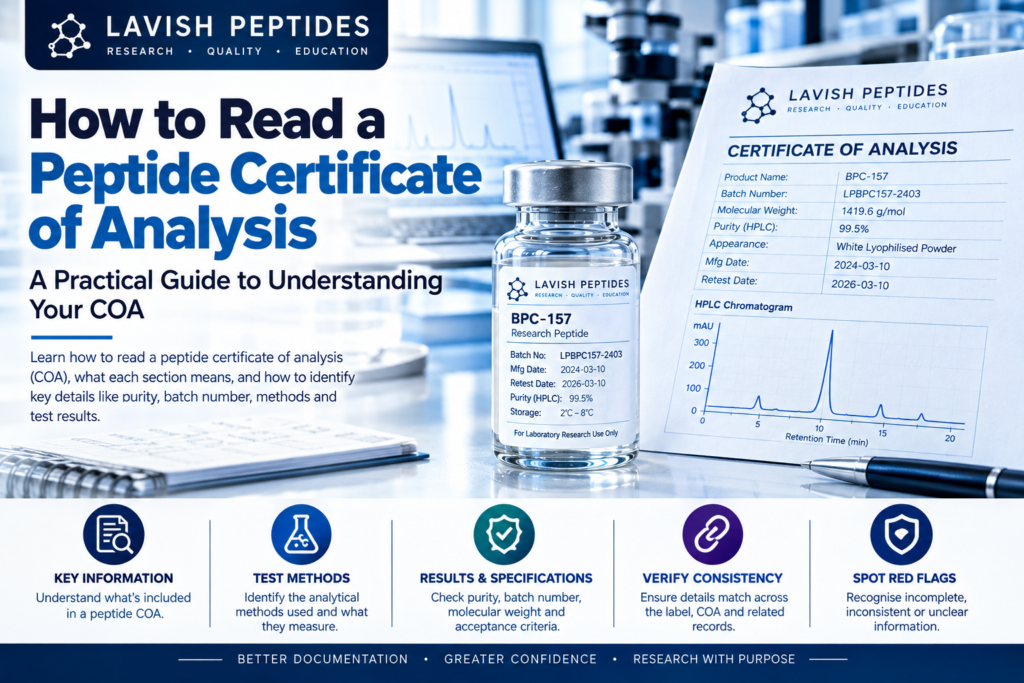
Table of Contents
- What is a peptide certificate of analysis?
- Check the product name and batch number
- Verify the laboratory and test dates
- Understand the analytical methods
- Interpret purity and other reported results
- Check specifications and acceptance criteria
- Look for missing information and inconsistencies
- Understand what a COA cannot prove
- Use a practical COA verification checklist
- Frequently asked questions
1. What Is a Peptide Certificate of Analysis?
A certificate of analysis is a document that reports test information for a defined material or sample. Depending on the supplier, manufacturer, laboratory and applicable quality system, it may contain identification details, analytical methods, test results, specifications and information about the organisation issuing the report.
For synthetic peptides, a COA may include high-performance liquid chromatography (HPLC) results, mass spectrometry data, appearance, sample identifiers or other tests relevant to the material.
The exact contents vary. There is no single universal COA template that includes every test for every peptide.
When learning how to check a peptide certificate of analysis, start by asking what the document actually covers. Does it report a test on a specific batch, summarise selected results, or provide general product information? The answer affects what conclusions the document can support.
A COA is most useful when its results can be connected clearly to the material being reviewed and the methods are appropriate for the claims being made.
2. Check the Product Name and Batch Number
The first step is to confirm that the document refers to the correct material.
Match the product name
Compare the product name on the COA with the name on the container label and associated paperwork. Similar names are not necessarily interchangeable, particularly when different peptide sequences, formulations or combinations are involved.
If the name is abbreviated, ask whether the abbreviation has a documented meaning. Do not assume that two products are equivalent merely because their names look similar.
Match the batch or lot number
A batch number connects the material to its associated records. Check that the number on the COA matches the number on the material label, taking care to preserve letters, punctuation and leading zeros.
A mismatch does not automatically prove that a document is invalid. It could reflect a clerical error or a distinction between a batch identifier and a laboratory sample reference. Nevertheless, the discrepancy needs a documented explanation before the report can confidently be linked to the material.
Distinguish batch numbers from sample numbers
A laboratory may assign a separate sample ID when receiving or testing material. That number can legitimately differ from the supplier’s batch number, provided the records establish the relationship between them.
For more background, read our guide on peptide batch number traceability. Verify the URL against the published article on your website before adding the link.
3. Verify the Laboratory and Test Dates
The organisation responsible for the testing should be identifiable. Look for the laboratory name, contact or address information where provided, report reference and any relevant accreditation details.
If a report claims that testing was performed by an independent laboratory, ask whether the issuing laboratory can confirm the report and whether the scope of any stated accreditation covers the relevant test. A logo or accreditation symbol alone is not enough to establish that a particular analysis was covered by an accredited scope.
Check the dates carefully
A COA may include several different dates:
- Manufacturing or preparation date: When the material was produced or prepared, if reported.
- Sample receipt date: When the laboratory received the sample, if reported.
- Test date: When the analysis was performed.
- Report date: When the results were issued.
- Retest or expiry date: A date defined by the relevant documentation system, where applicable.
These dates serve different purposes. A report date is not automatically a manufacturing date, and a retest date does not independently prove stability under every storage condition.
If dates appear inconsistent or important dates are missing, request clarification rather than trying to infer the intended meaning.
4. Understand the Analytical Methods
One of the most important parts of a COA is the description of the tests performed. A result is meaningful only in the context of the method that produced it.
HPLC: Chromatographic purity assessment
High-performance liquid chromatography separates components in a sample. A detector records signals as the components pass through the system, producing a chromatogram.
A COA may report an HPLC purity percentage calculated from integrated peak areas. This can be useful for assessing chromatographic purity under the method used, but the result depends on factors such as separation, detector response, integration and the peaks included in the calculation.
An HPLC purity result should not automatically be interpreted as the percentage of the entire sample by mass. Nor does a high percentage prove that every impurity has been detected or that the main peak has been unambiguously identified.
Read our related guide on what HPLC purity means for a more detailed explanation of chromatograms and area-based results.
Mass spectrometry: Mass and identity-related evidence
Mass spectrometry measures ions according to their mass-to-charge ratios. Depending on the method, it can support an assessment of molecular mass and contribute to peptide identity investigations.
However, a matching mass does not necessarily establish every aspect of molecular structure. Some different structures can have the same or similar mass, so additional analytical evidence may be needed.
Other tests
Depending on the material and purpose, a COA may report other analyses. The relevant methods might assess peptide content, particular impurities, water content, counter-ions or other specified characteristics.
Do not assume a test has been performed just because it would be useful. Look for the test name, result, units and method details in the document.
The European Medicines Agency’s guidance on the development and manufacture of synthetic peptides provides additional context on peptide characterisation, analytical control and impurity assessment.
5. Interpret Purity and Other Reported Results
A COA should be read result by result rather than judged by its largest or most impressive number.
Understand what the purity percentage represents
Suppose an illustrative report states that a sample has an HPLC area percentage of 97%. That number describes the result of the stated chromatographic calculation. It does not automatically mean that 97% of the entire sample’s mass is the target peptide.
Different substances may produce different detector responses. Some components may be poorly detected under the method used, while co-eluting compounds may contribute to the same apparent peak.
When reviewing the result, check whether the method and calculation are explained and whether the reported value is compared with a defined specification.
Check units and measurement basis
A number without units or a clear measurement basis may be difficult to interpret. Percentage, mass concentration, molar concentration and detector area percentage describe different things.
For example, a purity percentage and a peptide content result are not interchangeable. Purity concerns the analytical result defined by the method; content concerns how much of the specified material is present according to an appropriate measurement.
Our article on peptide purity versus peptide content explores this distinction.
Do not ignore unexpected results
A result that differs from an expected value is not automatically proof of a defective sample. It should be assessed against the method, stated specification, measurement uncertainty where available and relevant supporting information.
If a result is unclear, ask the issuing organisation to explain the method, calculation or acceptance criteria.
6. Check Specifications and Acceptance Criteria
A result is easier to interpret when the report states the relevant specification or acceptance criterion. These indicate the requirement against which a test result is assessed.
For example, a document may list a test, a specified limit and the measured result. Check that the result is presented clearly and that the relationship between the result and the criterion is understandable.
Do not assume that a value is acceptable simply because it looks high or appears in bold. The appropriate limit depends on the material, intended analytical purpose and applicable quality requirements.
Also distinguish between a reported result and a pass/fail statement. If a COA says “pass” but does not show the underlying result or the criterion, you may need additional information to understand what was assessed.
A well-presented report should make its claims and their basis clear enough for a reviewer to understand the result without relying on guesswork.
7. Look for Missing Information and Inconsistencies
A structured review can reveal issues that are easy to miss when focusing only on the purity percentage.
Look more closely when:
- The product name does not match the label.
- The batch number is absent or inconsistent.
- The laboratory responsible for the report is unclear.
- The method used for a reported result is not identified.
- Results are given without units or a clear measurement basis.
- Acceptance criteria are missing where they are needed to interpret the claim.
- Dates appear inconsistent or unexplained.
- The report appears incomplete or contains unexplained alterations.
- A general report is presented as proof that a particular batch was tested, but no reliable link to that batch is provided.
These warning signs do not automatically prove fraud, poor quality or an invalid result. They identify questions that should be resolved before the document is relied upon.
If clarification is required, keep the original document, record the discrepancy and request a written explanation from the responsible supplier or laboratory. Avoid editing a report to make inconsistent details appear to match.
8. Understand What a COA Cannot Prove
Knowing how to check a peptide certificate of analysis also means recognising its limits.
A COA is only as informative as its scope, methods and connection to the material. It does not automatically establish every quality attribute that a researcher might want to know.
Depending on the tests reported, a COA may not establish:
- Complete molecular identity or amino-acid sequence.
- Total peptide content or concentration.
- The absence of every possible impurity.
- Sterility or endotoxin status.
- Appropriate storage and transport throughout the material’s history.
- Long-term stability under conditions that were not studied.
- Authorisation or suitability for human use.
These attributes require appropriate evidence and methods. A purity result cannot substitute for an identity test, and a batch identifier cannot substitute for analytical evidence.
For laboratory research, the most defensible approach is to identify exactly what was tested, how it was tested, what the result means and what remains unverified.
9. Practical Checklist: How to Check a Peptide Certificate of Analysis
Use this checklist when reviewing a COA:
- Confirm that the product name matches the material label.
- Match the batch number or establish the documented link to the laboratory sample ID.
- Identify the issuing laboratory and relevant report reference.
- Review the test, report and other relevant dates.
- Identify the analytical methods used.
- Check the result, units and measurement basis for each test.
- Understand how the purity percentage was calculated.
- Review the stated specifications and acceptance criteria.
- Check whether identity testing and other relevant quality attributes were assessed.
- Investigate unexplained discrepancies or missing information.
- Retain the original report and any written clarification.
This process makes COA review more consistent and reduces the risk of treating one number as proof of overall quality.
Frequently Asked Questions
How do I check whether a peptide COA matches the product?
Compare the product name and batch number on the COA with the label. If the laboratory uses a separate sample ID, look for documentation connecting that sample ID to the batch. Request written clarification for unexplained mismatches.
Does a high HPLC purity percentage mean a peptide is completely pure?
No. An HPLC area percentage describes the result of a particular analytical method and calculation. It does not automatically establish mass percentage, complete identity or the absence of all impurities.
Should a peptide COA include mass spectrometry?
The appropriate tests depend on the material, the purpose of the analysis and the applicable specification. Mass spectrometry can provide useful mass-related and identity-related evidence, but the absence or presence of one particular test must be evaluated in context.
Can I trust a COA just because it has a laboratory logo?
A logo alone is not verification. Check the issuing organisation, report details, batch information, methods and results. Where necessary, contact the laboratory using independently verified contact information to ask whether it issued the report.
What should I do if a COA has no batch number?
Ask the responsible supplier or laboratory how the report is linked to the material. Without a clear link, you may not be able to establish that the results apply to the specific batch under review.
Is a COA proof that a peptide is suitable for human use?
No. A COA reports selected analytical information; it does not establish regulatory authorisation or suitability for human use. The scope of the document and the tests performed must be considered carefully.
Conclusion: How to Check a Peptide Certificate of Analysis Correctly
Learning how to check a peptide certificate of analysis means looking beyond the headline purity percentage. Verify the product and batch identifiers, identify the laboratory and methods, examine the results and units, and check the specifications against which the results are interpreted.
Most importantly, distinguish between what the COA demonstrates and what remains unverified. HPLC, mass spectrometry and other analytical methods provide different types of evidence, and no single number automatically proves every aspect of sample quality. When information is missing or inconsistent, request documented clarification instead of making assumptions.
A careful, evidence-based COA review supports better laboratory recordkeeping and more informed evaluation of research materials. For more educational information, visit the Lavish Peptides blog.
This article is for laboratory education only. It is not medical advice and does not establish that any product is authorised or suitable for human use.
Learning how to check a peptide certificate of analysis is essential for understanding what laboratory documentation actually proves. A thorough review starts with confirming the product name, matching the batch number, identifying the testing laboratory and checking that the reported results relate to the material being assessed. Knowing how to check a peptide certificate of analysis also means reviewing the methods used, understanding the reported units and checking whether the results are supported by clear acceptance criteria.
When considering how to check a peptide certificate of analysis, do not rely on a purity percentage alone. HPLC results can help assess chromatographic purity under specified conditions, while mass spectrometry can provide evidence about molecular mass and support identity investigations. Understanding how to check a peptide certificate of analysis requires recognising that these methods measure different properties and that neither automatically proves every aspect of sample quality.
A reliable approach to how to check a peptide certificate of analysis includes examining the document for missing information, inconsistent identifiers, unclear test methods and unexplained dates. If the batch number on the COA differs from the label, request documented clarification instead of assuming that the report applies to the material. Knowing how to check a peptide certificate of analysis helps researchers identify these gaps before relying on the accompanying documentation.
Ultimately, how to check a peptide certificate of analysis comes down to evaluating the evidence as a whole. Confirm the sample details, understand the analytical results, review the relevant specifications and establish which quality attributes remain unverified. A careful approach to how to check a peptide certificate of analysis supports better laboratory recordkeeping and more informed evaluation of research materials.
For further educational guidance, visit the Lavish Peptides blog and explore our articles on HPLC purity and peptide batch number traceability.
This article is for laboratory education only. It is not medical advice and does not establish that any product is authorised or suitable for human use.
