
What Is Peptide Lyophilisation? A Complete Guide
What is peptide lyophilisation, and why is it used in laboratory research? Peptide lyophilisation is a freeze-drying process that removes water from a frozen material under controlled conditions, usually by converting ice directly into water vapour under reduced pressure. It is widely used in pharmaceutical and biochemical settings because removing water can help produce a dry material that is easier to handle, package and store when the formulation and process are appropriately designed.
However, freeze-drying is not a guarantee of stability. A peptide’s behaviour depends on its sequence, formulation, moisture content, processing conditions, packaging and storage environment. Understanding what is peptide lyophilisation therefore means looking beyond the white powder in a vial and understanding the science behind the process, its benefits and its limitations.
This guide explains how lyophilisation works, why peptides may be freeze-dried, how the main processing stages differ, and what researchers should consider when interpreting product and laboratory documentation.
Why Understanding Peptide Lyophilisation Matters
Understanding what is peptide lyophilisation helps explain why freeze-drying is used to remove water from certain peptide preparations. The process can support stability, but the outcome depends on the peptide, formulation and drying conditions.
What Is Peptide Lyophilisation During the Drying Process?
When considering what is peptide lyophilisation, it is important to understand the three main stages: freezing, primary drying and secondary drying. Each stage has a specific purpose, and process conditions must be appropriate for the material being processed.
How Does Peptide Lyophilisation Affect Stability?
Knowing what is peptide lyophilisation helps researchers understand why removing water may improve the storage stability of some peptide formulations. However, freeze-drying does not guarantee stability, purity or identity, so suitable analytical testing remains important.
What Is Peptide Lyophilisation Not Designed to Prove?
The answer to what is peptide lyophilisation does not establish the purity or identity of a peptide. These properties require appropriate analytical methods and supporting documentation, such as a certificate of analysis (COA).
Factors to Consider After Lyophilisation
Researchers exploring what is peptide lyophilisation should also consider residual moisture, packaging, storage conditions and the characteristics of the specific peptide. These factors can influence stability, so product-specific documentation should guide any conclusions.
Frequently Asked Question: What Is Peptide Lyophilisation?
What is peptide lyophilisation? It is a freeze-drying process that removes frozen water through sublimation, followed by further drying to reduce remaining moisture. Its suitability and effect on stability depend on the formulation and process conditions.
Why Are Peptides Lyophilised?
Peptides are chains of amino acids, and their chemical and physical properties vary with sequence, length, structure and formulation. In a water-containing environment, some peptides may be susceptible to hydrolysis, oxidation, aggregation or other forms of degradation. The relevant pathways depend on the specific peptide and conditions.
Removing water can reduce some moisture-related degradation pathways and can make a material more practical to package and transport. Nevertheless, a dry peptide can still degrade, and a lyophilised product is not automatically stable at room temperature.
Common reasons for using peptide lyophilisation include:
- Reducing water content: Removing most of the water from the formulation.
- Supporting storage stability: Potentially slowing certain degradation processes when the formulation and storage conditions are suitable.
- Improving handling: Producing a dry material that can be packaged in a sealed container.
- Supporting transport: Making some formulations more practical to ship than their liquid counterparts.
- Providing a defined starting material: Creating a dry preparation for subsequent laboratory procedures where appropriate.
The benefit depends on the material and process. Freeze-drying should be considered one part of a broader quality and stability strategy rather than a substitute for analytical testing or suitable storage.
How Does Peptide Lyophilisation Work?
A typical freeze-drying process has three main stages: freezing, primary drying and secondary drying. The exact temperatures, pressures and durations depend on the formulation, equipment and process design.
1. Freezing
The liquid formulation is cooled until it freezes. Ice crystals form, while dissolved substances and the peptide become concentrated in the remaining unfrozen regions before the system becomes fully solid or glassy, depending on its composition.
Freezing conditions can influence ice-crystal size and the structure of the dried material. These characteristics can affect how easily water vapour moves through the product during drying.
Freezing is not always a harmless step. Some materials can experience concentration-related effects, changes in pH within the frozen matrix or other stresses during freezing. Formulation development may therefore include studies to determine whether the peptide retains its required characteristics after processing.
2. Primary Drying
During primary drying, pressure is reduced and energy is supplied under controlled conditions. Ice sublimes and the resulting water vapour is removed by the equipment’s condenser system.
This stage often accounts for a substantial portion of the drying time. Product temperature must be managed carefully because excessive heat can cause the frozen matrix to soften or collapse, potentially affecting the physical structure and quality of the dried material.
The drying conditions must allow ice to be removed without exposing the formulation to unsuitable temperatures or other damaging conditions.
3. Secondary Drying
After most of the ice has been removed, secondary drying helps reduce residual water that remains associated with the dried matrix. This may involve adjusting temperature and pressure under controlled conditions.
Residual moisture matters because it can influence stability, physical properties and storage behaviour. However, there is no single residual-moisture value that is appropriate for every peptide formulation. The target should be established for the particular material and its intended use.
Together, these stages explain the basic science behind what is peptide lyophilisation: freezing the formulation, removing ice by sublimation and reducing residual moisture to achieve the desired dried product.
Further Reading: Peptide Lyophilisation and Quality Control
For a deeper understanding of freeze-drying, the US Food and Drug Administration (FDA) provides a technical overview of lyophilisation and freeze-drying. It explains the main stages of the process, including freezing, primary drying and secondary drying, and discusses factors that can affect product quality.
For synthetic peptide manufacturing, the European Medicines Agency’s guideline on the development and manufacture of synthetic peptides provides additional information about manufacturing, characterisation, specifications and analytical control.
These resources help explain why lyophilisation must be evaluated alongside suitable analytical testing and product-specific stability information.
What Is the Difference Between Lyophilised and Liquid Peptides?
The main difference is the physical state and water content of the formulation. A lyophilised peptide is supplied in a dried form, while a liquid formulation contains the peptide dissolved or dispersed in a liquid.
| Feature | Lyophilised preparation | Liquid preparation |
|---|---|---|
| Physical state | Dried solid or cake | Solution or suspension |
| Water content | Reduced through drying | Contains a liquid phase |
| Storage needs | Depend on formulation, packaging and stability data | Depend on formulation and stability data |
| Handling | May require preparation before certain laboratory procedures | May be ready for a specified procedure |
| Stability | Can improve for some formulations, but must be demonstrated | Depends on the peptide, solvent, pH and other factors |
Neither form is universally superior. Some peptides and formulations may benefit from freeze-drying, while others may be stable and suitable in liquid form. The appropriate form depends on evidence from formulation and stability studies.
A lyophilised material may require reconstitution for a particular laboratory procedure. Reconstitution introduces a liquid phase and changes the conditions experienced by the peptide, so the stability information for the dried product should not automatically be applied to the reconstituted preparation.
Does Lyophilisation Guarantee Peptide Purity?
No. Lyophilisation removes water under controlled conditions; it does not inherently remove every impurity or prove the identity of the peptide.
If a starting formulation contains impurities, the drying process does not automatically eliminate them. Depending on the process, some components may remain in the dried product. Likewise, a white powder or an intact-looking cake does not establish chemical purity.
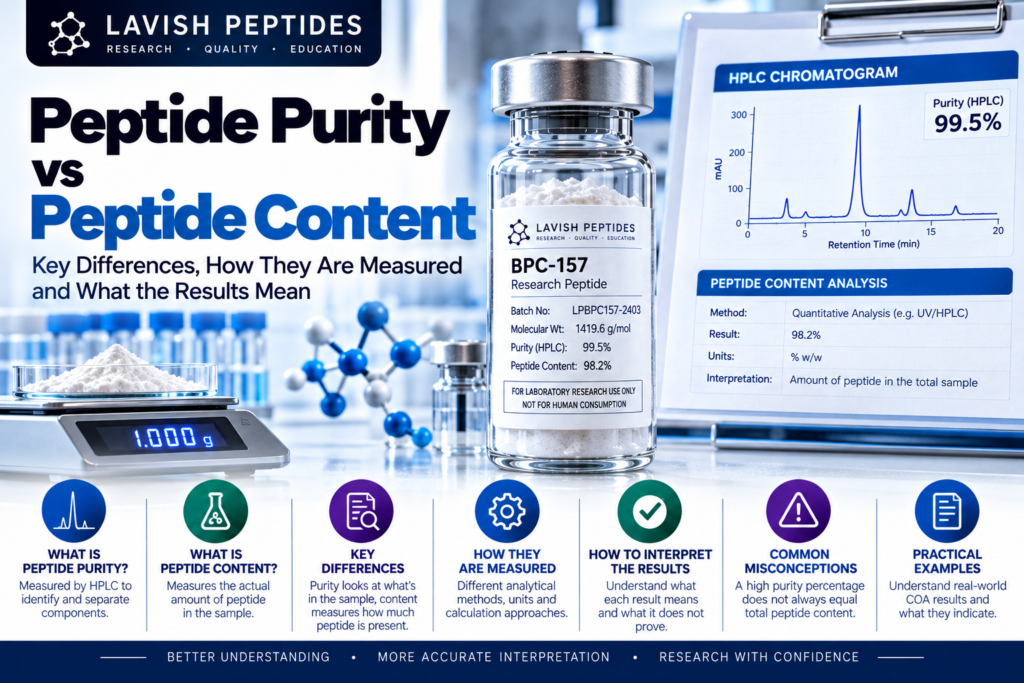
Purity and identity require appropriate analytical evidence. High-performance liquid chromatography (HPLC) may be used to assess chromatographic purity, while mass spectrometry can provide information about molecular mass and support identity investigations. These methods answer different questions and have their own limitations.
For more detail, read our related guides on what HPLC purity means and peptide purity versus peptide content. Check the live URLs on your website before publishing.
A reliable assessment considers the relevant analytical results, sample identification and documentation rather than assuming that the drying process itself confirms quality.
What Factors Affect the Quality of a Lyophilised Peptide?
The quality of a freeze-dried peptide depends on more than whether the product has been dried. Several variables can influence its physical and chemical characteristics.
Formulation
The peptide’s sequence, concentration, pH and other formulation components can influence how it behaves during freezing and drying. Some formulations include stabilising excipients, but their suitability must be evaluated for the particular material.
Freezing and Drying Conditions
Cooling rate, product temperature, pressure and drying duration can affect the resulting material. Poorly controlled conditions may cause structural changes or leave more residual moisture than intended.
Residual Moisture
Water remaining in a dried product can influence chemical reactions and physical stability. The significance depends on the peptide and formulation; less moisture is not automatically better in every respect if other quality attributes are compromised.
Container and Packaging
The packaging must protect the material against relevant environmental factors. Moisture ingress, oxygen exposure, light or unsuitable closure integrity may affect stability, depending on the formulation.
Storage Conditions
Temperature, humidity, light exposure and repeated temperature fluctuations can influence a product’s condition. Storage instructions should come from appropriate product-specific documentation, not from a general assumption that all lyophilised peptides have the same requirements.
These factors help explain why lyophilisation is a process that requires development and control rather than simply freezing a solution and removing the water.
How Can Researchers Assess a Lyophilised Peptide?
When reviewing a dried peptide for laboratory purposes, consider the available documentation and the tests relevant to the research objective.
Useful checks may include:
- Identity information: Confirm that the product name and sample or batch reference are clear.
- Analytical testing: Review suitable identity and purity results, where provided.
- Moisture-related testing: Check whether residual water is measured when it is relevant to the specification.
- Appearance: Record visible changes, while recognising that appearance alone cannot establish purity.
- Packaging integrity: Check for damage or evidence that the container may not have remained sealed.
- Storage history: Review whether the documented storage conditions are consistent with the supplier’s instructions.
- Traceability: Ensure that the analytical report can be linked to the material being assessed.
The appropriate tests depend on the product, purpose and applicable quality requirements. A certificate of analysis may provide some of this information, but it should not be assumed to cover every characteristic.
For more guidance, see our article on peptide batch number traceability and our guide on how to check a peptide certificate of analysis. Verify these internal links against the actual published pages.
Common Misconceptions About Peptide Lyophilisation
“Freeze-Dried Means Stable Forever”
It does not. Lyophilisation may improve stability for a particular formulation, but the product can still degrade during storage. Stability must be supported by appropriate data and conditions.
“A White Powder Proves Purity”
Appearance is not a reliable standalone purity test. Different substances can look similar, and impurities may not be visible. Analytical testing is needed to assess relevant quality attributes.
“Every Lyophilised Peptide Should Be Stored the Same Way”
Storage requirements vary. Follow the conditions established for the specific material and its packaging rather than applying a universal temperature rule.
“Reconstituted Material Has the Same Stability as the Dry Product”
Not necessarily. Once a dried material is dissolved or otherwise reconstituted, its chemical environment changes. Stability and handling instructions for the resulting preparation may differ from those for the unopened dry product.
“Lyophilisation Removes All Contaminants”
Freeze-drying is primarily a water-removal process. It is not a universal purification method and does not replace suitable testing for impurities or contamination.
Frequently Asked Questions
What is peptide lyophilisation in simple terms?
Peptide lyophilisation is freeze-drying: a process that freezes a formulation and removes ice by sublimation under reduced pressure, followed by drying to reduce residual moisture.
Why are peptides freeze-dried?
Freeze-drying can help produce a dry preparation that is easier to package and may be more stable than a liquid formulation under suitable conditions. The benefit depends on the peptide, formulation, process and storage environment.
Does lyophilisation change a peptide’s structure?
The process is designed to preserve the desired characteristics of the material, but freezing and drying can stress some formulations. Whether a peptide retains its required characteristics must be evaluated with appropriate methods.
Is a lyophilised peptide always more stable than a liquid peptide?
No. Stability depends on the particular peptide and formulation. Some dried preparations may be more stable, while other materials may be adequately stable in liquid form under defined conditions.
Can lyophilisation be used to confirm purity?
No. Lyophilisation removes water; it does not independently establish chemical purity or molecular identity. Those properties require appropriate analytical evidence.
What is the difference between lyophilisation and evaporation?
Evaporation converts liquid into vapour. In primary freeze-drying, ice changes directly into vapour through sublimation under reduced pressure. The processes operate differently and can affect materials differently.
Conclusion: What Is Peptide Lyophilisation?
Understanding what is peptide lyophilisation means recognising both the science and the limits of freeze-drying. The process removes water from a frozen formulation through sublimation and controlled drying, creating a dried material that may be easier to handle, package and store.
However, lyophilisation does not guarantee purity, molecular identity or indefinite stability. The quality of the final material depends on the formulation, process conditions, packaging, storage and appropriate analytical testing. Researchers should therefore review the available documentation and use product-specific evidence when assessing a lyophilised peptide.
For more laboratory-focused educational content, visit the Lavish Peptides blog.
This article is for laboratory education only. It is not medical advice and does not establish that any product is authorised or suitable for human use.
