
Causes of Peptide Degradation: Key Factors and Prevention
The causes of peptide degradation are important to understand when evaluating the stability, quality and analytical performance of synthetic peptides. Peptides can undergo chemical reactions or physical changes during manufacturing, storage, transport and laboratory handling. These changes may affect molecular identity, purity, solubility and the reliability of experimental results.
Peptide degradation does not follow one universal pathway. The amino acid sequence, molecular structure, formulation, moisture level, temperature, pH and surrounding environment all influence how a particular peptide behaves. Recognising the causes of peptide degradation helps researchers interpret analytical results and identify which stability factors require further investigation.
This guide explains the main degradation mechanisms, the conditions that may accelerate them, how degradation can be investigated and what laboratory quality documentation can—and cannot—establish.
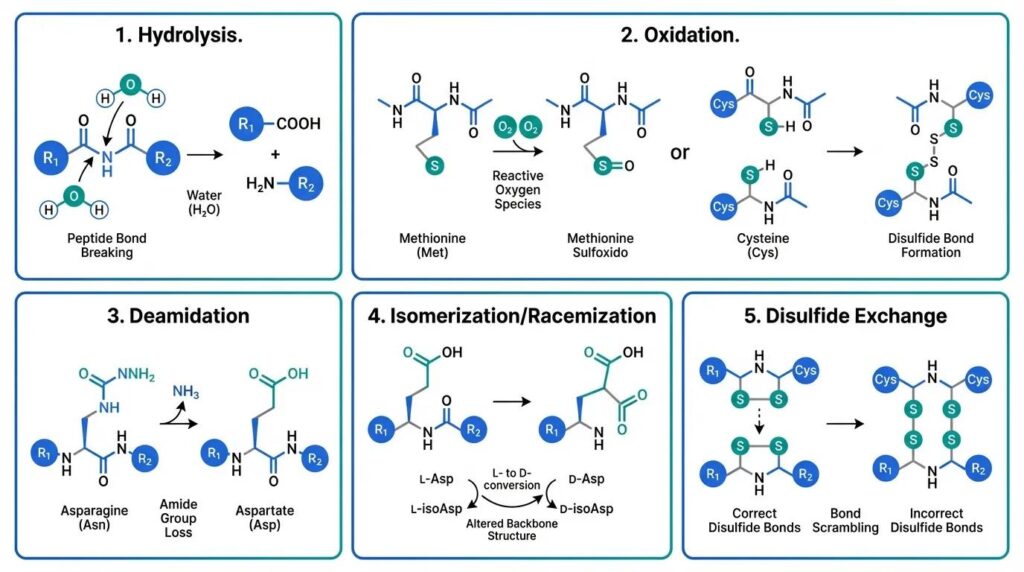
What Is Peptide Degradation?
Peptide degradation is a chemical or physical change that alters a peptide from its original state. Chemical degradation can modify amino acid side chains, break peptide bonds or change the arrangement of atoms within a molecule. Physical instability may cause peptides to aggregate, precipitate or interact with surfaces without necessarily changing their primary amino acid sequence.
These changes are not always visible. A sample can appear clear and unchanged while containing degradation products that require analytical testing to detect.
The causes of peptide degradation are commonly divided into two broad categories:
- Chemical degradation: reactions such as oxidation, hydrolysis, deamidation and isomerisation that change the molecular structure.
- Physical degradation or instability: changes such as aggregation, precipitation, adsorption and loss of solubility.
The distinction matters because different mechanisms require different analytical approaches. A single purity result or visual inspection cannot identify every possible change.
1. Oxidation
Oxidation is one of the recognised causes of peptide degradation. It involves chemical reactions that modify susceptible parts of a peptide molecule. Methionine and cysteine residues can be particularly sensitive, although other residues may also undergo oxidation depending on the molecular structure and environment.
Potential contributing factors include reactive oxygen species, certain trace-metal contaminants, light exposure and formulation components that promote oxidative reactions. The importance of each factor depends on the individual peptide and its surrounding conditions.
Oxidation may produce modified molecular species that differ from the original peptide. These changes can affect chromatographic behaviour, molecular mass or other measured properties.
What researchers should consider: Analytical methods should be appropriate for the suspected modification. High-performance liquid chromatography (HPLC) can help separate components, while mass spectrometry can provide evidence of changes in molecular mass. Neither result should be interpreted outside the context of the method and its limitations.
2. Hydrolysis and Peptide-Bond Cleavage
Hydrolysis involves a reaction with water that can break susceptible chemical bonds. In peptides, hydrolysis may cause cleavage of the backbone or changes to particular functional groups. The rate and location of these reactions depend on the sequence, molecular environment and conditions.
Acidic or alkaline environments can influence hydrolysis, although the relationship between pH and degradation is peptide-specific. Some sequences contain structural features that make particular bonds more susceptible than others.
Hydrolysis is among the important causes of peptide degradation because cleavage can produce shorter fragments or other related substances. Such products may change the chromatographic profile or create additional peaks in an analytical report.
Researchers should avoid assuming that every additional chromatographic peak represents hydrolysis. Additional peaks may arise from other chemical modifications, synthesis-related impurities or analytical artefacts. Appropriate method controls and, where needed, orthogonal testing help distinguish between these possibilities.
3. Deamidation and Isomerisation
Deamidation is a chemical modification commonly associated with asparagine and, under certain conditions, glutamine residues. It changes the relevant side-chain chemistry and may affect the charge, molecular properties or analytical behaviour of a peptide.
Isomerisation can alter the spatial or structural arrangement of a molecule without necessarily changing its overall elemental composition. Aspartic acid-containing sequences, for example, may undergo changes that produce different structural forms.
These reactions are influenced by the peptide sequence, pH, temperature and surrounding chemical environment. Consequently, the causes of peptide degradation cannot be determined from storage temperature alone; the molecule’s own chemistry also matters.
Depending on the modification, mass spectrometry may not distinguish every structural isomer because some forms have the same nominal or exact molecular mass. Additional separation methods or specialised analytical techniques may be required to investigate a suspected change.
4. Temperature and Temperature Fluctuations
Temperature can affect the rate of many chemical reactions. In general, elevated temperatures can accelerate some degradation pathways, but the magnitude of the effect varies by peptide and formulation.
Repeated temperature changes can also affect physical stability, especially where they cause condensation, moisture exposure or changes in solubility. Freezing and thawing may be relevant for certain solutions, but their effects are not identical across all peptide preparations.
Temperature is therefore one of several causes of peptide degradation to consider when reviewing a sample’s handling history.
Researchers should use storage conditions supported by product-specific stability information rather than assuming every peptide requires the same conditions. Where a temperature excursion has occurred, its significance should be assessed using the available stability data and an appropriate quality procedure.
5. Moisture and Humidity
Water can participate directly in chemical reactions and can influence molecular mobility within a material. Moisture may therefore affect both chemical stability and the physical behaviour of some peptides.
Lyophilised, or freeze-dried, material is not necessarily immune to moisture-related changes. Some dried peptide powders are hygroscopic and can absorb water from their environment. The effect depends on the formulation, packaging, humidity and characteristics of the peptide.
Moisture is one of the causes of peptide degradation that may be overlooked when a sample is assumed to be stable simply because it is a dry powder.
The European Medicines Agency’s guideline on the development and manufacture of synthetic peptides discusses moisture control, container suitability and stability assessment. These considerations support evaluating the material and its packaging together rather than treating the powder alone as the complete system.
6. pH and Formulation Conditions
The pH of a solution can influence several peptide degradation pathways, including hydrolysis, deamidation and isomerisation. However, there is no single pH that guarantees stability for every peptide.
The effects of pH depend on the amino acid sequence, the chemical groups present, the solvent system and other formulation components. A condition that is suitable for one peptide may be unsuitable for another.
Formulation conditions may also influence solubility and aggregation. Changes in ionic strength, buffer composition or concentration can affect how peptide molecules interact with each other and with their environment.
When investigating the causes of peptide degradation, researchers should consider pH alongside temperature, moisture and molecular structure. Conclusions should be based on suitable studies rather than general rules applied to all peptides.
7. Aggregation, Precipitation and Surface Adsorption
Not all peptide instability involves the breaking or formation of covalent bonds. Peptide molecules can associate with one another to form aggregates, or material may precipitate from a solution when its solubility changes.
Aggregation can be influenced by sequence, concentration, pH, ionic strength, temperature and impurities. Surface adsorption is another potential issue: some peptides can interact with the walls of containers or other laboratory materials, reducing the amount recovered for analysis.
These physical effects are among the causes of peptide degradation that may complicate laboratory measurements even when the primary peptide molecule has not undergone a chemical change.
A decrease in measured concentration does not automatically prove chemical degradation. Researchers may need to distinguish between molecular breakdown, precipitation, adsorption, incomplete recovery and analytical variation.
8. Light, Contaminants and Handling
Light can contribute to photochemical reactions in susceptible molecules or formulations. Reactive contaminants, including certain metal ions, may also influence specific degradation pathways. The relevance of these factors depends on the peptide and its environment.
Handling can introduce additional sources of uncertainty. Poorly controlled sample preparation, incompatible containers, contamination, repeated transfers or inconsistent analytical procedures may affect the observed result.
These are further causes of peptide degradation or apparent changes in sample quality, but they should not be treated as interchangeable. Contamination, for example, may introduce an additional component without chemically degrading the original peptide.
Good laboratory records help researchers distinguish genuine stability changes from issues introduced during sample preparation, storage or measurement.
How Can Researchers Detect Peptide Degradation?
Visual inspection may reveal some physical changes, such as precipitation or discolouration, but it cannot reliably establish chemical integrity. Analytical testing is needed to investigate changes that are not visible.
Common approaches include:
- HPLC or UPLC: separates components so the main peptide peak and related peaks can be evaluated under the method’s conditions.
- Mass spectrometry (MS): provides molecular-mass information that can support identification of the target peptide or certain modifications.
- LC-MS: combines chromatographic separation with mass analysis to provide complementary evidence.
- Peptide mapping or specialised structural methods: may be appropriate when more detailed investigation of sequence or modification sites is required.
- Stability studies: compare samples over defined conditions and time points using suitable, validated or otherwise appropriately qualified methods.
The method must be capable of detecting the changes being investigated. A method that measures total peak area may not identify the chemical structure of every impurity, while a mass result alone may not distinguish all isomers.
For a deeper explanation, read our guide to what HPLC purity means and our comparison of HPLC vs mass spectrometry for peptides.
How to Assess Stability Documentation
When reviewing a peptide’s quality records, researchers should examine whether the documentation identifies the material and batch, describes the analytical methods and reports results relevant to the intended assessment.
A certificate of analysis (COA) may provide useful information about a tested batch, but a single result does not establish long-term stability. It should be interpreted alongside the test date, method, acceptance criteria and any available stability data.
When reviewing possible causes of peptide degradation, consider these questions:
- Is the sample clearly linked to its batch documentation?
- Are the analytical methods suitable for the suspected degradation pathway?
- Are the reported results dated and traceable to the tested sample?
- Is there evidence from stability testing under relevant conditions?
- Are unexplained peaks, changes or limitations discussed appropriately?
Our guides to checking a peptide certificate of analysis and peptide batch number traceability explain how documentation and analytical results can be assessed together.
Frequently Asked Questions
What are the main causes of peptide degradation?
The main causes of peptide degradation include oxidation, hydrolysis, deamidation, isomerisation, aggregation and other physical or chemical changes. Temperature, pH, moisture, light and contaminants can influence these pathways, depending on the peptide.
Does heat always degrade peptides?
No. Temperature can accelerate certain reactions, but the effect depends on the peptide, formulation, exposure duration and other conditions. Stability conclusions should be based on appropriate data for the specific material.
Can a lyophilised peptide still degrade?
Yes. Freeze-drying removes water under controlled conditions, but it does not eliminate every possible degradation pathway. Moisture uptake, oxidation, temperature and other factors may still affect the dried material.
Can HPLC alone confirm peptide identity?
Not necessarily. HPLC can provide evidence about chromatographic purity and separation, but retention time or peak area alone may not prove molecular identity. Mass spectrometry or other suitable methods may be needed.
How can researchers investigate peptide degradation?
Researchers can use suitable chromatographic and spectrometric methods, review sample-handling records and conduct stability studies under defined conditions. The chosen approach should reflect the suspected degradation mechanism and the limitations of the available methods.
Conclusion
Understanding the causes of peptide degradation requires considering both molecular chemistry and the conditions surrounding a sample. Oxidation, hydrolysis, deamidation, pH, temperature, moisture and aggregation can all be relevant, but their effects depend on the individual peptide and formulation.
Reliable assessment combines traceable documentation, appropriate analytical methods and stability evidence. Appearance alone, a single purity percentage or an isolated molecular-mass result is not enough to explain every change.
For further reading, explore the Lavish Peptides guides to peptide purity versus peptide content and how to interpret a peptide certificate of analysis.
Educational information only. Research peptides and analytical findings should be evaluated by appropriately qualified laboratory personnel. This article does not establish that any research material is authorised for human use.
