
Synthetic vs Naturally Occurring Peptides: Key Differences
Understanding synthetic vs naturally occurring peptides begins with one important distinction: where a peptide comes from and how it is produced. Naturally occurring peptides are generated by living organisms, while synthetic peptides are manufactured using laboratory techniques. However, a synthetic peptide can have the same amino acid sequence as a naturally occurring peptide, or it can contain deliberate structural modifications designed for a specific research objective.
The comparison of synthetic vs naturally occurring peptides is therefore more complex than simply deciding which type is better. Production method, amino acid sequence, molecular structure, purity, analytical characterisation and intended research application all influence how a peptide should be evaluated.
This guide explains how natural and synthetic peptides are produced, how they differ, how researchers assess their quality and why the word “synthetic” does not automatically indicate anything about safety, purity or biological activity.
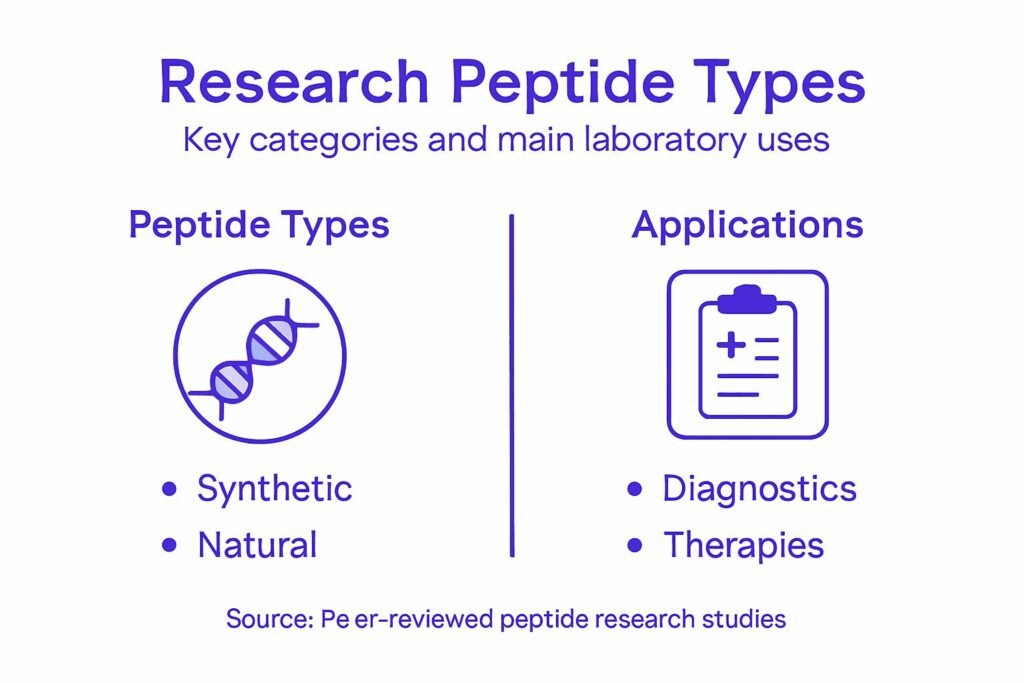
What Are Naturally Occurring Peptides?
Naturally occurring peptides are short chains of amino acids produced by living organisms. They can be generated within human and animal cells, plants, microorganisms and other biological systems. Some act as signalling molecules, while others participate in defence, regulation and cellular communication.
Examples include oxytocin, a peptide hormone, and naturally produced fragments of larger proteins. Many peptides are initially produced as longer precursor molecules that undergo enzymatic processing before the mature peptide is formed.
The characteristics of a naturally occurring peptide depend on its amino acid sequence, how it is produced and any subsequent modifications. Biological systems can introduce structural changes that influence the peptide’s final properties.
When comparing synthetic vs naturally occurring peptides, it is important to recognise that natural origin does not automatically mean a material is pure or suitable for a particular experiment. Peptides isolated from biological sources may be accompanied by proteins, salts, metabolites or other substances that need to be separated and characterised.
Comparing Synthetic vs Naturally Occurring Peptides in Quality Control
When comparing synthetic vs naturally occurring peptides, researchers should evaluate the source, manufacturing or isolation process, analytical methods and batch documentation. These factors help explain differences between samples and provide context for interpreting purity, identity and consistency results.
Choosing Between Synthetic vs Naturally Occurring Peptides for Research
The choice between synthetic vs naturally occurring peptides depends on the research objective, the molecular characteristics required and the evidence available to confirm sample quality. A clearly defined sequence and appropriate analytical testing are essential for meaningful comparisons.
What Are Synthetic Peptides?
Synthetic peptides are manufactured through laboratory processes that assemble amino acids into a specified sequence. Chemical peptide synthesis allows researchers to produce a target sequence without relying on a living organism to generate the complete molecule.
One established technique is solid-phase peptide synthesis (SPPS). In this process, the growing peptide chain is assembled step by step on a solid support. Protected amino acids are coupled in the required order, and protecting groups are removed at appropriate stages. The completed chain is then cleaved from the support and processed using suitable purification and analytical methods.
Other approaches include liquid-phase synthesis and combinations of synthesis techniques. The method selected depends on factors such as sequence length, chemical properties, manufacturing requirements and the intended use of the material.
The European Medicines Agency’s guideline on the development and manufacture of synthetic peptides discusses manufacturing, characterisation, specifications and analytical control.
In the context of synthetic vs naturally occurring peptides, laboratory production offers control over the intended sequence and manufacturing process. However, synthesis alone does not prove that the final material has the correct identity, purity or structural characteristics.
Synthetic vs Naturally Occurring Peptides: Main Differences
Both categories contain amino acid chains connected by peptide bonds, but their production routes and quality considerations can differ.
| Feature | Naturally occurring peptides | Synthetic peptides |
|---|---|---|
| Origin | Produced by living organisms | Manufactured through laboratory processes |
| Production | Biological synthesis and processing | Chemical synthesis or other controlled production methods |
| Sequence | Determined by biological processes, including precursor processing | Specified during design and production |
| Structural modifications | May arise through biological processing | May replicate natural modifications or include deliberate changes |
| Purification | May require separation from complex biological material | Usually requires appropriate post-synthesis purification |
| Quality assessment | Depends on source, isolation and analytical testing | Depends on synthesis controls, purification and analytical testing |
| Batch consistency | Can be influenced by biological source and isolation methods | Can be influenced by synthesis, purification and quality controls |
| Research applications | Studying biological systems and naturally produced molecules | Studying known sequences, modified structures and specific molecular questions |
This comparison shows that synthetic vs naturally occurring peptides is primarily a comparison of origin and production, not a universal ranking of quality.
Neither category is automatically superior. The appropriate choice depends on the research question, the material’s characteristics and the evidence available to establish its identity and suitability.
Can a Synthetic Peptide Be Identical to a Natural Peptide?
Yes. A synthetic peptide can be manufactured to match the amino acid sequence of a peptide found in nature. If the relevant structural features also match, the two may be chemically equivalent in those respects.
However, matching the amino acid sequence does not automatically establish complete equivalence. Some peptides contain modifications, specific stereochemical features or other structural characteristics that must be considered during characterisation.
For example, a synthetic version may reproduce the main sequence but differ in a modification or contain small amounts of related impurities. Conversely, an appropriately manufactured and characterised synthetic peptide can closely reproduce a naturally occurring molecule.
This is a key point when examining synthetic vs naturally occurring peptides: the manufacturing route alone cannot tell researchers whether two samples are structurally identical. Analytical evidence is required.
Why Are Synthetic Peptides Used in Laboratory Research?
Synthetic peptides can help researchers investigate molecular interactions, protein regions, biological signalling and the relationship between molecular structure and function.
Their value comes partly from the ability to specify a sequence and manufacture material for a defined research question. Researchers can compare related sequences, examine the effects of individual amino acid changes or investigate selected structural modifications.
Synthetic peptides may be used in areas such as:
- Molecular biology: studying interactions between peptides and other biological molecules.
- Biochemistry: investigating sequence-dependent chemical and structural properties.
- Immunology research: examining selected peptide sequences and their interactions with immune-system components.
- Analytical method development: evaluating separation, detection and characterisation techniques.
- Drug discovery research: investigating candidate molecules under appropriately controlled experimental conditions.
These applications do not mean every synthetic peptide has an established biological effect. Results depend on the particular molecule, experimental model and quality of the evidence.
Purity and Quality: Natural Does Not Mean Pure
A common misconception is that naturally occurring peptides are inherently purer or more reliable than laboratory-produced peptides. In reality, purity depends on the source, processing, contamination controls and analytical methods used.
A peptide isolated from biological material may contain other naturally occurring substances. A synthetic peptide may contain residual synthesis-related impurities, deletion sequences, truncated sequences or other peptide-related components.
When evaluating synthetic vs naturally occurring peptides, researchers should distinguish purity from identity and content:
- Identity concerns whether the material matches the intended molecular structure.
- Purity describes the proportion of the measured material attributed to the target relative to detected impurities, according to the method used.
- Content or assay concerns how much of the target substance is present in a sample or preparation, using the stated measurement approach.
A high HPLC purity percentage does not, by itself, establish the total quantity of peptide in a sample or prove every aspect of its identity.
For further reading, see our guides to peptide purity versus peptide content and what HPLC purity means.
How Are Natural and Synthetic Peptides Analysed?
Analytical testing helps researchers determine what a sample contains and whether its characteristics are consistent with expectations. The methods required depend on the peptide, the potential impurities and the purpose of the analysis.
High-performance liquid chromatography (HPLC) separates components based on their interactions with a chromatographic system. It can help assess chromatographic purity, but a peak alone does not provide complete structural identification.
Mass spectrometry (MS) measures mass-to-charge ratios and can provide evidence supporting molecular-mass assessment and identification. Additional techniques may be needed to distinguish structures that have similar or identical masses.
Liquid chromatography–mass spectrometry (LC-MS) combines separation with mass analysis, allowing researchers to investigate components in greater detail. Other specialised methods may be necessary to examine particular structural features or modifications.
The European Medicines Agency’s synthetic peptide guideline highlights the importance of appropriate characterisation and analytical control in synthetic peptide manufacturing.
The comparison of synthetic vs naturally occurring peptides should therefore include the quality of the supporting analytical evidence, not just the label describing the material’s origin.
Structural Modifications and Synthetic Peptide Design
Some synthetic peptides are designed to reproduce naturally occurring sequences as closely as possible. Others are intentionally modified to investigate how structural changes affect properties such as stability, molecular interactions or susceptibility to degradation.
Depending on the research objective, modifications may involve selected amino acid substitutions, changes in stereochemistry, terminal modifications or the attachment of other chemical groups.
Such changes can alter a peptide’s behaviour, but their effects cannot be predicted reliably from the word “modified” alone. Each design requires appropriate characterisation and experimental evaluation.
This makes synthetic vs naturally occurring peptides an especially useful comparison in research: it encourages attention to the exact molecule rather than assumptions based only on how it was produced.
Common Misconceptions About Natural and Synthetic Peptides
Several assumptions can lead to incorrect conclusions:
Misconception 1: Natural peptides are always safer.
Natural origin does not establish safety or suitability. These properties depend on the molecule, exposure, preparation and context of use.
Misconception 2: Synthetic peptides are always less pure.
Purity depends on manufacturing controls, purification and analytical testing. The production method alone cannot determine the final result.
Misconception 3: The same sequence guarantees identical properties.
Sequence is important, but modifications, stereochemistry, formulation and other structural details can also matter.
Misconception 4: A high purity result proves identity.
Purity and identity are different analytical questions. Suitable complementary methods may be needed to establish both.
Misconception 5: Synthetic means biologically active.
Manufacturing a specified sequence does not prove that it produces a particular effect in an experimental system.
These distinctions are central to interpreting synthetic vs naturally occurring peptides accurately and avoiding claims that go beyond the available evidence.
How Should Researchers Evaluate a Peptide Sample?
Before drawing conclusions about a peptide, researchers should review the documentation and analytical information available for the specific material.
Useful questions include:
- Is the intended sequence or molecular identity clearly specified?
- Is the production route documented where relevant?
- Are any modifications identified and described?
- Are the analytical methods appropriate for the properties being assessed?
- Are purity, identity and content reported as distinct measurements where appropriate?
- Is the certificate of analysis linked to the correct batch?
- Are limitations, missing information and relevant stability considerations acknowledged?
For practical guidance, read our article on how to check a peptide certificate of analysis.
A certificate of analysis can support quality assessment, but its value depends on the information it contains, the methods used and the traceability of the results. Documentation should be evaluated critically rather than treated as an automatic guarantee of quality.
Frequently Asked Questions
What is the main difference between synthetic and naturally occurring peptides?
Naturally occurring peptides are produced by living organisms, whereas synthetic peptides are manufactured through laboratory processes. Their molecular structures may be identical or different, depending on the intended sequence and any modifications.
Are synthetic peptides chemically identical to natural peptides?
Some synthetic peptides can match naturally occurring peptides in sequence and relevant structural features. Others are deliberately modified. Analytical testing is needed to assess the characteristics of a particular sample.
Are naturally occurring peptides always better quality?
No. Natural origin does not guarantee purity, identity, consistency or suitability for research. Quality must be assessed using appropriate documentation and analytical methods.
How can researchers confirm the identity of a synthetic peptide?
Depending on the molecule and the question being investigated, researchers may use mass spectrometry, chromatography and additional structural methods. No single result should be assumed to answer every identity and purity question.
Why is analytical testing important?
Analytical testing helps establish whether a material’s measured characteristics are consistent with its specification. It can also reveal impurities or structural differences that may affect research interpretation.
Conclusion
The key to understanding synthetic vs naturally occurring peptides is recognising that origin and production method are only part of the picture. Natural peptides are generated by biological systems, while synthetic peptides are produced through laboratory techniques that allow specified sequences and, where required, deliberate structural modifications.
Neither category automatically guarantees higher purity, better quality or a particular biological effect. Researchers should focus on molecular identity, structural characteristics, analytical evidence, batch traceability and the limits of the available data.
By evaluating these factors together, laboratory researchers can make more informed comparisons and interpret peptide research results more responsibly.
Educational information only. Research materials should be evaluated by appropriately qualified laboratory personnel. This article does not establish that any research peptide is authorised or suitable for human use.
