
Peptide Identity Testing Methods: How Laboratories Confirm Identity
Peptide identity testing methods help laboratories determine whether a peptide sample matches its intended molecular structure. For synthetic peptides, confirming identity is an important part of analytical characterisation because the manufacturing process can produce related substances, incomplete sequences and other components that need to be evaluated.
A peptide may have the expected name on its label, but the label alone does not establish its molecular identity. Appropriate analytical evidence is needed to support that conclusion. Depending on the peptide and the purpose of the analysis, laboratories may use mass spectrometry, chromatography, amino acid analysis, nuclear magnetic resonance spectroscopy and other complementary techniques.
Understanding peptide identity testing methods also requires distinguishing identity from purity and content. These measurements answer different questions, and a result from one test should not automatically be treated as proof of every aspect of sample quality.
This guide explains the principal testing techniques, their strengths and limitations, and how laboratories interpret analytical findings responsibly.
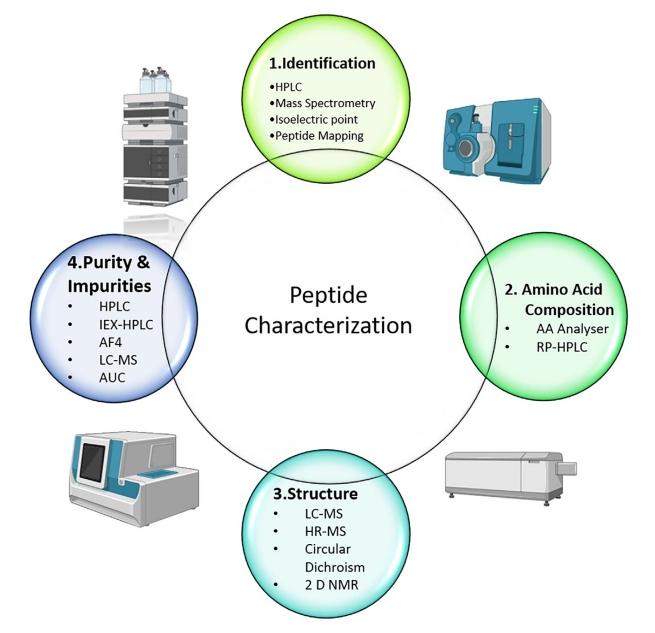
What Is Peptide Identity Testing?
Peptide identity testing is the analytical process used to assess whether a sample corresponds to the intended peptide. This may involve confirming its molecular mass, amino acid sequence, composition or other structural characteristics.
The level of confirmation required depends on the purpose of the analysis. A preliminary check may provide evidence consistent with the expected molecule, while more comprehensive characterisation may require several independent techniques.
Peptide identity testing methods are particularly important for synthetic materials because synthesis and subsequent processing can produce related substances. These may include deletion sequences, truncated sequences, insertion sequences, chemical modifications or other impurities.
A reliable assessment compares the expected molecular characteristics with appropriate analytical findings. It also considers whether the chosen methods can distinguish the target from plausible alternatives.
Peptide Identity Testing Methods for Sequence Confirmation
Peptide identity testing methods for sequence confirmation may combine tandem mass spectrometry, chromatographic separation and other structural techniques. The appropriate approach depends on whether the laboratory needs to confirm molecular mass, investigate sequence order or distinguish closely related structures.
Peptide Identity Testing Methods for Investigating Unexpected Results
When results do not match the expected profile, peptide identity testing methods can help researchers investigate possible sequence-related impurities, chemical modifications or analytical interference. Findings should be reviewed alongside the method conditions, reference information and sample documentation.
Selecting Peptide Identity Testing Methods for a Specific Sample
Selecting suitable peptide identity testing methods requires considering the peptide’s structure, the possible alternatives and the level of confirmation needed. A method that supports molecular-mass assessment may not be sufficient to establish the full sequence or distinguish every structural isomer.
1. Mass Spectrometry for Peptide Identity
Mass spectrometry (MS) is a major technique for investigating peptide identity. It measures the mass-to-charge ratios of ions, allowing researchers to derive information about molecular mass and, with suitable methods, investigate structural features.
The measured mass is compared with the expected value for the intended peptide. Interpretation must account for the instrument, ionisation process, charge states, adducts and molecular form being analysed.
What can mass spectrometry confirm?
A mass measurement consistent with the expected peptide provides useful evidence supporting its identity. It may also help identify certain modifications or related species whose masses differ from the target.
However, matching molecular mass does not always establish the complete amino acid sequence. Different structures can share the same mass, and some isomers are difficult to distinguish using mass alone.
For this reason, peptide identity testing methods often combine mass spectrometry with complementary techniques when a stronger level of structural confirmation is required.
2. Tandem Mass Spectrometry (MS/MS)
Tandem mass spectrometry, commonly called MS/MS, provides additional information by fragmenting selected ions and analysing the resulting fragments. The fragment pattern can help researchers investigate the amino acid sequence and identify particular structural features.
During peptide analysis, fragmentation data are compared with expected patterns or suitable reference information. Interpretation may include assigning observed fragments and determining whether they support the proposed sequence.
MS/MS can provide more sequence-related evidence than a simple molecular-mass measurement. Nevertheless, results depend on the peptide, fragmentation behaviour, instrument settings and quality of the data.
Some sequences produce ambiguous or incomplete fragmentation patterns. Additional analysis may be needed when the available fragments do not adequately distinguish the intended peptide from a related structure.
3. High-Performance Liquid Chromatography (HPLC)
High-performance liquid chromatography separates components based on their interactions with a stationary phase and a mobile phase. It is widely used to investigate peptide mixtures and evaluate chromatographic profiles.
In a typical analysis, a detector records responses as separated components leave the column. The resulting chromatogram displays peaks that can be assessed under the conditions of the method.
Can HPLC confirm peptide identity?
HPLC can provide supporting evidence when a sample’s chromatographic behaviour is compared with an appropriate reference under the same validated or otherwise suitable conditions. Retention time may be useful, but it is not definitive proof of identity on its own.
Different compounds can have similar retention times, while changes in method conditions can shift the retention time of the same compound. A chromatographic peak therefore needs to be interpreted in context.
It is important to distinguish identity testing from purity testing. HPLC may show that a sample contains a dominant peak, but the size of that peak alone does not prove that the molecule has the intended sequence.
For more detail, read our guide to what HPLC purity means.
4. Liquid Chromatography–Mass Spectrometry (LC-MS)
Liquid chromatography–mass spectrometry combines chromatographic separation with mass analysis. The chromatographic system separates components, while the mass spectrometer provides information about the ions associated with those components.
This combination can be particularly useful when a sample contains several related substances. Researchers can examine the chromatographic profile and investigate the molecular masses of detected components.
LC-MS may help identify the target peptide and investigate certain impurities or degradation products. Tandem mass spectrometry can provide further structural evidence where appropriate.
However, LC-MS does not automatically resolve every identity question. Closely related isomers may require additional separation or specialised structural methods.
The European Medicines Agency’s guideline on the development and manufacture of synthetic peptides discusses the characterisation and analytical control of synthetic peptides in its medicinal-product regulatory scope.
5. Amino Acid Analysis
Amino acid analysis determines the amino acids present in a sample after an appropriate preparation process, often involving hydrolysis of the peptide into individual amino acids.
The resulting measurements can help assess amino acid composition and provide complementary evidence during peptide characterisation. Depending on the method, the findings may support an assessment of whether the overall composition is consistent with expectations.
A key limitation is that conventional amino acid analysis generally does not preserve the original order of the amino acids. Two different peptide sequences can contain the same amino acid composition.
Consequently, composition alone may not establish the full identity of a peptide. It is often most useful when interpreted alongside sequence-related and molecular-mass evidence.
6. Nuclear Magnetic Resonance (NMR) Spectroscopy
Nuclear magnetic resonance spectroscopy examines the behaviour of certain atomic nuclei in a magnetic field. The resulting spectra provide information about the chemical environments of those nuclei and can support structural characterisation.
Depending on the peptide and the research question, NMR may help investigate chemical structure, amino acid environments and other molecular features. One-dimensional and two-dimensional experiments can provide different types of structural information.
NMR requires appropriate sample quality, suitable instrumentation and specialised interpretation. It is not necessary for every routine identity assessment, but it can be valuable when other methods do not fully resolve a structural question.
Among peptide identity testing methods, NMR is especially useful as a complementary technique when detailed structural information is needed.
7. Comparing the Main Peptide Identity Testing Methods
Different techniques answer different analytical questions. The most suitable method depends on the peptide’s properties, the possible alternatives and the level of confirmation required.
| Method | Main contribution | Important limitation |
|---|---|---|
| Mass spectrometry | Supports molecular-mass assessment | Matching mass alone may not prove sequence |
| Tandem mass spectrometry | Provides fragmentation evidence for sequence and structure | Fragmentation may be incomplete or ambiguous |
| HPLC | Separates components and supports chromatographic comparison | Retention time alone is not definitive identity evidence |
| LC-MS | Combines separation with mass information | Some related structures may still require additional analysis |
| Amino acid analysis | Helps assess amino acid composition | Usually does not establish sequence order |
| NMR spectroscopy | Provides detailed structural information | Requires suitable samples and specialised interpretation |
The methods are complementary rather than interchangeable. A laboratory should choose techniques that address the identity question and the likely sources of uncertainty.
8. Peptide Identity Testing Versus Purity Testing
Identity and purity are related but distinct properties.
Identity asks whether the material corresponds to the intended molecule. Purity concerns the proportion of the target relative to other detected components according to a defined analytical method. Content concerns the amount of the target substance present in the sample.
A peptide can produce a high chromatographic purity result without that result independently proving its complete molecular identity. Likewise, a mass measurement consistent with the expected molecule does not establish that the sample contains no other substances.
Reliable peptide identity testing methods should therefore be selected according to the property being investigated. Where necessary, complementary methods should be used to build a more complete picture of the sample.
Our article on peptide purity versus peptide content explains why these measurements should not be confused.
9. How to Evaluate an Identity Test Report
When reviewing an analytical report, researchers should consider more than the final result or a simple pass statement. The supporting information helps determine what the analysis actually establishes.
Useful questions include:
- Is the tested material clearly identified?
- Does the report state which analytical method was used?
- Are the observed findings compared with appropriate expected values or reference data?
- Is the method suitable for distinguishing the target from plausible alternatives?
- Are limitations or unresolved findings acknowledged?
- Can the report be linked to the correct sample and batch?
A certificate of analysis may contain identity-related results, but its value depends on the tests performed and the information reported. A single result should not be interpreted as proof of characteristics that were not measured.
For practical guidance, see our article on how to check a peptide certificate of analysis.
10. Why Multiple Methods May Be Needed
No analytical method is capable of resolving every possible identity question for every peptide. Molecular mass, chromatographic behaviour, amino acid composition and structural data each describe different aspects of a molecule.
Combining appropriate techniques can help address these differences. For example, mass spectrometry may support molecular-mass assessment, tandem mass spectrometry may provide sequence-related evidence, and chromatography may help separate the target from related components.
This approach is often described as using complementary or orthogonal analytical methods. The objective is not simply to perform more tests, but to select methods that address different sources of uncertainty.
The appropriate testing strategy depends on the peptide, the analytical purpose and the evidence needed to support the conclusion.
Frequently Asked Questions
What are the most common peptide identity testing methods?
Common approaches include mass spectrometry, tandem mass spectrometry, HPLC, LC-MS, amino acid analysis and NMR spectroscopy. The appropriate combination depends on the peptide and the identity questions being investigated.
Is mass spectrometry enough to confirm peptide identity?
Mass spectrometry provides valuable molecular-mass information, but matching mass alone may not prove the complete sequence or distinguish all isomers. Additional methods may be needed.
Can HPLC alone confirm a peptide’s identity?
HPLC can support identity assessment when used with suitable reference information, but retention time alone is not definitive. Complementary analytical evidence may be required.
Why is amino acid analysis not always sufficient?
Amino acid analysis can provide composition information, but conventional analysis usually does not preserve the original sequence order. Different peptides can have the same overall amino acid composition.
Does a certificate of analysis guarantee identity?
No. A certificate reports specified information and test results. Its value depends on the methods used, the sample and batch traceability, and the scope of the reported testing.
Conclusion
Peptide identity testing methods help laboratories establish whether a sample’s measured characteristics are consistent with its intended molecular structure. Mass spectrometry, tandem mass spectrometry, chromatography, LC-MS, amino acid analysis and NMR each contribute different forms of evidence.
The strongest assessment uses methods suited to the peptide and the question being asked. Researchers should distinguish identity from purity and content, review the limitations of each method and ensure that results are traceable to the correct sample.
Reliable peptide characterisation depends not on a single headline result, but on appropriate analytical evidence interpreted in context.
Educational information only. Research peptides should be evaluated and handled by appropriately qualified laboratory personnel. This article does not establish that any research peptide is authorised or suitable for human use.
