
How Are Synthetic Peptides Analysed? A Complete Guide
How are synthetic peptides analysed? Laboratories use a combination of analytical techniques to investigate peptide identity, purity, molecular mass, composition and potential impurities. The methods selected depend on the peptide’s structure, the purpose of the analysis and the properties that need to be confirmed.
Synthetic peptides are manufactured by assembling amino acids into a specified sequence. Although synthesis can produce a molecule with the intended structure, the manufacturing process may also produce related substances, including incomplete sequences, modified peptides and other impurities. Analytical testing helps determine whether the resulting material matches the intended specification.
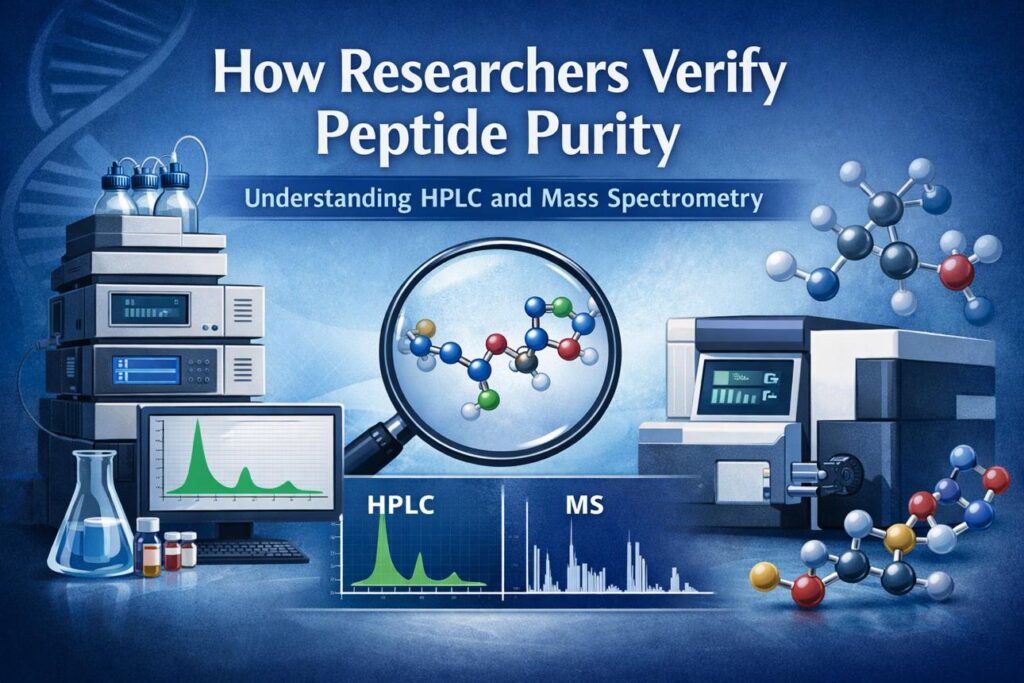
Understanding how are synthetic peptides analysed is important because no single test necessarily answers every quality question. High-performance liquid chromatography (HPLC), mass spectrometry (MS), amino acid analysis and other complementary methods provide different types of evidence.
This guide explains the principal techniques, what their results mean, how laboratories interpret analytical reports and why peptide identity, purity and content must be assessed separately.
Why Are Synthetic Peptides Analysed?
Synthetic peptide analysis helps researchers determine whether a material has the expected characteristics and whether the available evidence supports its intended research purpose.
Testing may be used during method development, manufacturing quality control, impurity investigation, stability studies or the evaluation of reference materials. The precise testing programme depends on the peptide and the requirements of the investigation.
When asking how are synthetic peptides analysed, it helps to separate the main analytical questions:
- Identity: Does the material match the intended peptide?
- Purity: What proportion of the measured sample or detected components is attributed to the target under the specified method?
- Molecular mass: Does the measured mass agree with the expected molecular composition?
- Content: How much of the target substance is present in the material?
- Impurity profile: Which related or unrelated components may be present?
- Stability: Does the material change over time or under defined conditions?
These questions are related, but they are not interchangeable. A sample may show a high chromatographic purity result while still requiring additional testing to establish its identity or content.
1. High-Performance Liquid Chromatography (HPLC)
High-performance liquid chromatography is widely used to separate peptide mixtures into individual components. Separation occurs because different molecules interact differently with the stationary phase inside the column and the mobile phase passing through it.
As the components leave the column, a suitable detector records their responses. The resulting chromatogram displays peaks associated with detected components under the conditions of the method.
How HPLC is used for peptide analysis
Reversed-phase HPLC is commonly used for peptide separation. It can help laboratories evaluate the main peptide peak, detect some related impurities and compare chromatographic profiles.
The interpretation depends on factors such as the column, mobile-phase composition, gradient, detector and sample preparation. Different methods may produce different separation patterns for the same material.
HPLC peak area is often used to calculate chromatographic purity. However, the result is method-dependent because different substances may produce different detector responses, and some components may not be detected effectively under the chosen conditions.
When learning how are synthetic peptides analysed, it is therefore important to understand what the reported HPLC percentage represents rather than interpreting it as a complete measurement of every aspect of sample quality.
For more detail, read our guide to what HPLC purity means.
2. Mass Spectrometry (MS)
Mass spectrometry measures the mass-to-charge ratios of ions. With appropriate instrumentation and interpretation, it can provide evidence about a peptide’s molecular mass and help identify certain structural modifications or impurities.
A measured mass is compared with the expected value calculated for the intended molecular composition. The comparison must account for factors such as ionisation, charge state, adducts and the form of the molecule being analysed.
What mass spectrometry can reveal
Mass spectrometry can help investigate whether a detected species has a mass consistent with the target peptide. It can also provide evidence of some chemical changes, including modifications that alter molecular mass.
However, a matching mass does not necessarily prove the complete amino acid sequence or distinguish every structural isomer. Some molecules can share the same molecular formula or have identical masses while differing in structure.
This is why how are synthetic peptides analysed cannot be answered by mass spectrometry alone in every case. The method is powerful, but its results must be interpreted in context and supported by additional evidence when required.
3. Liquid Chromatography–Mass Spectrometry (LC-MS)
Liquid chromatography–mass spectrometry combines chromatographic separation with mass analysis. The chromatography separates components, while the mass spectrometer provides information about the ions associated with those components.
This combination is useful when a laboratory needs to investigate both the separation profile and the molecular-mass characteristics of detected substances.
LC-MS can support the investigation of peptide-related impurities, degradation products and some structural modifications. More advanced approaches, such as tandem mass spectrometry (MS/MS), can provide fragmentation information that helps researchers investigate sequence and structural features.
The method still has limitations. Results depend on separation performance, ionisation behaviour, instrument settings, reference information and the complexity of the sample.
For a scientific discussion of these challenges, see the review on characterising synthetic peptide therapeutics using LC-MS.
4. Amino Acid Analysis
Amino acid analysis measures the amino acids present after a suitable sample-preparation process, commonly involving hydrolysis of the peptide into its constituent amino acids.
The resulting measurements can help characterise composition or support other analytical findings. Depending on the method, researchers may use amino acid analysis as complementary evidence when evaluating a synthetic peptide.
However, this technique generally does not establish the original order of amino acids because the peptide chain is broken down during preparation. Different sequences containing the same amino acid composition may therefore produce similar composition results.
This illustrates an important principle: analytical methods should be selected according to the specific question being asked. One technique may support composition assessment while another is needed to investigate sequence or molecular identity.
5. Nuclear Magnetic Resonance (NMR) Spectroscopy
Nuclear magnetic resonance spectroscopy examines how certain atomic nuclei behave in a magnetic field. The resulting spectra provide information about the chemical environments of those nuclei.
Depending on the peptide and the experimental design, NMR can contribute to structural characterisation and help investigate whether a molecule has the expected chemical features.
One-dimensional and two-dimensional NMR experiments can provide complementary information. Interpretation may require specialised expertise, suitable reference data and sufficient sample quality.
NMR is not required for every routine peptide analysis. Its suitability depends on the structural question, sample properties and the level of characterisation needed.
6. Testing for Peptide-Related Impurities
Synthetic peptide production may generate related substances, such as deletion sequences, truncated sequences, modified forms and other process-related impurities. Additional impurities can arise from degradation or other stages of handling and processing.
Analytical methods help detect and investigate these components. Chromatographic techniques can separate some impurities, while mass spectrometry may provide evidence about their molecular masses and possible structures.
Not every impurity can be identified conclusively from one chromatographic peak or mass measurement. Some substances may have similar properties, and certain structural isomers can be particularly challenging to distinguish.
The European Medicines Agency’s guideline on the development and manufacture of synthetic peptides addresses manufacturing, characterisation, specifications and analytical control. Its regulatory scope is specific to medicinal-product development and should not be mistaken for a universal testing checklist for every research material.
How Are Synthetic Peptides Analysed During Quality Control?
Understanding how are synthetic peptides analysed during quality control means looking at whether the material matches its specification and whether the analytical evidence supports the reported results. Laboratories may combine chromatographic separation, molecular-mass measurements and other appropriate tests to investigate identity, purity and potential impurities.
How Are Synthetic Peptides Analysed to Identify Impurities?
When investigating how are synthetic peptides analysed for impurities, researchers consider both the separation of detected components and the evidence available to identify them. HPLC can reveal additional chromatographic peaks, while mass spectrometry may help investigate their molecular masses. Further testing may be necessary to establish the identity of a particular impurity.
How Are Synthetic Peptides Analysed for Molecular Identity?
A key part of how are synthetic peptides analysed is comparing analytical findings with the expected molecular structure. Mass spectrometry can support molecular-mass assessment, while complementary techniques may be needed to investigate sequence-related questions or distinguish structural isomers.
How Are Synthetic Peptides Analysed in Stability Studies?
Researchers studying how are synthetic peptides analysed during stability investigations may compare samples over defined time points using suitable analytical methods. These comparisons can help identify changes in chromatographic profiles, molecular mass or other measured properties, although the interpretation depends on the method and experimental conditions.
How Are Synthetic Peptides Analysed Before Results Are Reported?
Before reporting findings, researchers evaluating how are synthetic peptides analysed should review the method, sample identity, batch documentation and limitations of each result. Conclusions should distinguish identity, purity and content rather than treating them as interchangeable measurements.
7. How Laboratories Interpret Analytical Results
Analytical results must be evaluated against the question being investigated, the method used and the applicable specification.
A chromatogram may show a dominant peak, but that observation alone does not prove the full molecular identity of the sample. Similarly, a mass measurement consistent with the target does not automatically establish chromatographic purity or total content.
When reviewing how are synthetic peptides analysed, researchers should consider whether different results support one another and whether the methods have relevant limitations.
A sound interpretation typically considers:
- The expected molecular identity and composition.
- The suitability of each analytical method.
- The presence and significance of additional peaks or detected species.
- Whether the reported purity calculation is clearly defined.
- Whether identity, purity and content have been distinguished.
- Whether the sample and batch are traceable to the relevant records.
Where results conflict, the discrepancy should be investigated rather than resolved by selecting whichever result appears most favourable.
8. Identity, Purity and Content Are Different
These three concepts are often confused in peptide testing.
Identity concerns whether the material corresponds to the intended molecular structure. Mass spectrometry, chromatographic comparison and other structural techniques may contribute evidence.
Purity describes the target’s proportion relative to other detected components according to the specified analytical method and calculation. The result depends on the method’s ability to separate and detect the relevant substances.
Content concerns the amount of target substance present in the sample. Depending on the material and analytical approach, content assessment may require calibration, reference materials or additional measurements.
For example, a chromatographic result of high purity does not necessarily mean that nearly all the material’s total mass consists of the target peptide. Water, counter-ions, residual solvents or other substances may affect the relationship between chromatographic purity and actual content.
Our guide to peptide purity versus peptide content explains this distinction in more detail.
9. Certificates of Analysis and Batch Traceability
A certificate of analysis (COA) summarises test results for a specified material or batch. Depending on the supplier and testing programme, it may identify the material, list methods, report analytical findings and state relevant specifications.
A COA should be interpreted according to the information it actually provides. The presence of a purity result does not prove that every possible impurity has been assessed, and a single test cannot automatically establish long-term stability.
Researchers should check that the report identifies the correct material and batch, that the methods are described clearly and that the conclusions do not exceed the evidence.
For practical guidance, see how to check a peptide certificate of analysis and peptide batch number traceability.
Frequently Asked Questions
How are synthetic peptides analysed for identity?
Laboratories may combine mass spectrometry, chromatographic comparison and other structural methods, depending on the peptide and the level of confirmation required. The methods should address the relevant identity questions and their limitations.
Is HPLC enough to prove peptide purity and identity?
Not always. HPLC can provide information about chromatographic separation and purity under a defined method, but identity may require complementary testing. The appropriate combination depends on the material and the purpose of the analysis.
What does mass spectrometry tell researchers about peptides?
Mass spectrometry provides mass-to-charge measurements that can support molecular-mass assessment and help investigate some modifications and impurities. Additional techniques may be needed to confirm sequence or distinguish structural isomers.
Why are several analytical methods sometimes needed?
Different methods measure different properties. Combining complementary techniques can provide stronger evidence about identity, purity, composition and impurities than relying on a single result.
Does a certificate of analysis guarantee peptide quality?
No. A COA reports specified information and results, but its value depends on the tests performed, the documentation’s traceability and the scope of the report. It should be assessed critically.
Conclusion
How are synthetic peptides analysed? Laboratories use complementary analytical techniques to investigate molecular identity, chromatographic purity, molecular mass, composition and potential impurities. HPLC, mass spectrometry, LC-MS, amino acid analysis and NMR each provide different types of evidence, and no single technique answers every question.
Reliable interpretation depends on matching the method to the property being assessed, understanding its limitations and reviewing results alongside appropriate specifications and batch documentation.
For researchers, the central principle is simple: analytical results are most useful when their meaning is clearly defined, their limitations are acknowledged and the conclusions remain supported by the evidence.
Educational information only. Research peptides should be evaluated and handled by appropriately qualified laboratory personnel. This article does not establish that any research peptide is authorised or suitable for human use.
