
Interest in research peptides across Spain and the wider European market has made product documentation, analytical information and international shipping considerations increasingly important topics. Anyone researching laboratory materials should begin with the product’s intended classification, supporting documentation and applicable legal requirements. The Lavish Peptides research catalogue provides a starting point for reviewing available research materials and their published product information, but availability on a website should never be taken as confirmation that a product may legally be imported, sold or used in every country.

For laboratories and organisations in Spain, evaluating high purity peptides shipping Spain involves more than comparing catalogue descriptions or delivery estimates. It requires attention to product identity, analytical evidence, batch traceability, packaging information, shipping conditions and the regulatory framework that applies to the specific substance.
This guide explains nine important considerations for evaluating research peptide suppliers and understanding cross-border shipping within Europe. It is intended as general laboratory and regulatory information, not as an offer of medicines or advice about personal use.
1. Understanding High Purity Peptides Shipping Spain
The phrase high purity peptides shipping Spain can refer to several different considerations: the analytical quality of a peptide, the supplier’s documentation, the location from which an order is dispatched and the rules that apply when a product crosses a border.
These are separate issues.
A product may have a published purity figure, but that figure does not independently establish its identity, suitability for a particular experiment or legal status. Likewise, a supplier may advertise European delivery without demonstrating that every product in its catalogue can lawfully enter Spain.
Before evaluating a supplier, establish what the material is, how it is classified and what the intended activity involves. A research chemical, a pharmaceutical active substance and a medicinal product are not automatically treated alike under applicable rules.
For further background on the company and its published information, visit the Lavish Peptides website.
2. Check the Product’s Legal Classification Before Shipping
One of the most important steps when researching peptides in Spain is identifying the legal category of the specific product.
The Spanish Agency of Medicines and Medical Devices, known as AEMPS, oversees relevant aspects of medicines regulation. The rules that apply can depend on whether a substance is a medicinal product, an active pharmaceutical ingredient, an investigational medicinal product or another type of laboratory material.
A label such as “research use only” does not automatically exempt a product from applicable legislation. Nor does a supplier’s location in another European country establish that a particular product can be supplied without restrictions.
AEMPS publishes information about the importation of medicinal products and the procedures that apply to regulated imports. Its guidance explains that imports of medicines are subject to specific authorisation requirements and that authorised pharmaceutical operators have defined responsibilities.
Official reference: AEMPS, Import Procedures.
For this reason, organisations should establish the product’s classification and consult the appropriate regulatory authority or qualified legal adviser before arranging cross-border supply.
3. Evaluate Analytical Evidence Rather Than Marketing Claims
A supplier’s use of phrases such as premium quality, high purity or laboratory grade should not replace verifiable analytical information.
When assessing a research peptide, laboratories should look for documentation that clearly identifies the material and explains the analytical method used. A useful quality-documentation package may include:
- Product or compound identification.
- Batch or lot reference.
- Analytical method and test date.
- Reported analytical findings.
- Laboratory identification.
- Relevant limitations of the test.
- A clear connection between the report and the supplied batch.
High-performance liquid chromatography, commonly called HPLC, is one analytical technique used to examine the composition of peptide samples. Depending on the method and the material, it can help assess chromatographic purity and identify peaks that require further investigation.
However, an HPLC result should not be interpreted as proof of every quality characteristic. A purity percentage alone does not necessarily confirm molecular identity, biological activity, sterility, endotoxin levels or the absence of every possible contaminant.
This distinction is particularly important when comparing suppliers that publish different types of certificates or analytical summaries.
4. Understand Certificates of Analysis and Batch Traceability
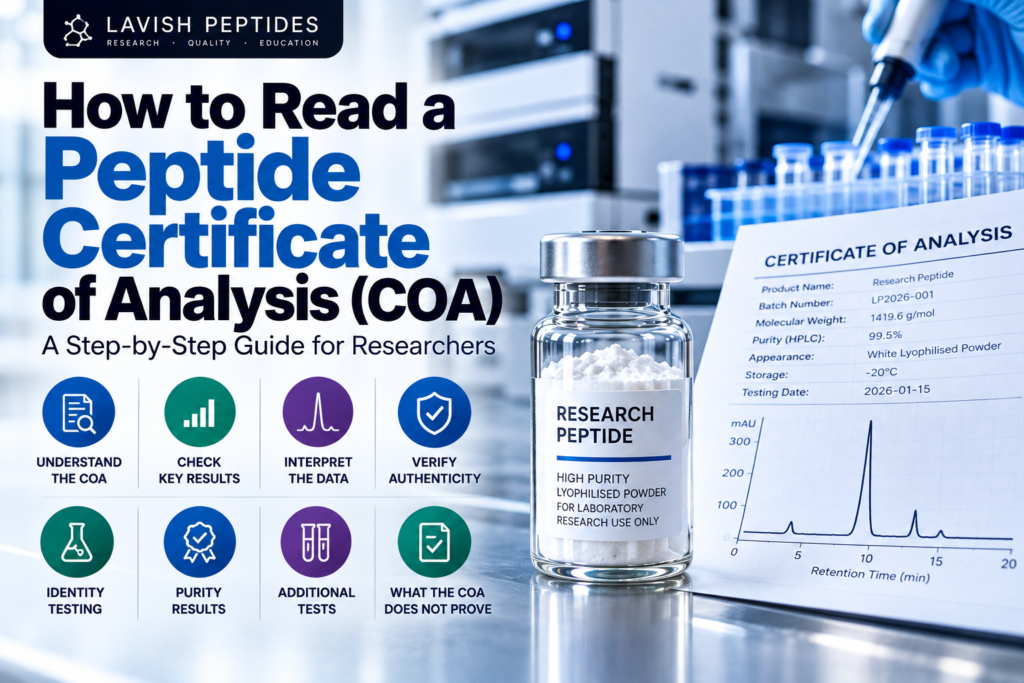
A Certificate of Analysis, or COA, is a document that reports specified analytical results for a material or batch.
For laboratories considering international suppliers, a COA can be useful when it is sufficiently detailed and clearly connected to the material being evaluated.
A document should ideally identify the product, batch number, test method, reported results and issuing laboratory. If a supplier provides a general certificate without a batch reference, it may be difficult to establish whether the document relates to the specific material under consideration.
Batch traceability also helps organisations maintain consistent records. A laboratory should be able to connect its internal inventory records with the relevant supplier documentation.
When reviewing a COA, consider these questions:
- Does the product name match the material being described?
- Is a batch or lot number visible?
- Is the analytical method identified?
- Are the reported findings understandable?
- Is the testing organisation identifiable?
- Does the document state its limitations?
A certificate is evidence of the tests reported on that document. It should not be treated as an unlimited guarantee of product performance or regulatory approval.
Additional educational material can be found in the Lavish Peptides blog.
5. Compare HPLC and LC-MS Information Carefully
HPLC and liquid chromatography–mass spectrometry, usually abbreviated LC-MS, are different analytical techniques. They can provide complementary information, depending on the method and the question being investigated.
HPLC separates components in a sample. Its results can be used to assess chromatographic profiles and estimate relative purity under the stated analytical conditions.
LC-MS combines chromatographic separation with mass spectrometry. The mass-spectrometry component can provide information about molecular mass and support the investigation of compound identity.
Neither technique should be described as automatically proving every characteristic of a material. Results depend on method development, instrument performance, sample preparation, reference standards and the competence of the laboratory conducting the analysis.
When reviewing a supplier’s analytical documentation, look for enough information to understand what was measured and what conclusions can reasonably be drawn.
A supplier that explains the scope and limitations of its analytical evidence offers a more useful basis for evaluation than one that relies exclusively on broad promotional language.
6. Review Packaging, Labelling and Product Identification
Packaging is another important consideration when evaluating high purity peptides shipping Spain.
For laboratory materials, packaging and labelling should support clear identification, inventory control and appropriate handling under the relevant institutional procedures.
Depending on the product and its classification, useful information may include:
- Product name or identifier.
- Batch or lot reference.
- Quantity or stated content.
- Relevant storage information.
- Supplier identification.
- Appropriate handling warnings.
- Supporting documentation.
Packaging claims should be specific. A supplier may describe a container as suitable for a particular application, but laboratories should assess whether the packaging specification is appropriate for the material and its intended, lawful use.
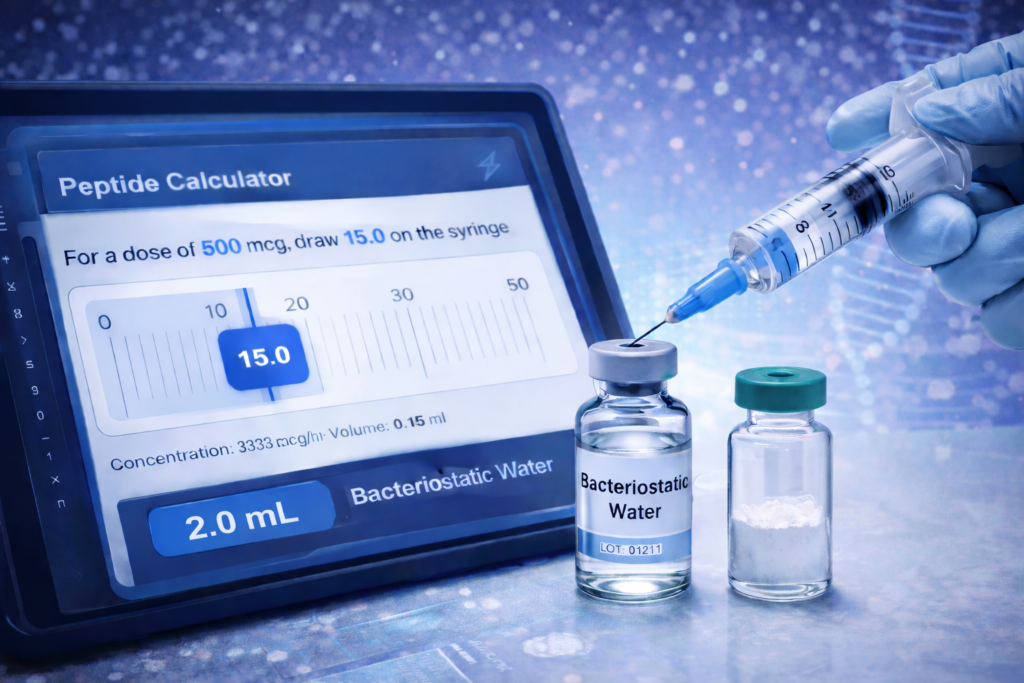
It is also important to distinguish ordinary packaging claims from validated transport conditions. A statement that a product is securely packaged does not, by itself, establish that temperature, humidity or other environmental conditions were controlled throughout transit.
7. Understand Shipping Across Spain and the European Union
International shipping information can be confusing because not every movement of goods is treated in the same way.
Spain is an EU Member State. However, the applicable procedures depend on the nature of the material, its regulatory classification and the countries involved in the transaction.
A movement between EU Member States is not necessarily treated in the same way as an import from outside the EU. For medicinal products, additional pharmaceutical requirements may apply beyond ordinary parcel and customs procedures.
AEMPS explains that the import and export framework for medicines includes authorisation procedures and controls associated with pharmaceutical trade. Its guidance also distinguishes movements within the EU from imports and exports involving countries outside the EU.
Official information is available through the AEMPS foreign trade section.
Before relying on a supplier’s shipping statement, organisations should establish:
- The country where the goods originate.
- Whether the shipment crosses an external EU border.
- The legal classification of the material.
- Whether the relevant authorisations are required.
- Which party is responsible for regulatory compliance.
- Whether the carrier can lawfully transport the material.
A delivery estimate is not evidence of import permission. A tracking number is not evidence that a shipment has satisfied every applicable regulatory requirement.
8. Consider the Responsibilities of Suppliers and Importers
A reliable supplier should communicate clearly about the information it can provide and the responsibilities that remain with the purchaser or importing organisation.
For regulated medicinal products, the requirements can include authorised importers, appropriate quality systems, batch controls and other regulatory safeguards. These requirements should not be confused with the ordinary documentation practices used for general laboratory chemicals.
The European Commission’s Access2Markets resource outlines requirements for pharmaceutical products, including import authorisation and marketing authorisation requirements for medicinal products.
Official reference: European Commission Access2Markets – Pharmaceutical Products.
For a laboratory evaluating a potential supplier, useful questions include:
- Can the supplier identify the legal entity responsible for the transaction?
- Is the product’s classification clearly stated?
- Is batch-specific documentation available where appropriate?
- Are the product description and supporting documents consistent?
- Can the supplier explain which shipping information it can substantiate?
- Does the supplier avoid making unsupported claims about legal status?
The answers can help an organisation determine whether it has enough information to proceed with its own compliance review.
9. Build a Responsible Supplier Evaluation Process
Searching for where to buy research peptides in Spain can produce a wide range of commercial websites, catalogues and international suppliers. Search visibility, attractive product descriptions and claims of immediate dispatch should not be the only selection criteria.
A more useful evaluation process considers documentation, transparency and regulatory suitability.
Documentation quality
Review whether the supplier provides meaningful product information, identifiable batch references and analytical documentation where applicable.
Analytical transparency
Look for explanations of the analytical methods used and the scope of the results. Avoid treating a single percentage as a complete assessment of quality.
Traceability
Check whether product descriptions, batch references and supporting documents are consistent.
Shipping transparency
Look for clear information about dispatch origin, carrier limitations and the distinction between estimated transit times and regulatory permission.
Regulatory awareness
A supplier should not make blanket statements that every peptide is legal to purchase, import or possess in Spain. Product classification and intended use matter.
Customer information
Clear contact information, accurate product descriptions and accessible documentation make it easier for an organisation to evaluate a supplier before entering into a transaction.
For an overview of published product information, laboratories can consult the Lavish Peptides shop. Reviewing a catalogue is only one part of supplier due diligence; it does not replace independent regulatory checks.
Research Peptide Delivery in Spain, France and Wider Europe
Searches for research peptide delivery in France and Europe often combine several different questions: where a supplier is based, whether a product is available, how long transport might take and whether the material can legally be supplied to the destination.
These questions should be considered separately.
A supplier may operate from an EU country while offering a catalogue that includes products with different regulatory classifications. The fact that a parcel can physically travel between two countries does not establish that every substance in it is lawful to distribute or receive.
Organisations should also avoid assuming that shipping information for France automatically applies to Spain or another European destination. National rules, product classification and the route of supply may differ.
For cross-border transactions involving medicinal products, the relevant national authorities and EU rules should be consulted before the transaction is arranged.
Common Mistakes When Evaluating Peptide Shipping
Several mistakes can make supplier comparisons unreliable.
Assuming every research-labelled product is unrestricted. A research-use statement does not override medicines legislation or other applicable controls.
Treating purity as proof of identity. Purity and identity are separate analytical questions.
Accepting a generic COA as batch-specific evidence. A certificate should be examined to establish which material and batch it actually describes.
Assuming EU dispatch means automatic compliance. The origin of a parcel does not settle every regulatory question.
Relying on delivery promises. A shipping estimate does not guarantee that a shipment will clear any applicable checks.
Confusing product availability with authorisation. A listing on a commercial website does not establish marketing authorisation or permission to import a medicinal product.
Avoiding these mistakes creates a more consistent basis for supplier evaluation and laboratory procurement decisions.
Frequently Asked Questions
1. Can research peptides be shipped to Spain?
The answer depends on the particular substance, its legal classification, intended use and the route of supply. Some products may be subject to medicines legislation or other controls. A research-use label alone does not establish that a product can be legally imported or supplied.
2. Are peptides legal in Spain?
There is no single answer that applies to every peptide. Legal treatment depends on the substance and the way it is classified and supplied. AEMPS is an important source for Spanish medicines regulation and import procedures.
3. What does high purity mean for a research peptide?
High purity generally refers to a stated analytical assessment of the proportion of a target component in a sample. The meaning of the reported figure depends on the analytical method and its limitations. It does not automatically establish identity, sterility or suitability for a particular experiment.
4. What is an HPLC report?
An HPLC report describes findings from high-performance liquid chromatography. Depending on the method, it can provide information about the sample’s chromatographic profile and estimated purity. It should be interpreted alongside the method details and other relevant evidence.
5. Why is a Certificate of Analysis important?
A COA records specified test results for a material or batch. It can support quality review and traceability when the document identifies the product, batch, test method and issuing laboratory.
6. Does a COA prove that a peptide is legal in Spain?
No. A Certificate of Analysis is an analytical document, not a marketing authorisation, import permit or legal opinion. Regulatory status must be assessed separately.
7. Does shipping from another EU country remove import restrictions?
Not automatically. The rules depend on the product’s classification and the nature of the transaction. Medicinal products can be subject to specific requirements even where the movement takes place within the EU.
8. What should laboratories check before selecting an international supplier?
They should examine product identification, available analytical evidence, batch traceability, supplier identity, packaging information and the applicable regulatory requirements. The laboratory should also confirm that the intended activity and supply route are permitted.
9. Where can organisations find official information about importing medicines into Spain?
The Spanish Agency of Medicines and Medical Devices, AEMPS, publishes official information about pharmaceutical foreign trade and import procedures. The European Commission’s Access2Markets portal also provides information about pharmaceutical import requirements.
Conclusion: Make Documentation and Compliance the Priority
Evaluating high purity peptides shipping Spain requires more than comparing product descriptions or advertised delivery times. Laboratories and organisations should consider analytical documentation, batch traceability, product classification, packaging information and the legal requirements that apply to the specific material.
HPLC and LC-MS reports can contribute useful analytical information, while a well-prepared COA can support batch identification and quality review. However, none of these documents independently establishes that a product is authorised for every purpose or can be imported without restrictions.
The most responsible approach is to verify the product’s classification, consult official Spanish and EU guidance, and evaluate suppliers on the strength and transparency of their documentation.
For additional company and laboratory research information, visit Lavish Peptides or browse the research catalogue. Always confirm applicable legal and regulatory requirements before arranging any cross-border supply.
