
When researching research grade peptides Netherlands, it is important to understand how product identification, analytical testing, batch documentation and supplier transparency contribute to the evaluation of laboratory research materials. Lavish Peptides provides an online research peptide catalogue where visitors can explore its listed materials and review the information available for individual products. However, selecting research materials should involve more than comparing product descriptions or advertised purity percentages. Buyers should understand the analytical evidence behind a product, the documentation supplied and the regulatory requirements that apply in the Netherlands.
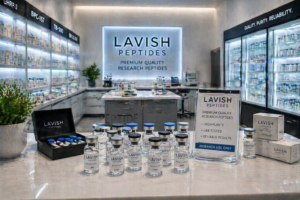
Peptides are specialised molecules made up of amino acid chains. Their chemical characteristics, molecular structures and analytical properties make them relevant to a variety of scientific research fields.
As interest in peptide research continues across Europe, buyers increasingly search for information about research-grade materials, independent testing, HPLC analysis and certificates of analysis.
This guide explores seven important quality standards to consider when evaluating research-labelled peptide materials in the Netherlands.
1. Understanding Research Grade Peptides Netherlands
The phrase research grade peptides Netherlands generally refers to peptide materials marketed for laboratory research and scientific investigation.
Research-grade terminology describes a supplier’s stated product category. It should not automatically be interpreted as proof of pharmaceutical-grade manufacturing, medicinal approval or suitability for human consumption.
The characteristics of a research material should be assessed using its available technical specifications and supporting analytical evidence.
What are peptides?
Peptides are molecules consisting of amino acids connected through peptide bonds.
Their structures can vary considerably depending on the number, order and chemical characteristics of their amino acid components.
Scientific research involving peptides may examine subjects such as:
- Molecular structure and chemical properties.
- Protein interactions.
- Cellular signalling pathways.
- Biochemical mechanisms.
- Analytical chemistry.
- Molecular characterisation.
- Synthetic peptide development.
These areas require accurate identification and appropriate analytical methods.
Why research-grade terminology matters
When evaluating research grade peptides Netherlands, buyers should distinguish between several commonly used descriptions:
| Term | General meaning |
|---|---|
| Research grade | Describes materials marketed for research applications |
| Laboratory grade | A broad description that requires supporting specifications |
| HPLC tested | Indicates that high-performance liquid chromatography testing is claimed or documented |
| Pharmaceutical grade | A regulated quality designation that should not be assumed without appropriate evidence |
| COA documented | Indicates that a certificate of analysis is available |
These descriptions are not interchangeable.
A supplier should explain its terminology accurately and avoid implying that research-labelled products are authorised medicines.
2. Understanding Peptide Purity and Quality Standards
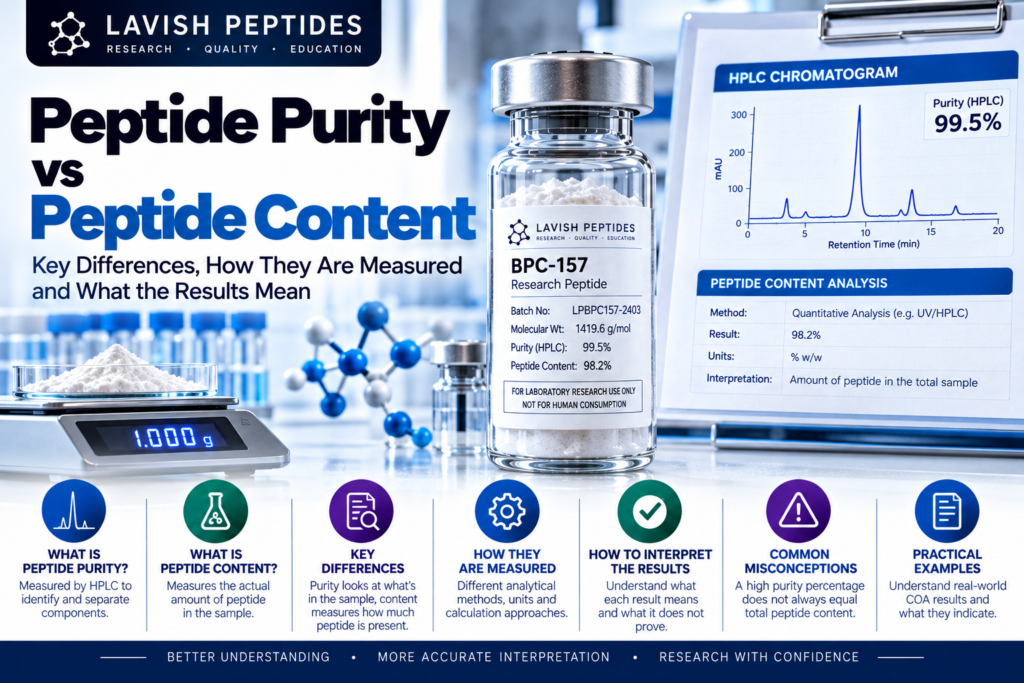
Purity is one of the most frequently discussed characteristics when researching peptide materials.
However, a purity percentage should always be interpreted in the context of the analytical method used.
What does peptide purity mean?
Purity generally describes the proportion of a desired component relative to other detected or measured substances.
In peptide analysis, purity may be assessed using chromatographic methods such as HPLC.
An analytical report may show the relative area of the principal chromatographic peak compared with the total integrated peak area.
However, this does not necessarily represent absolute mass purity.
Different substances can produce different detector responses, and some impurities may not be detected effectively under particular analytical conditions.
Why advertised purity percentages need supporting evidence
When comparing premium pharma grade research peptides, buyers should not rely exclusively on advertised percentages.
A meaningful purity claim should be supported by relevant documentation identifying:
- The material examined.
- The batch or sample reference.
- The analytical method.
- The reported result.
- The testing date.
- The organisation responsible for testing.
A statement that a peptide has 99% purity should not be treated as independently verified unless the supporting evidence establishes that result.
Research-grade versus pharmaceutical-grade materials
The phrase pharmaceutical grade has a specific regulatory and quality context.
A research material should not be described as pharmaceutical grade merely because it has undergone HPLC testing or has a high reported chromatographic purity.
Pharmaceutical manufacturing involves additional requirements relating to the manufacturing process, quality systems, specifications and regulatory controls.
For this reason, research grade peptides Netherlands should be evaluated according to their actual documentation rather than broad marketing descriptions.
3. HPLC Testing and Certificates of Analysis
High-performance liquid chromatography, commonly known as HPLC, is widely used in analytical chemistry.
It separates components within a sample according to how they interact with a chromatographic column and mobile phase.
What does HPLC testing show?
HPLC analysis may provide information about:
- The principal detected component.
- Additional chromatographic peaks.
- Retention times.
- Relative peak areas.
- The chromatographic profile.
- Certain detectable impurities.
The resulting chromatogram provides a visual representation of detector response over time.
A prominent principal peak may indicate that one detected component accounts for a large proportion of the chromatographic response.
However, HPLC results should be interpreted according to the analytical method and its limitations.
Understanding certificates of analysis
A Certificate of Analysis, or COA, is a document reporting analytical findings for a particular material.
A useful certificate may include:
| COA information | Purpose |
|---|---|
| Product identification | Identifies the material |
| Batch reference | Connects the report to a specific lot |
| Testing date | Shows when analysis was performed |
| Analytical method | Explains how the material was examined |
| Reported results | Provides the findings |
| Laboratory information | Identifies the organisation responsible |
| Acceptance criteria | Provides context for the reported results |
When evaluating research grade peptides Netherlands, buyers should establish whether a certificate relates to the specific batch being considered.
A certificate from an earlier batch should not automatically be applied to a different lot.
HPLC and LC-MS analysis
HPLC and liquid chromatography–mass spectrometry (LC-MS) can provide complementary information.
HPLC separates components, while mass spectrometry provides information about the mass-to-charge ratios of detected ions.
LC-MS may help investigate whether a detected molecular species is consistent with the expected molecular mass of a peptide.
Depending on the analytical requirements, additional methods may be necessary to establish more detailed structural or sequence information.
The European Medicines Agency provides technical guidance on synthetic peptide development, manufacture and analytical control.
Its synthetic peptide development and manufacture guideline is a useful technical reference for understanding why analytical characterisation and impurity control matter.
4. Independent Testing and Laboratory Verification
Independent testing can provide additional evidence when evaluating research-labelled peptide materials.
A supplier may conduct internal quality-control testing, while an external laboratory may perform separate analytical examinations.
Both approaches can contribute useful information when the methods and documentation are appropriate.
What is independent peptide testing?
Independent testing involves an external organisation examining a sample according to specified analytical requirements.
The report should identify the laboratory and provide enough information to understand the sample and the testing performed.
Buyers reviewing research grade peptides Netherlands should look for:
- The laboratory’s name.
- The sample identification.
- The batch reference.
- The testing date.
- The analytical methods.
- The reported findings.
- Relevant testing limitations.
Does third-party testing guarantee quality?
No.
The value of third-party testing depends on the competence of the laboratory, the relevance of the analytical methods and the relationship between the tested sample and the supplied material.
An external laboratory report does not automatically prove every possible quality characteristic.
For example, an HPLC purity result does not independently establish sterility, endotoxin status or the absence of every possible contaminant.
Understanding laboratory accreditation
Laboratory accreditation can provide information about an organisation’s competence for specified testing activities.
ISO/IEC 17025 is an important international standard for testing and calibration laboratories.
However, accreditation does not automatically apply to every test performed by an organisation.
Buyers should check the laboratory’s published accreditation scope before relying on claims about accredited peptide testing.
5. Evaluating Research Peptide Suppliers in the Netherlands
Choosing a supplier requires a balanced assessment of product information, documentation, communication and applicable regulations.
Searches for best peptides Netherlands research often reflect an interest in identifying suppliers that provide clear technical information.
Rather than relying on rankings or promotional descriptions, buyers should apply consistent evaluation criteria.
Supplier transparency
A supplier should clearly identify the business responsible for its product listings.
Useful information includes:
- Business contact details.
- Product identification.
- Available technical documentation.
- Clear research-use descriptions.
- Batch-related information.
- Applicable restrictions.
A transparent supplier should not make unsupported claims about testing or purity.
Product documentation
Product information should be consistent with supporting technical documents.
Where a COA is provided, the product and batch references should be identifiable.
Where HPLC testing is claimed, the analytical method and relevant report should be available for review.
Communication
A professional supplier should be able to explain what documents are available and what they establish.
Buyers should be cautious when a supplier makes broad claims but cannot identify the testing organisation or provide relevant analytical information.
Comparing suppliers fairly
When comparing direct peptides Netherlands premium quality search results or other supplier descriptions, it is useful to compare the same criteria across each business.
For example:
| Evaluation area | What to examine |
|---|---|
| Product identity | Clear material identification |
| COA availability | Supporting analytical documentation |
| HPLC information | Relevant chromatographic results |
| Independent testing | Identifiable external laboratory |
| Batch traceability | Consistent batch references |
| Business transparency | Clear supplier information |
| Regulatory information | Accurate research-use and legal descriptions |
This approach provides a more meaningful comparison than relying on marketing terms such as premium, professional or high purity.
6. Packaging, Storage Information and Material Traceability
Packaging and documentation are also important when evaluating laboratory research materials.
The container is part of the overall packaging system, and its specifications should be appropriate for the material and intended application.
Understanding research peptide packaging
Depending on the material, suppliers may describe packaging using terms such as:
- Glass containers.
- Borosilicate glass.
- Type I hydrolytic glass.
- Sealed laboratory containers.
- Batch-labelled packaging.
These terms should be supported by relevant packaging specifications.
A particular glass classification does not automatically establish that the contents are sterile, contamination-free or suitable for a particular research application.
Why packaging specifications matter
Packaging information can help establish the type of container used and whether the supplier has documented its specifications.
The complete packaging system may include the container, closure, stopper and labelling.
Each component should be considered in the context of the material.
Storage documentation
Storage information should be based on the material’s actual specifications and supporting evidence.
Buyers should not assume that all peptides have identical storage requirements.
A supplier should provide appropriate product-specific information rather than applying one general statement to every material.
Traceability and documentation
Traceability connects product identification, batch references and associated records.
For research grade peptides Netherlands, this is particularly useful when reviewing analytical documents from different batches.
Clear traceability helps prevent confusion between materials and their supporting reports.
7. Understanding Netherlands and EU Regulatory Considerations
The Netherlands operates within the wider European Union regulatory framework, but buyers should not assume that every research-labelled peptide can automatically be marketed, supplied or possessed without restrictions.
Regulatory classification depends on the substance, its characteristics, presentation, intended purpose and applicable legislation.
Research use does not automatically establish legal status
A research-use statement is not a blanket exemption from medicines legislation.
Certain peptide substances may be classified or regulated as medicinal products depending on their composition, presentation and intended use.
A supplier should not present research-labelled materials as authorised medicines unless the relevant regulatory requirements have been met.
Pharmaceutical-grade terminology
The term pharmaceutical grade should be used carefully.
A material being marketed for research does not automatically meet the standards required for an authorised medicinal product.
Likewise, a high HPLC purity result does not establish medicinal approval.
Netherlands regulatory information
The Dutch Health and Youth Care Inspectorate (IGJ) oversees important areas of healthcare regulation, including medicines supervision.
Its official medicines information is a useful starting point for understanding Dutch medicines oversight.
Businesses and buyers should check the applicable rules before purchasing, importing, distributing or using any substance.
Responsible supplier communication
Accurate product descriptions should explain the research context without making unsupported medical claims.
This is especially important for suppliers serving customers across different European countries, where regulatory requirements and product classifications may need individual assessment.
Premium Research Peptides Netherlands: What Buyers Should Avoid
When comparing research materials, several common mistakes can lead to misunderstandings.
Relying only on advertised purity
A percentage without a relevant analytical report provides limited evidence.
Assuming every COA is independent
The document should identify whether the analysis was performed by the manufacturer, supplier or an external laboratory.
Ignoring batch references
A certificate should be connected to the material it describes.
Confusing research grade with pharmaceutical grade
These terms have different meanings and should not be used interchangeably.
Assuming HPLC proves everything
HPLC provides valuable chromatographic information, but additional testing may be required for other quality characteristics.
Accepting unsupported shipping claims
Searches such as direct peptides premium peptides for sale Netherlands online or buy peptides Netherlands HPLC COA may reflect commercial intent, but availability and delivery claims should only be made when they are accurate, lawful and supported by the supplier’s actual arrangements.
Ignoring regulatory requirements
A research-use label does not automatically remove a product from applicable medicines or other legal controls.
Exploring the Lavish Peptides Research Catalogue
Lavish Peptides provides an online catalogue for visitors reviewing its range of research-labelled peptide materials.
The Lavish Peptides website provides information about the business, while the online shop presents the available catalogue.
Examples of individual product listings include:
These are examples of catalogue pages, not a claim that all listed materials have identical specifications, purity results, testing arrangements or regulatory status.
Each product should be evaluated according to its own information and supporting documentation.
For additional educational material, visitors can explore the Lavish Peptides blog.
The wider research peptide catalogue is available for visitors who want to review the listed range.
More About Research Grade Peptides Netherlands
When evaluating research grade peptides Netherlands, buyers should consider the available product specifications and analytical documentation. Choosing research grade peptides Netherlands requires more than comparing advertised purity percentages. Reliable information about research grade peptides Netherlands should explain the material’s identity and relevant testing methods. Buyers researching research grade peptides Netherlands should also consider batch traceability.
Understanding Research Peptide Quality
The quality assessment of research grade peptides Netherlands should begin with clear product identification. Suppliers discussing research grade peptides Netherlands should provide accurate technical descriptions. Documentation for research grade peptides Netherlands should be consistent with the relevant product information. A careful evaluation of research grade peptides Netherlands should distinguish documented results from general marketing claims.
HPLC Testing and Peptide Analysis
HPLC testing is an important consideration when researching research grade peptides Netherlands. Buyers comparing research grade peptides Netherlands should understand what chromatographic purity results actually represent. Analytical reports for research grade peptides Netherlands should identify the methods used. Evaluating research grade peptides Netherlands also involves understanding the limitations of individual testing techniques.
Certificates of Analysis
Certificates of analysis provide useful information when reviewing research grade peptides Netherlands. Buyers looking for research grade peptides Netherlands should check whether COAs identify the relevant batch. A useful certificate for research grade peptides Netherlands should report the tests performed and their findings. Clear documentation makes it easier to assess research grade peptides Netherlands responsibly.
Independent Laboratory Verification
Independent testing can provide additional evidence when evaluating research grade peptides Netherlands. Buyers comparing suppliers of research grade peptides Netherlands should identify the laboratory responsible for external testing. Claims about independently tested research grade peptides Netherlands should be supported by relevant reports. A transparent approach to research grade peptides Netherlands should explain what has actually been verified.
Batch Identification and Traceability
Batch identification is important when reviewing research grade peptides Netherlands. Analytical records for research grade peptides Netherlands should identify the sample or batch examined. Buyers evaluating research grade peptides Netherlands should compare product references with supporting documents. Proper traceability helps make information about research grade peptides Netherlands easier to review.
Comparing Netherlands Research Suppliers
When comparing suppliers of research grade peptides Netherlands, buyers should use consistent evaluation criteria. A supplier offering research grade peptides Netherlands should communicate clearly about available documentation. Product descriptions for research grade peptides Netherlands should not contain unsupported quality claims. Buyers researching research grade peptides Netherlands should review business transparency alongside technical information.
Packaging and Product Information
Packaging specifications can also be relevant when evaluating research grade peptides Netherlands. Buyers considering research grade peptides Netherlands should review the information supplied about containers and labelling. Product records for research grade peptides Netherlands should maintain clear batch identification. Accurate packaging information supports the wider documentation review of research grade peptides Netherlands.
Regulatory and Research-Use Considerations
Regulatory information is another important consideration for research grade peptides Netherlands. Research-use terminology for research grade peptides Netherlands should not be interpreted as medicinal approval. Buyers reviewing research grade peptides Netherlands should consider applicable Dutch and European requirements. Responsible information about research grade peptides Netherlands should distinguish research materials from authorised medicines.
Making an Informed Supplier Evaluation
A careful assessment of research grade peptides Netherlands should consider analytical evidence, product identification and supplier transparency. Buyers comparing research grade peptides Netherlands should look beyond promotional descriptions. The available documentation for research grade peptides Netherlands should support the claims being made. Ultimately, evaluating research grade peptides Netherlands requires attention to accurate information and appropriate quality records.
Frequently Asked Questions
What are research grade peptides Netherlands?
The phrase generally refers to peptide materials marketed for laboratory research in the Netherlands. Buyers should examine product identification, specifications, analytical documentation and applicable legal requirements.
What is the difference between research grade and pharmaceutical grade peptides?
Research grade describes a product category associated with research applications. Pharmaceutical grade relates to a more specific quality and regulatory context. Research-grade terminology does not establish medicinal approval.
How can peptide purity be assessed?
Purity may be investigated using analytical methods such as HPLC. The reported result should be interpreted according to the method, detector and calculation procedure.
What is a peptide certificate of analysis?
A COA is a document reporting analytical findings for a material. It may identify the product, batch, testing method, date and reported results.
Why is HPLC testing important?
HPLC can separate components within a sample and provide information about its chromatographic profile. It is useful for analytical characterisation but does not establish every possible quality characteristic.
What is the difference between HPLC and LC-MS?
HPLC separates components in a sample. LC-MS combines liquid chromatography with mass spectrometry to provide additional information about detected molecular species.
Are all research peptide suppliers independently tested?
No. Testing arrangements differ between suppliers. Buyers should establish who performed the analysis and whether an external laboratory was involved.
Does a 99% purity result guarantee overall product quality?
No. A chromatographic purity result does not automatically establish identity, sterility, endotoxin status or the absence of every possible impurity.
Can research peptides be treated as medicines in the Netherlands?
Not automatically. Regulatory classification depends on the substance, presentation, intended use and applicable legislation. Research-use labelling does not establish medicinal authorisation.
What should I check before evaluating a research peptide supplier?
Review product identification, available COAs, analytical methods, batch references, testing laboratory information and regulatory descriptions.
Conclusion: Choosing Research Grade Peptides Netherlands with Confidence
Evaluating research grade peptides Netherlands requires attention to more than product names and advertised purity percentages.
Buyers should understand how HPLC and LC-MS contribute to analytical characterisation, why batch-specific certificates matter and how independent laboratory testing should be interpreted.
The seven essential quality considerations discussed in this guide provide a framework for reviewing product identification, purity claims, COA documentation, supplier transparency, packaging, traceability and regulatory considerations.
The most useful supplier information is clear, accurate and supported by relevant evidence.
For visitors exploring research-labelled peptide materials, the Lavish Peptides shop provides access to the available catalogue and individual product listings.
Research-use notice: This article is for general educational information about peptide research materials, analytical testing and laboratory documentation. Research-labelled products are not presented as medicines or as products for human or veterinary consumption. Nothing in this article constitutes medical advice, treatment guidance, dosing instructions or instructions for human administration. Purchasers and laboratories are responsible for complying with applicable laws, institutional procedures and relevant safety requirements.
