
When researching HPLC verified peptides UK, it is important to understand how laboratory testing, analytical documentation and batch identification contribute to the evaluation of research materials. Lavish Peptides provides an online research peptide catalogue where visitors can explore its listed products and review the information available for individual materials. However, a professional assessment should go beyond product descriptions and advertised purity percentages. Buyers should understand what the analytical results demonstrate, which methods were used and whether the documentation relates to the specific batch being evaluated.
High-performance liquid chromatography, commonly known as HPLC, is an important analytical technique used in peptide research and characterisation. It can help separate components within a sample and provide information about its chromatographic profile. When combined with suitable complementary techniques, HPLC can contribute to a more complete assessment of peptide identity and purity.
This guide explains how HPLC peptide testing works, what an analytical report should contain, why independent verification matters and how to evaluate research peptide documentation in the UK.
What Are HPLC Verified Peptides UK?
The phrase HPLC verified peptides UK is commonly used by people looking for research peptide suppliers that provide analytical testing information.
HPLC is a separation technique. It passes a sample through a chromatographic column under controlled conditions. Different components interact with the column and mobile phase differently, allowing them to separate and reach the detector at different times.
The resulting chromatogram provides a visual representation of the detected components.
For peptide research, HPLC may be used to investigate:
- The principal chromatographic peak.
- Additional detected peaks.
- Relative peak areas.
- Retention times.
- The separation of related substances.
- Changes in a sample’s chromatographic profile.
However, HPLC verification should not be treated as a universal guarantee of product quality.
The analytical result depends on the method, detector, reference materials, sample preparation and the characteristics of the material being tested.
A supplier using the phrase HPLC verified peptides UK should therefore be able to explain what was tested and provide relevant supporting documentation.
How HPLC Peptide Testing Works
HPLC separates components according to how they interact with a stationary phase inside a column and a liquid mobile phase moving through the system.
In reverse-phase HPLC, which is commonly used in peptide analysis, separation is influenced by differences in the interaction of sample components with the stationary and mobile phases.
Understanding the chromatogram
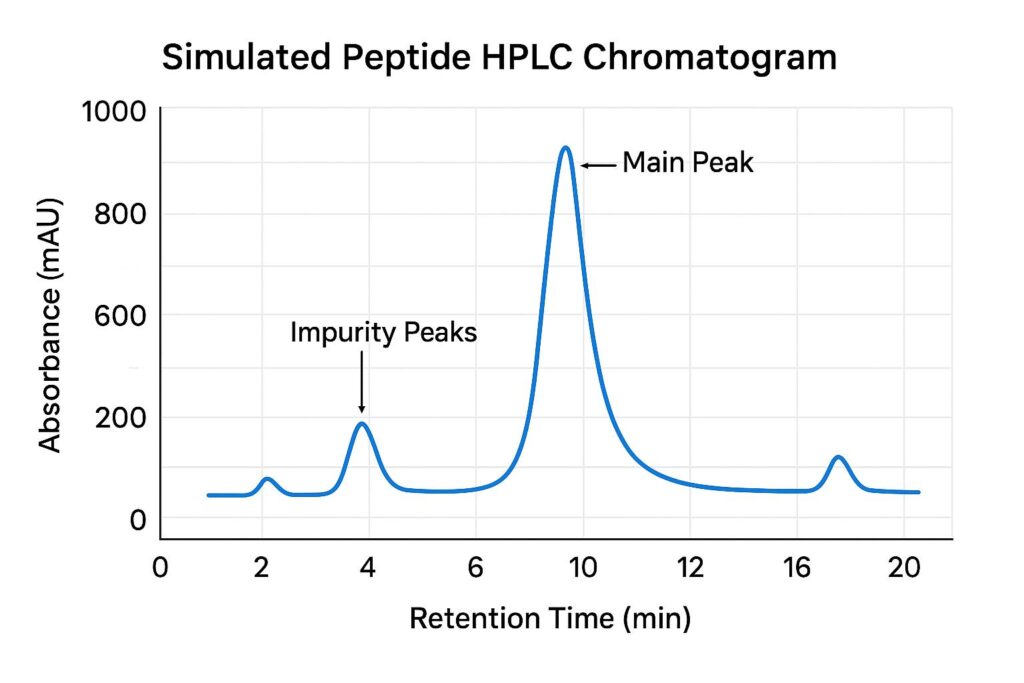
A chromatogram is one of the most useful documents associated with HPLC analysis.
It generally displays detector response against retention time.
The peaks represent components detected during the analysis. A principal peak may correspond to the main peptide component, while additional peaks may indicate other detected substances.
When reviewing HPLC verified peptides UK documentation, buyers should look for:
- The sample identification.
- The analytical method.
- The column and relevant conditions, where reported.
- The detector information.
- The retention time.
- The peak integration and reported percentages.
- The date of analysis.
- The batch or lot reference.
These details help establish what the chromatogram represents.
What does the main peak indicate?
A prominent principal peak can indicate that one detected component represents a large proportion of the chromatographic response.
However, a single large peak does not automatically establish that the sample contains only the intended peptide.
Some impurities may co-elute with the principal component, while others may not respond strongly under the selected detector conditions.
For this reason, chromatographic purity should be interpreted alongside suitable identity testing and other relevant analytical evidence.
HPLC Purity Versus Peptide Identity
One of the most important distinctions in peptide verification is the difference between purity and identity.
HPLC can provide useful information about the chromatographic composition of a sample. It does not, by itself, always establish that the principal peak has the correct molecular structure.
What is peptide purity?
Peptide purity generally refers to the proportion of the desired peptide relative to other detected or measured components under a defined analytical procedure.
An HPLC purity result is often reported as a percentage based on integrated peak areas.
For example, a report might show that the principal peak accounts for a specified percentage of the total integrated chromatographic area.
That result should not automatically be interpreted as the absolute percentage by weight of the desired peptide.
Different substances can produce different detector responses. Some materials may also require additional testing to establish their actual peptide content.
What is peptide identity?
Peptide identity concerns whether the material corresponds to the intended compound.
Depending on the peptide and the analytical requirements, identity may be investigated using:
- Mass spectrometry.
- Liquid chromatography–mass spectrometry.
- Tandem mass spectrometry.
- Peptide mapping.
- Amino acid analysis.
- Nuclear magnetic resonance.
These methods provide different kinds of information and are selected according to the analytical question.
For buyers comparing HPLC verified peptides UK, it is important to distinguish a reported purity result from evidence supporting molecular identity.
HPLC and LC-MS: Why Both Matter
HPLC and liquid chromatography–mass spectrometry (LC-MS) are complementary analytical techniques.
HPLC separates sample components, while mass spectrometry provides information about the mass-to-charge ratios of detected ions.
When combined, these techniques can provide more information than either method alone.
HPLC analysis
HPLC can help evaluate the chromatographic profile of a sample.
Its applications may include:
- Assessing relative chromatographic purity.
- Investigating additional detected peaks.
- Comparing analytical profiles.
- Monitoring changes in specified sample characteristics.
LC-MS analysis
LC-MS combines chromatographic separation with mass spectrometric detection.
It can help investigate whether a detected component has a mass consistent with the expected molecular mass of the intended peptide.
Depending on the method, LC-MS/MS may provide additional information about sequence and structural features.
Why complementary methods are useful
A chromatographic peak may appear consistent with the expected product, but mass-related information can help investigate whether that peak corresponds to the expected molecular species.
The European Medicines Agency’s guidance on synthetic peptides discusses analytical approaches for characterisation, identity and impurity control.
This illustrates why a credible analytical assessment should use methods appropriate to the characteristics of the peptide rather than relying on a single percentage.
Peptide Verification and Testing UK: What Should Buyers Look For?
People searching for peptide verification and testing UK are often trying to determine whether a supplier provides meaningful analytical evidence.
Verification should be considered a process rather than a single label.
A useful assessment may involve several areas.
1. Product identification
The analytical report should identify the material being tested.
The name, product identifier or other relevant information should be sufficiently clear to connect the report with the product description.
2. Batch identification
A batch or lot reference helps distinguish one supply batch from another.
A report should identify the sample or batch tested wherever applicable.
A document relating to an earlier batch should not automatically be treated as evidence for a newer batch.
3. Analytical method
The report should identify the analytical technique used.
For HPLC analysis, useful information may include the method conditions, detector, chromatographic column and calculation approach.
The amount of technical detail available will vary, but the testing method should be identifiable.
4. Testing laboratory
Buyers should establish whether testing was performed internally or by an independent laboratory.
If independent testing is claimed, the report should identify the testing organisation and provide sufficient information to evaluate the result.
5. Reported results
The report should clearly state what was measured and the units or calculation method used.
A purity percentage without a supporting analytical explanation offers limited information.
Independent Third-Party Peptide Testing
Independent third-party testing can provide an additional layer of analytical evidence.
A manufacturer or supplier may conduct its own quality-control testing. An external laboratory may also be engaged to examine particular characteristics of a material.
Both approaches can be useful when supported by appropriate methods and documentation.
What should an independent testing report include?
When evaluating a third-party report, consider whether it identifies:
- The testing laboratory.
- The sample received.
- The batch or lot number.
- The date of analysis.
- The analytical method.
- The reported findings.
- Relevant limitations.
- The laboratory’s accreditation status, where applicable.
A report should relate to the actual sample tested. A general document displaying a product name without a clear sample reference may not establish that the material currently being supplied was analysed.
Is third-party testing automatically better?
Not necessarily.
The value of independent testing depends on the laboratory’s competence, the analytical method and the relevance of the test to the material.
An external report is not automatically reliable simply because it comes from an organisation outside the supplier.
Likewise, supplier testing should not automatically be dismissed. In-house testing may form part of a documented quality-control system.
The important issue is whether the testing is appropriate, traceable and supported by understandable records.
Understanding Peptide Certificates of Analysis
A certificate of analysis, commonly called a COA, is a document reporting analytical findings against specified criteria.
For buyers researching HPLC verified peptides UK, a COA can be an important part of the supplier’s technical documentation.
What should a COA contain?
A useful certificate may include:
| Document detail | Why it matters |
|---|---|
| Product identification | Identifies the material |
| Batch or lot number | Connects the report to a particular batch |
| Testing date | Establishes when analysis took place |
| Analytical method | Explains how the sample was examined |
| Reported result | Shows the measured findings |
| Acceptance criteria | Provides context for interpreting results |
| Laboratory details | Identifies the organisation responsible |
| Authorisation | Shows the document’s approval information |
Not every COA contains every item. Nevertheless, buyers should be able to establish what material was examined and what the reported results actually demonstrate.
Why batch-specific COAs matter
Analytical findings from one batch should not automatically be applied to another.
A batch-specific certificate helps connect the reported result to a particular material.
When evaluating HPLC verified peptides UK, buyers should compare the product’s batch identification with the reference shown on its supporting documentation.
Understanding 99% Peptide Purity Claims
Searches for HPLC-verified research peptides often include phrases such as 99% purity.
Although a high percentage may sound impressive, it is important to understand how the figure was obtained.
HPLC area percentage
Many chromatographic purity reports calculate the relative area of the principal peak compared with the total integrated peak area.
This can provide useful information about the chromatographic profile.
However, area percentage is not necessarily equivalent to absolute mass purity.
Why the method matters
The reported result can be influenced by:
- Detector response.
- Sample preparation.
- Chromatographic separation.
- Integration settings.
- Reference standards.
- Co-eluting components.
- Substances not detected effectively by the selected method.
A responsible supplier should not present an HPLC area percentage as a complete measurement of every quality characteristic.
What buyers should request
When a supplier advertises a particular purity percentage, buyers should look for the batch-specific analytical report and the method used to calculate the result.
A blanket claim that every product has the same purity should not replace individual batch documentation.
Research Peptides UK HPLC Verified: Evaluating Supplier Transparency
A supplier’s transparency is an important part of evaluating research-labelled materials.
People searching for research peptides UK HPLC verified are often looking for information about testing, documentation and product identification.
A professional supplier should make it possible to understand what information is available for each material.
Clear product descriptions
Product descriptions should identify the material accurately and avoid unsupported technical claims.
Where analytical information is provided, it should be consistent with the supporting documentation.
Accessible documentation
Buyers should be able to understand how to request relevant product information.
This may include certificates of analysis, analytical reports and batch identification details.
Consistent information
Product names, batch references and technical specifications should be consistent across product pages and supporting documents.
Differences between a product description and its analytical report should be clarified rather than ignored.
Responsible research-use communication
A product described as a research material is not automatically an authorised medicine or suitable for human consumption.
Regulatory status depends on the substance, its presentation, intended purpose and applicable legislation.
UK Laboratory Accreditation and HPLC Testing
Laboratory accreditation can provide useful information about the competence of a testing organisation.
In the UK, the United Kingdom Accreditation Service (UKAS) is the national accreditation body.
Testing and calibration laboratories may be assessed against ISO/IEC 17025, which establishes requirements concerning laboratory competence, impartiality and consistent operation.
However, accreditation should be interpreted carefully.
Does UKAS certify individual peptides?
No. UKAS accreditation applies to an organisation’s specified conformity-assessment activities. It does not automatically certify every product tested by that organisation.
A laboratory may hold accreditation for certain testing activities without every analytical method falling within its accredited scope.
How to check accreditation claims
When a supplier refers to UKAS-accredited testing, buyers should check:
- The name of the laboratory.
- Its accreditation status.
- The relevant standard.
- Its published accreditation schedule.
- Whether the specific testing activity is included.
- Whether the analytical report identifies the sample tested.
More information is available from UKAS laboratory accreditation resources.
Common Mistakes When Evaluating HPLC Verified Peptides UK
Even buyers familiar with laboratory terminology can misunderstand analytical reports.
Mistake 1: Treating HPLC purity as complete proof of identity
HPLC can provide useful separation and purity information, but additional analytical techniques may be required to establish identity.
Mistake 2: Assuming every COA is independent
A COA may come from the manufacturer, supplier or external laboratory. The document should identify who performed the analysis.
Mistake 3: Ignoring batch references
A report without a clear connection to the supplied batch offers limited evidence about the particular material being evaluated.
Mistake 4: Assuming 99% means absolute purity
An HPLC area percentage should not automatically be interpreted as absolute mass purity.
Mistake 5: Confusing accreditation with product approval
Laboratory accreditation and product authorisation are different concepts. One does not automatically establish the other.
Mistake 6: Relying only on promotional descriptions
Marketing descriptions should be evaluated alongside technical documentation and appropriate analytical evidence.
Exploring the Lavish Peptides Catalogue
Lavish Peptides provides an online catalogue for customers reviewing its range of research-labelled peptide materials.
Visitors can explore the Lavish Peptides shop and review the information supplied for individual products.
Examples of catalogue pages include:
These pages are examples of catalogue listings, not evidence that every product has identical specifications or analytical results.
For any particular material, buyers should review its own description, documentation and applicable research-use restrictions.
The research peptide catalogue provides access to the wider range.
A Closer Look at HPLC Verified Peptides UK and Laboratory Quality
When comparing HPLC verified peptides UK, buyers should consider the analytical evidence accompanying each material. A supplier discussing HPLC verified peptides UK should explain which testing methods are used. The evaluation of HPLC verified peptides UK should include batch identification and relevant documentation. Reliable information about HPLC verified peptides UK makes it easier to understand what has actually been tested.
Understanding Analytical Reports
Analytical reports are important when evaluating HPLC verified peptides UK because they provide details beyond a product description. Buyers researching HPLC verified peptides UK should examine the chromatogram and reported results. Documentation for HPLC verified peptides UK should identify the sample and analytical method. A clear report helps buyers assess claims associated with HPLC verified peptides UK.
Comparing Peptide Purity Information
Purity percentages are frequently discussed when researching HPLC verified peptides UK. However, buyers should understand how the reported percentage was calculated. Information about HPLC verified peptides UK should distinguish chromatographic area percentage from absolute mass purity. A supplier discussing HPLC verified peptides UK should avoid presenting one analytical result as proof of every quality characteristic. This distinction is essential when comparing HPLC verified peptides UK documentation.
The Importance of Batch Traceability
Batch traceability is another important consideration when assessing HPLC verified peptides UK. Buyers reviewing HPLC verified peptides UK should check whether the analytical report identifies the relevant batch. Records associated with HPLC verified peptides UK should be consistent with the product information. This makes the evaluation of HPLC verified peptides UK more transparent and easier to follow.
HPLC and Complementary Testing Methods
HPLC is a useful technique when investigating HPLC verified peptides UK, but additional analytical methods may be appropriate. Researchers examining HPLC verified peptides UK may also encounter LC-MS documentation. Combining relevant analytical evidence can improve the understanding of HPLC verified peptides UK. The purpose of evaluating HPLC verified peptides UK is to understand the evidence available, not to assume that one test proves everything.
Independent Laboratory Documentation
Independent reports can provide additional information when comparing HPLC verified peptides UK suppliers. Buyers looking at HPLC verified peptides UK should identify the laboratory responsible for external testing. Any claims about independently tested HPLC verified peptides UK should be supported by relevant reports. Clear laboratory information helps distinguish documented HPLC verified peptides UK results from general promotional statements.
Choosing a Research Peptide Supplier
Supplier transparency should remain central when researching HPLC verified peptides UK. A supplier offering information about HPLC verified peptides UK should provide clear product identification. Buyers comparing HPLC verified peptides UK suppliers should consider the availability of batch documentation. A consistent approach to HPLC verified peptides UK evaluation helps buyers make informed decisions based on evidence.
Reviewing Product Specifications
Product specifications are another useful part of evaluating HPLC verified peptides UK. Buyers researching HPLC verified peptides UK should compare the product description with available analytical records. Information relating to HPLC verified peptides UK should not make unsupported purity or identity claims. Accurate specifications make it easier to review HPLC verified peptides UK materials responsibly.
Laboratory Standards and Testing Transparency
Laboratory standards are relevant to the assessment of HPLC verified peptides UK. Buyers should understand what accreditation means when reviewing HPLC verified peptides UK testing claims. Accreditation does not automatically certify every product described as HPLC verified peptides UK. Instead, the relevant laboratory activities and accreditation scope should be examined when assessing HPLC verified peptides UK documentation.
Making an Informed Evaluation
A careful review of HPLC verified peptides UK involves more than comparing advertised percentages. Buyers should assess the available evidence for HPLC verified peptides UK, including testing methods and batch references. A transparent approach to HPLC verified peptides UK should explain the limitations of each analytical method. Ultimately, evaluating HPLC verified peptides UK requires attention to documentation, traceability and accurate scientific information.
Frequently Asked Questions
What are HPLC verified peptides UK?
The phrase generally refers to research peptide materials accompanied by HPLC analytical information. Buyers should check the method, batch identification and report before interpreting a supplier’s verification claim.
Does HPLC prove peptide identity?
Not by itself in every case. HPLC provides chromatographic separation and can help assess purity. Additional techniques, such as mass spectrometry, may be required to support molecular identity.
What is the difference between HPLC and LC-MS?
HPLC separates components within a sample. LC-MS combines liquid chromatography with mass spectrometry, providing additional information about the mass-to-charge ratios of detected ions.
Does 99% HPLC purity mean 99% purity by weight?
Not necessarily. HPLC area percentage and absolute mass purity are different measurements. The analytical method and calculation approach must be considered.
Why is a batch-specific certificate of analysis important?
It connects the analytical findings to a particular batch. This helps prevent results from one batch being incorrectly applied to another.
Is independent third-party peptide testing necessary?
Its relevance depends on the material, research requirements and quality-control programme. Independent testing can provide additional evidence when the laboratory and methods are appropriate.
What does UKAS accreditation mean?
UKAS accreditation provides recognition that an organisation has demonstrated competence for specified activities. It does not automatically certify every product or test performed by that organisation.
Can one HPLC test identify every impurity?
No. The suitability of a method depends on the substances being investigated and the separation achieved. Additional methods may be needed for impurities that are not adequately detected or separated.
What should I look for in a peptide analytical report?
Look for sample identification, batch reference, testing date, analytical method, reported results and the organisation responsible for the analysis.
Are HPLC verified research peptides approved for human use?
HPLC testing does not establish medicinal approval or suitability for human consumption. Research-use labelling and analytical results should not be interpreted as authorisation for human or veterinary use.
Conclusion: Understanding HPLC Verified Peptides UK
Evaluating HPLC verified peptides UK requires more than looking at a purity percentage or a supplier’s marketing description.
HPLC can provide valuable information about the chromatographic profile of a sample, while LC-MS and other analytical methods can contribute additional evidence about molecular identity and composition.
A meaningful assessment should consider batch-specific documentation, the analytical methods used, the testing laboratory and the limitations of each reported result.
Certificates of analysis should be clear and traceable. Independent testing claims should be supported by identifiable reports. Laboratory accreditation should be checked against the actual scope of the testing activity.
For anyone reviewing research-labelled peptide materials, the most useful approach is to prioritise accurate product information, appropriate analytical evidence and transparent documentation.
Explore the Lavish Peptides catalogue to review the available range and the information provided for individual listings.
Research-use notice: This article is for general educational information about analytical testing and laboratory documentation. Research-labelled products are not presented as medicines or as products for human or veterinary consumption. Nothing here constitutes medical advice, treatment guidance, dosing instructions or instructions for human administration. Purchasers and laboratories are responsible for complying with applicable laws, institutional procedures and relevant safety requirements.
