
When researching peptides with COA UK, understanding the documentation behind a research material is just as important as reviewing its product description. Lavish Peptides provides an online research peptide catalogue where visitors can explore listed products and review the information available for individual materials. A Certificate of Analysis (COA) can help buyers understand the analytical characteristics reported for a particular batch, including its identity, purity-related results and testing methods. However, not all certificates provide the same level of detail, and a COA should always be evaluated according to the evidence it contains.
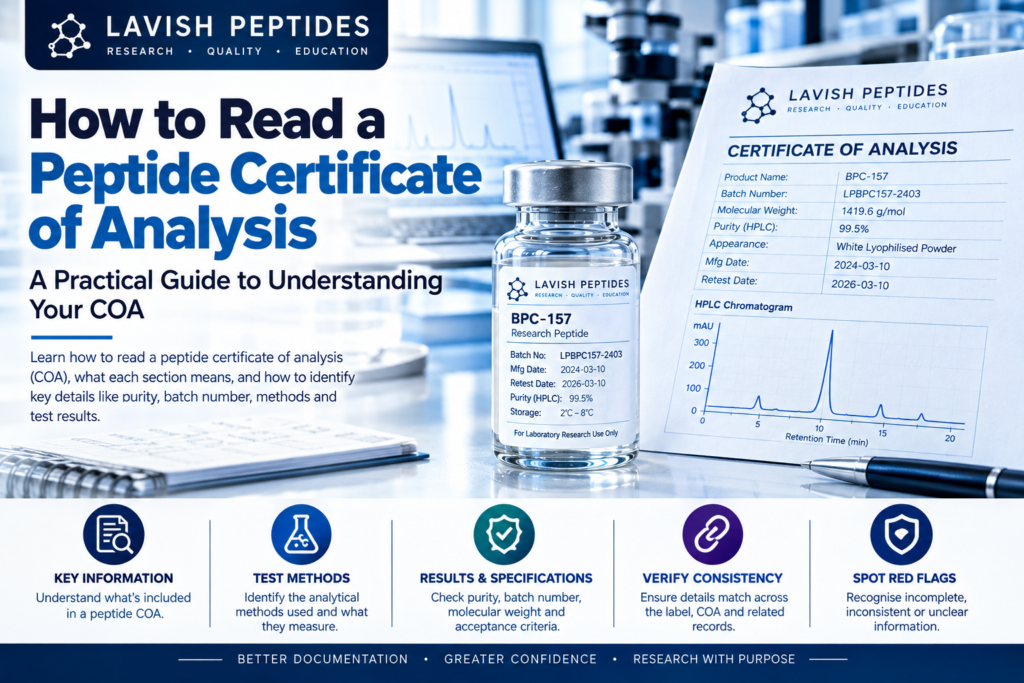
For anyone researching peptide materials in the UK, understanding certificates of analysis, HPLC reports, laboratory testing and batch traceability is essential. A product description may contain technical terminology, but supporting documentation helps explain what has actually been tested.
This guide explores what a peptide COA is, what information it should contain, how to interpret HPLC results, why batch verification matters and what to consider when evaluating a supplier’s documentation.
What Are Peptides with COA UK?
The search phrase peptides with COA UK generally refers to research-labelled peptide materials accompanied by a Certificate of Analysis.
A COA is a document that records analytical findings for a material against specified tests or acceptance criteria.
Depending on the supplier and testing programme, a peptide COA may contain information about:
- Product identification.
- Batch or lot number.
- Analytical testing date.
- Chromatographic purity results.
- Molecular mass information.
- Testing methods.
- Laboratory identification.
- Reported specifications.
- Relevant analytical observations.
The purpose of the document is to communicate what was examined and what the results showed.
A COA should not be interpreted as a universal guarantee of quality. Its usefulness depends on the methods used, the laboratory responsible, the sample tested and the information provided.
Why COA documentation matters
Research materials can have complex chemical characteristics. A product name alone does not establish its identity, composition or analytical quality.
A certificate provides a more structured way of reviewing available testing information.
For example, two materials with similar product descriptions may have different batch references and analytical results. Reviewing the relevant certificates helps distinguish the documentation associated with each material.
For buyers searching for peptides with COA UK, this makes documentation an important part of supplier evaluation.
What Is a Peptide Certificate of Analysis?
A Certificate of Analysis is a technical document reporting the results of specified analytical examinations.
It may be issued by a manufacturer, supplier or external testing laboratory.
The organisation issuing the document should be identifiable so that buyers can understand where the reported findings originated.
Main components of a peptide COA
A well-structured certificate may contain the following information.
| COA component | Purpose |
|---|---|
| Product name | Identifies the material |
| Batch number | Identifies the specific lot |
| Testing date | Shows when analysis was performed |
| Analytical method | Explains how the material was examined |
| Purity result | Reports a specified analytical purity measurement |
| Molecular mass | Provides relevant mass-related information |
| Laboratory details | Identifies the organisation responsible |
| Acceptance criteria | Provides context for interpreting results |
| Authorisation | Records document approval information |
Not every certificate contains all these elements. The appropriate information depends on the product and analytical programme.
Why the batch number is important
A batch number is one of the most useful details on a COA.
It connects the report to a particular production or supply batch.
Suppose a supplier provides a certificate for a material tested several months ago. If the current product belongs to a different batch, the earlier report should not automatically be treated as evidence for the newer material.
This is why buyers researching peptides with COA UK should look for documentation that clearly identifies the relevant batch.
Understanding COA Verified Research Peptides
The phrase COA verified is often used in research peptide searches. However, it is important to understand what verification actually means.
A certificate records reported analytical results. It does not automatically establish that every claim about a product has been independently confirmed.
Supplier-issued COA
A supplier-issued COA may contain results generated through the supplier’s own quality-control procedures or information supplied by its manufacturer.
Such documentation can be useful when it contains clear methods, results and batch references.
However, buyers should establish who performed the testing.
Independent laboratory COA
An independent laboratory COA comes from an external organisation that performs the specified analytical examination.
This can provide additional evidence beyond a supplier’s own product description.
The value of the report depends on:
- The laboratory’s competence.
- The analytical method.
- The sample identification.
- The testing scope.
- The reported results.
- The connection between the tested sample and the supplied batch.
A report is not automatically reliable simply because it was issued externally.
COA versus independent verification
These terms should not be confused.
A COA is a document reporting analytical results. Independent verification describes the involvement of an external testing organisation in examining the material.
A supplier may provide a COA without the analysis having been independently performed.
When evaluating peptides with COA UK, buyers should distinguish between the document itself and the organisation responsible for the underlying testing.
HPLC Testing and Peptide Certificates of Analysis
High-performance liquid chromatography, commonly called HPLC, is widely used in analytical chemistry.
It separates components within a sample according to their interactions with a stationary phase and a liquid mobile phase.
For peptide analysis, HPLC can help assess the chromatographic profile of a material.
What does an HPLC report show?
An HPLC report commonly includes a chromatogram.
This is a graph displaying detector response against retention time.
The chromatogram may show:
- The principal detected peak.
- Additional peaks.
- Retention times.
- Integrated peak areas.
- Relative peak-area percentages.
A prominent principal peak may indicate that one detected component represents a large proportion of the chromatographic response.
However, the interpretation depends on the analytical conditions and detector used.
Understanding HPLC purity percentages
Some peptide certificates report a purity percentage based on chromatographic peak-area integration.
This is useful information, but it should not automatically be interpreted as absolute mass purity.
Different substances may produce different detector responses. Some impurities may also be difficult to detect or separate using a particular method.
For this reason, a statement such as 99% HPLC purity should be accompanied by the relevant analytical evidence and method information.
Buyers should avoid assuming that an advertised percentage establishes every aspect of a material’s quality.
HPLC and molecular identity
HPLC can help assess chromatographic purity, but it does not always independently establish the complete molecular identity of a peptide.
Additional analytical methods may be required.
One example is mass spectrometry, which can provide information about the mass-to-charge ratios of detected ions.
This distinction is important when reviewing peptides with COA UK because a purity result and an identity result answer different analytical questions.
HPLC and LC-MS: Understanding Complementary Testing
Liquid chromatography–mass spectrometry (LC-MS) combines chromatographic separation with mass spectrometric detection.
The two techniques provide complementary information.
HPLC analysis
HPLC is used to separate components in a sample.
Depending on the method, it can help assess:
- Chromatographic purity.
- Relative peak areas.
- Additional detected components.
- Retention-time characteristics.
LC-MS analysis
LC-MS can provide mass-related information about detected components.
It may help investigate whether an observed molecular species is consistent with the expected molecular mass of the intended peptide.
Depending on the analytical requirements, further techniques may be necessary for more detailed sequence or structural characterisation.
Why both techniques may appear on a COA
Some analytical programmes use multiple techniques because one method may not answer every quality question.
An HPLC result may provide information about the chromatographic profile, while LC-MS may contribute additional evidence about molecular mass.
When reviewing a peptide certificate, buyers should understand which tests were actually performed rather than assuming that every certificate contains both.
The European Medicines Agency provides technical guidance on synthetic peptide development, manufacture and analytical control in its guideline on synthetic peptides.
Batch Verification: Why It Matters for Research Peptides
Batch verification is an important part of evaluating research materials.
A batch represents a particular lot of material associated with its own production or supply records.
Different batches may have different analytical results, so documentation should be connected to the specific material being reviewed.
What is batch verification?
Batch verification involves checking whether the information supplied about a particular lot is consistent with its associated records.
This may involve reviewing:
- Product identification.
- Batch or lot reference.
- Certificate of analysis.
- Analytical testing date.
- Reported analytical findings.
- Supplier documentation.
- Packaging and identification records.
The objective is to establish a clear connection between the material and the information used to describe it.
What should buyers check?
When reviewing peptides with COA UK, compare the batch number shown on the product documentation with the batch reference on the analytical report.
Also check whether the document identifies the material clearly and whether the testing date and reported findings are understandable.
A certificate without a clear batch reference may provide less useful evidence than one that directly identifies the lot being evaluated.
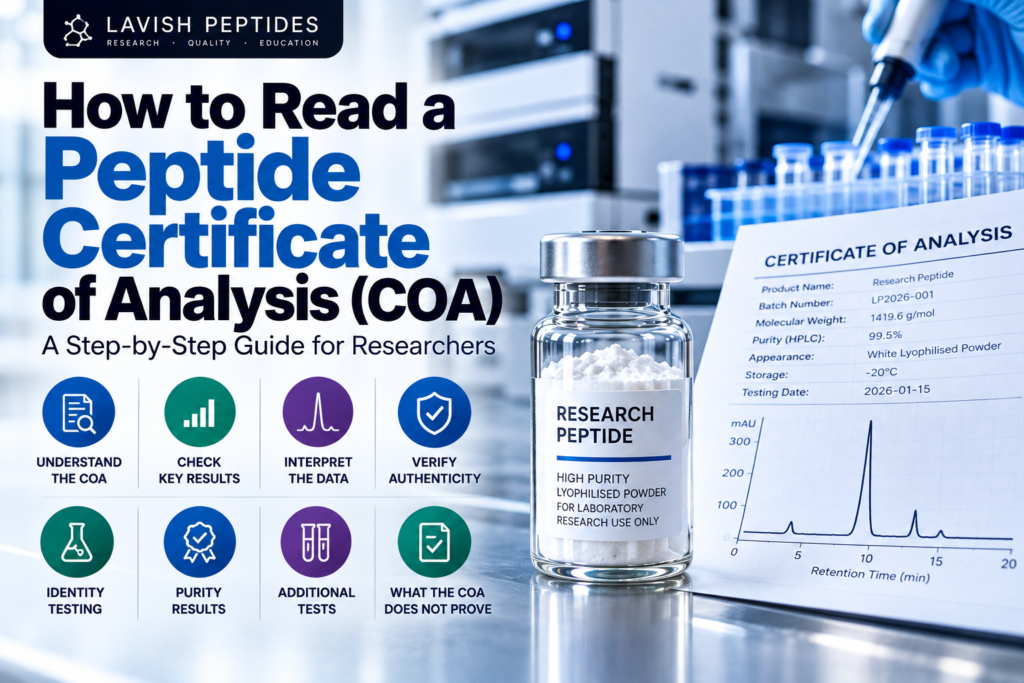
UK Peptides COA Certificate of Analysis: What Makes Documentation Useful?
A certificate should be understandable and sufficiently detailed for its intended purpose.
Buyers should not have to rely on vague product descriptions to understand what was tested.
Clear product identification
The certificate should identify the material using a product name or other suitable identifier.
Where necessary, additional information such as a sequence or molecular specification may help distinguish similar compounds.
Relevant analytical results
The report should identify the tests performed and provide the corresponding results.
A document that displays only a headline purity percentage may not provide enough information to evaluate the result properly.
Identifiable testing organisation
The issuing organisation should be identifiable.
If the supplier claims independent testing, buyers should be able to determine which external laboratory performed the analysis.
Document consistency
The certificate should be consistent with the product description and relevant batch information.
Differences in product names, batch references or specifications should be clarified.
These considerations are useful when comparing different suppliers offering peptides with COA UK.
How to Evaluate a COA Library
Some research material suppliers publish a COA library or documentation area on their websites.
A COA library can make it easier for visitors to review available analytical information.
However, the existence of a library does not automatically establish that every document is current or applicable to every product.
What should a COA library contain?
A useful documentation library may organise certificates by:
- Product name.
- Product identifier.
- Batch number.
- Testing date.
- Document reference.
- Laboratory or issuing organisation.
This organisation can help visitors identify the relevant document.
Why current batch information matters
A COA library may contain documents relating to different batches.
A certificate for one lot should not be assumed to apply to another.
Buyers should establish which document corresponds to the material being reviewed.
What about downloadable certificates?
Downloadable documents can improve accessibility, but their contents should still be examined.
Check the document date, batch reference, testing method and issuing organisation.
A downloadable PDF is not automatically evidence of independent verification.
For suppliers offering a COA library, clear document organisation and batch identification are important elements of transparency.
UKAS Accreditation and Peptide Testing
The United Kingdom Accreditation Service (UKAS) is the UK’s national accreditation body.
It assesses organisations that provide testing, calibration, inspection and other conformity-assessment services.
For testing laboratories, ISO/IEC 17025 is an important international standard concerning laboratory competence and consistent operation.
Does UKAS certify individual peptides?
No.
UKAS accreditation applies to an organisation’s specified activities. It does not automatically certify every product that the organisation tests.
A laboratory may be accredited for certain analytical activities without every method or material falling within its accredited scope.
How should buyers evaluate accreditation claims?
When a supplier refers to UKAS-accredited testing, buyers should check:
- The name of the laboratory.
- Its accreditation status.
- The applicable standard.
- Its published accreditation scope.
- Whether the relevant analytical activity is covered.
- Whether the report identifies the tested sample.
More information is available through UKAS laboratory accreditation resources.
This distinction is important when reviewing claims about UK peptides COA verification and laboratory testing.
What a COA Does Not Prove
A certificate of analysis is useful, but it has limitations.
Understanding those limitations prevents buyers from interpreting a document more broadly than its results justify.
A COA does not automatically establish sterility
A chromatographic purity result does not establish that a material is sterile.
Sterility requires separate assessment using appropriate methods.
A COA does not automatically establish endotoxin status
Endotoxin testing is different from HPLC purity analysis.
A certificate reporting an HPLC result should not be treated as evidence that endotoxin testing has been completed unless the relevant test is included.
A COA does not automatically establish every impurity level
Different impurities require different analytical approaches.
A single test may not detect or quantify every possible contaminant.
A COA does not establish medicinal approval
Analytical testing does not establish that a substance is authorised as a medicine or approved for human consumption.
Regulatory status depends on the substance, its presentation, intended purpose and applicable legislation.
A COA does not guarantee suitability for every research application
Suitability depends on the requirements of the specific research project, the material’s characteristics and the applicable laboratory procedures.
Evaluating a UK Research Peptide Supplier
When comparing a supplier offering peptides with COA UK, it helps to use a consistent evaluation process.
1. Review the product description
Check whether the material is clearly identified and whether the technical description is consistent.
2. Request relevant documentation
Establish which certificates, analytical reports and batch records are available.
3. Check the batch reference
Confirm that the document relates to the relevant material or batch.
4. Understand the analytical method
Identify whether the reported findings come from HPLC, LC-MS or another technique.
5. Check who performed the analysis
Distinguish between supplier testing and independent laboratory testing.
6. Review accreditation claims
Where accreditation is mentioned, check the organisation’s published scope.
7. Evaluate transparency
A professional supplier should communicate clearly about what has been tested, what documentation is available and what limitations apply.
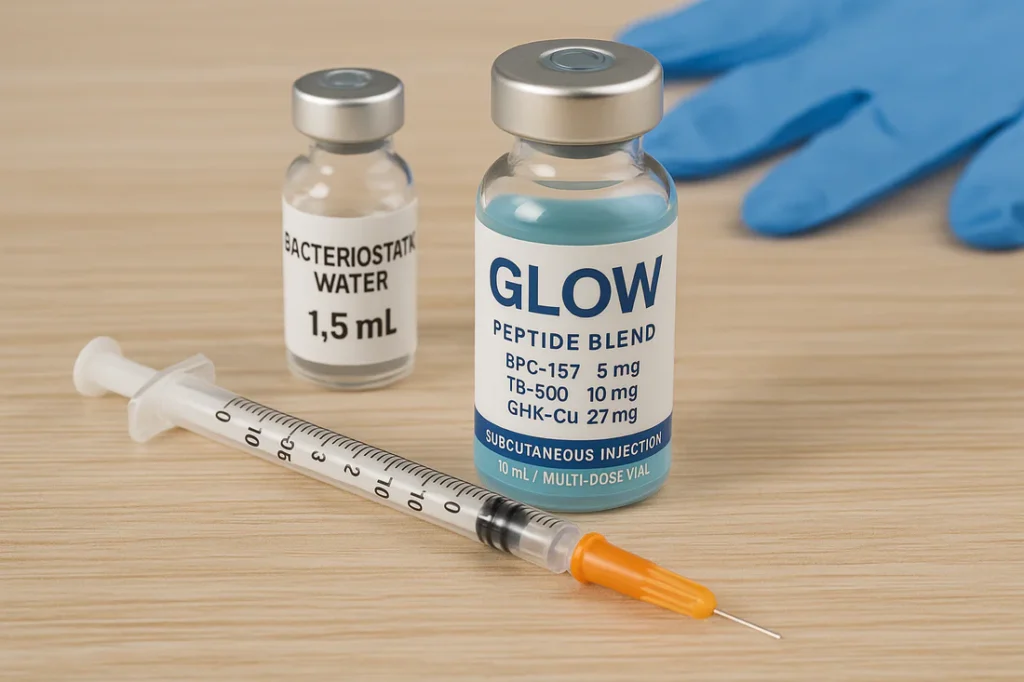
Exploring the Lavish Peptides Research Catalogue
Lavish Peptides provides an online catalogue for visitors reviewing its range of research-labelled peptide materials.
When examining individual listings, buyers should consider the available product description, supporting documentation and stated research-use limitations.
Examples of catalogue pages include:
These links are examples of catalogue listings, not a statement that every product has identical specifications or analytical results.
Each material should be assessed according to its own documentation.
Visitors can also explore the wider Lavish Peptides research catalogue for the available range.
For additional educational material, visit the Lavish Peptides website and its research and educational articles.
Common Mistakes When Reviewing Peptide COAs
Assuming every certificate is independent
A COA may be issued by a supplier, manufacturer or external laboratory. Buyers should establish who performed the analysis.
Ignoring the batch number
A certificate relating to an earlier batch should not automatically be used to describe a different lot.
Treating purity as complete proof of quality
A chromatographic purity percentage does not establish every characteristic of a material.
Assuming UKAS accreditation covers every test
Accreditation applies to specified activities. The relevant scope should be checked.
Confusing a COA library with current verification
A website may contain certificates from different dates and batches. The relevant document must be identified.
Accepting unsupported marketing claims
Terms such as independently verified, high purity and laboratory tested should be supported by meaningful documentation.
A Complete Guide to Peptides with COA UK Documentation
When comparing peptides with COA UK, buyers should examine the analytical documentation supplied with each material. Information about peptides with COA UK should clearly identify the product and relevant batch. Evaluating peptides with COA UK also involves understanding the analytical methods used. Reliable documentation for peptides with COA UK should make reported results easy to interpret. Buyers researching peptides with COA UK should distinguish between supplier-issued certificates and independent laboratory reports.
Understanding Certificate of Analysis Requirements
A certificate of analysis is an important document when reviewing peptides with COA UK. Buyers considering peptides with COA UK should check whether the certificate identifies the testing organisation. Documentation for peptides with COA UK should include relevant analytical findings. A useful COA makes it easier to evaluate peptides with COA UK using documented evidence. The purpose of reviewing peptides with COA UK certificates is to understand what was actually tested.
Batch Identification and Traceability
Batch identification is essential when assessing peptides with COA UK. Buyers comparing peptides with COA UK should check the batch number on the product documentation. Reports associated with peptides with COA UK should identify the relevant sample wherever possible. Clear batch records help buyers evaluate peptides with COA UK more accurately. This is particularly important when different batches of peptides with COA UK have separate analytical reports.
HPLC Testing and Analytical Results
HPLC testing provides useful information when reviewing peptides with COA UK. Buyers researching peptides with COA UK should understand how chromatographic purity is calculated. An HPLC report for peptides with COA UK should identify the analytical method. A reported purity percentage for peptides with COA UK should be interpreted according to that method. Analytical transparency helps buyers assess claims about peptides with COA UK without relying solely on advertising.
Independent Laboratory Verification
Independent testing can provide additional evidence when evaluating peptides with COA UK. Buyers comparing suppliers of peptides with COA UK should establish whether an external laboratory performed the analysis. Documentation for independently tested peptides with COA UK should identify the laboratory and sample. A transparent supplier should explain the testing arrangements for peptides with COA UK. This helps distinguish independent analytical evidence from general claims about peptides with COA UK.
Reviewing COA Libraries
A COA library can make it easier to find documents relating to peptides with COA UK. Buyers reviewing peptides with COA UK should check the dates and batch references of available certificates. A useful library should organise documentation for peptides with COA UK clearly. The presence of a certificate does not automatically mean it applies to every batch of peptides with COA UK. Buyers should identify the correct report before relying on information about peptides with COA UK.
Evaluating Supplier Transparency
Supplier transparency matters when choosing between providers of peptides with COA UK. Product information for peptides with COA UK should be consistent with available analytical documents. Buyers evaluating peptides with COA UK should be able to identify who issued the certificate. Clear communication about peptides with COA UK helps explain what has been verified. A responsible approach to peptides with COA UK places accurate documentation ahead of unsupported marketing claims.
Frequently Asked Questions
What are peptides with COA UK?
The phrase generally describes research-labelled peptide materials accompanied by certificates of analysis. These documents report specified analytical results and should identify the material and relevant batch wherever applicable.
What does COA stand for?
COA stands for Certificate of Analysis. It is a document reporting analytical findings for a material against specified tests or criteria.
Does every peptide COA come from an independent laboratory?
No. A COA may be issued by a manufacturer, supplier or external laboratory. Buyers should check who performed the actual analysis.
What should a peptide COA contain?
A useful certificate may contain product identification, batch number, testing date, analytical method, reported results and laboratory details.
What is the difference between HPLC and LC-MS?
HPLC separates components within a sample and can help assess its chromatographic profile. LC-MS combines liquid chromatography with mass spectrometry to provide additional mass-related information.
Does a 99% HPLC purity result mean 99% purity by weight?
Not necessarily. HPLC area percentage and absolute mass purity are different measurements. The method and calculation should be considered.
Why is batch verification important?
Batch verification helps connect a specific material to its associated analytical records. It prevents results from one batch being incorrectly applied to another.
Does UKAS certify peptide products?
No. UKAS accredits organisations for specified conformity-assessment activities. This does not automatically certify individual peptide products.
What is a COA library?
A COA library is a collection of certificates or analytical documents made available for review. Its usefulness depends on clear document identification, dates and batch references.
Does a COA prove that a peptide is safe for human use?
No. A certificate of analysis does not establish medicinal approval or suitability for human consumption. Research-use documentation should not be interpreted as medical or administration guidance.
Conclusion: Understanding Peptides with COA UK
Choosing between suppliers offering peptides with COA UK requires more than comparing product descriptions and advertised purity percentages.
A useful certificate of analysis should identify the material, provide relevant analytical results and establish which batch was examined. HPLC and LC-MS can provide complementary information, while independent laboratory reports may offer additional evidence when the testing organisation and methods are appropriate.
Buyers should also understand the limitations of certificates, verify batch references and distinguish laboratory accreditation from product certification.
Ultimately, good research material documentation is built around transparency, traceability and accurate analytical reporting.
To explore the available research-labelled materials, visit the Lavish Peptides shop.
Research-use notice: This article provides general educational information about certificates of analysis, analytical testing and laboratory documentation. Research-labelled products are not presented as medicines or as products for human or veterinary consumption. Nothing in this article constitutes medical advice, treatment guidance, dosing instructions or instructions for human administration. Purchasers and laboratories are responsible for complying with applicable laws, institutional procedures and relevant safety requirements.
